
Why Functional Medicine Is a High-Demand Niche in 2026
Why Functional Medicine Is a High-Demand Niche in 2026
Functional medicine is defined as a personalized, systems-based approach to healthcare that identifies and treats the root causes of disease rather than managing symptoms alone. It is one of the fastest-growing specialties in American healthcare, and the reasons why functional medicine is a high-demand niche are grounded in hard market data. Nearly 60% of American adults live with at least one chronic illness. Conventional medicine, built around 11-minute appointments and symptom suppression, cannot adequately serve that population. Functional medicine fills that gap, and both patients and practitioners are taking notice.
Why is functional medicine a high-demand niche?
The short answer: chronic disease is everywhere, and conventional care is not built to address it at the root. Functional medicine steps in where standard protocols fall short, offering longer consultations, deeper diagnostics, and individualized care plans that adapt over time.
The market numbers confirm the momentum. Functional medicine telehealth is growing at a compound annual growth rate of 28–35%, roughly three times faster than general telehealth. That pace reflects genuine patient demand, not a passing trend.
Several forces are converging to drive this growth:
- Chronic disease prevalence. With nearly six in ten American adults managing a chronic condition, the demand for care that addresses underlying causes is structural, not cyclical.
- Patient dissatisfaction with conventional care. Patients increasingly want clarity on why they are sick, not just a prescription to manage how they feel.
- Technology integration. AI-driven analytics, advanced diagnostics, and telehealth infrastructure are making personalized care at scale viable for the first time.
- Financial sustainability. Gross margins in specialty functional medicine telehealth range from 65–80%, with patient lifetime value reaching $4,800–$12,000 for certain treatment protocols. That economics profile attracts serious clinical investment.
The growing interest in functional medicine is not just cultural. It is backed by measurable market forces that show no sign of reversing.
How does functional medicine differ from conventional practice?

Functional medicine is an extension of conventional medicine, not a replacement. It uses the same biochemistry and physiology as standard care, but applies that knowledge to find root causes rather than suppress symptoms. Dr. Michael Ruscio describes it as a stable, complementary baseline, particularly valuable for patients with unresolved chronic conditions.
The most visible difference is time. A functional medicine initial consultation runs 60–90 minutes, covering detailed health history, lifestyle, genetics, environment, and patient goals. A standard primary care visit averages 11 minutes. That gap in contact time is not inefficiency. It is the mechanism through which root causes get identified.
| Feature | Functional medicine | Conventional medicine |
|---|---|---|
| Consultation length | 60–90 minutes | ~11 minutes |
| Primary focus | Root cause identification | Symptom management |
| Treatment approach | Iterative, adaptive care plans | Standardized protocols |
| Patient role | Active participant in lifestyle change | Passive recipient of treatment |
| Diagnostic depth | Advanced testing, genetics, lifestyle | Standard labs and imaging |
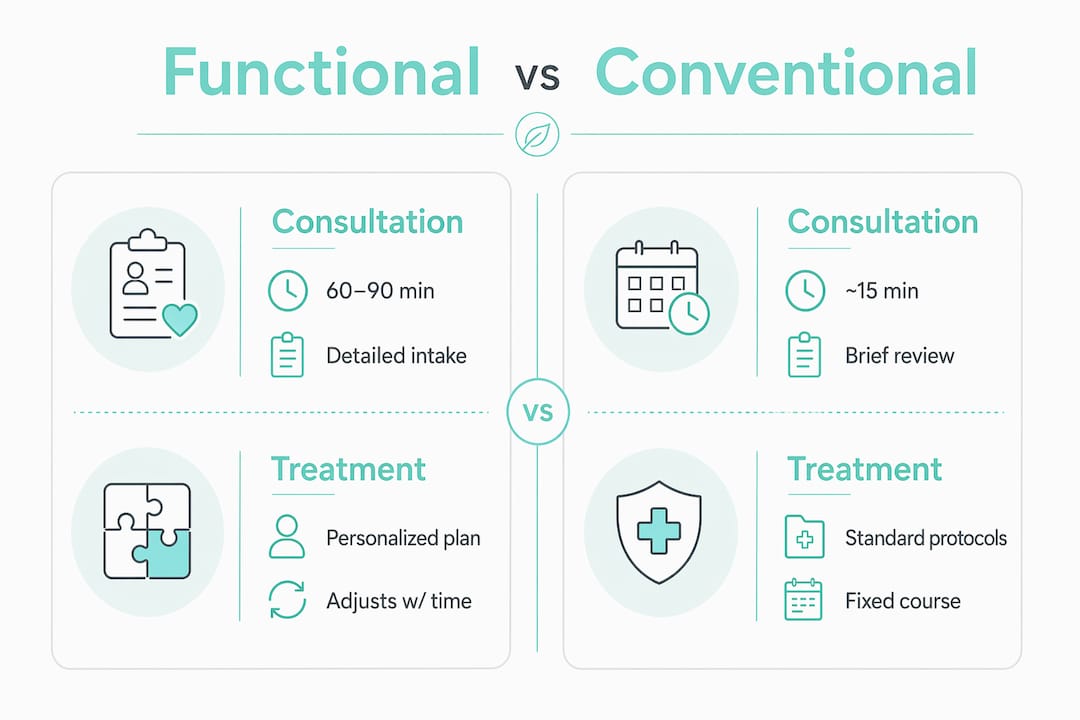
The treatment philosophy also differs. Functional medicine builds clinical roadmaps that adjust over 4–12 weeks based on patient feedback, lab results, and lifestyle changes. Conventional care tends toward static protocols. That iterative model demands more from both the practitioner and the patient, but it produces a fundamentally different quality of engagement.
Pro Tip: When explaining functional medicine to patients accustomed to conventional care, frame the longer intake as an investment. The 90-minute first visit replaces years of fragmented specialist referrals.
What are the operational and financial realities for practitioners?
Entering functional medicine requires honest planning. The clinical model is rewarding, but the operational demands are real and specific.
Diagnostic costs are the most immediate challenge. Advanced testing, including comprehensive metabolic panels, microbiome analysis, and genetic screening, can cost $3,000–$12,000 annually per patient. Practices that communicate these costs transparently from the first visit retain patients far more effectively than those that introduce costs gradually. Transparent cost communication is not just ethical. It is a retention strategy.
Revenue model selection matters enormously. Functional medicine practices typically operate under one of two structures:
- Membership or subscription models. Patients pay a monthly or annual fee for ongoing access, care coordination, and regular check-ins. This model creates predictable revenue and deepens patient relationships.
- Fee-for-service models. Patients pay per visit or per service. This model offers flexibility but produces less revenue stability and lower patient lifetime value.
The time intensity of functional medicine also creates staffing challenges. Functional medicine clinics face real bottlenecks from longer patient visits and complex cases. Practices that scale successfully invest in specialized support staff and digital tools, including advanced electronic health records that track iterative care plans over time.
Pro Tip: Build your intake process around a structured health history questionnaire completed before the first visit. This cuts in-session data collection time and lets you spend the consultation on interpretation and planning, not paperwork.
Patient adherence is the other operational variable that separates successful practices from struggling ones. Functional medicine requires patients to commit to nutrition changes, stress management, and sleep optimization. Practitioners who build accountability structures into their care plans, such as scheduled check-ins and progress tracking, see meaningfully better outcomes.
How does functional medicine improve patient outcomes?
The evidence for functional medicine’s effectiveness is growing. A JAMA Network Open study found that functional medicine patients reported significantly better quality-of-life outcomes at six months compared to patients receiving conventional care. That result matters because quality of life is the metric patients actually care about, not just lab values.
Patients typically see symptom improvement within 4–12 weeks, though full resolution of chronic conditions requires longer-term behavioral commitment. The conditions that respond most consistently include autoimmune disorders, metabolic dysfunction, gastrointestinal issues, hormonal imbalances, and fatigue-related syndromes. These are precisely the conditions that conventional medicine manages but rarely resolves.
“Patients want clearer health pictures, baseline tracking, and personalized guidance. Functional medicine answers this demand by offering deeper insights driven by advanced testing and comprehensive evaluation.” — Prenuvo Health Research
The long-term cost picture is also compelling. Functional medicine reduces long-term healthcare utilization by lowering emergency visits and specialty referrals, even though upfront out-of-pocket costs are higher. Follow-up studies show total healthcare cost reduction over time. That data point is critical for practitioners making the case to cost-conscious patients. The initial investment pays off.
The key to achieving those outcomes is treating the patient, not the lab report. Iterative, patient-centered care frameworks consistently outperform static protocols because they account for how a patient’s life, stress, sleep, and diet interact with their biology over time. Lab results are one data point in a much larger picture. Practitioners who understand that distinction deliver better results and build more loyal patient relationships. For a deeper look at the evidence, the outcomes research on functional medicine is worth reviewing before building your clinical framework.
Understanding the functional medicine clinical timeline also helps practitioners set realistic expectations with patients from day one, which directly improves adherence and long-term results.
Key Takeaways
Functional medicine is a high-demand, financially viable specialty because it addresses the root causes of chronic disease with personalized, data-driven care that conventional medicine is structurally unable to provide.
| Point | Details |
|---|---|
| Market growth is structural | Functional medicine telehealth grows at 28–35% CAGR, driven by chronic disease prevalence and patient demand. |
| Longer visits produce better outcomes | Initial consultations of 60–90 minutes enable root-cause identification that 11-minute visits cannot achieve. |
| Diagnostics require cost transparency | Advanced testing costs $3,000–$12,000 annually per patient; transparent communication drives retention. |
| Outcomes are evidence-backed | JAMA data shows better quality-of-life results at six months and lower long-term healthcare utilization. |
| Revenue models determine sustainability | Membership models create predictable income; fee-for-service requires higher patient volume to sustain. |
What I’ve learned after years watching this specialty mature
I have watched functional medicine move from a fringe conversation to a serious clinical and business category. The practitioners who succeed are not the ones who treat it as a philosophy. They are the ones who treat it as a discipline, with the same rigor they would apply to any evidence-based specialty.
The biggest mistake I see is practitioners underestimating the operational lift. The clinical model is genuinely different. Longer visits, complex cases, and high patient expectations create real pressure on scheduling, staffing, and revenue. Practices that do not plan for that pressure burn out fast, regardless of how passionate the clinician is about root-cause care.
The second mistake is treating functional medicine as a standalone identity rather than an extension of existing clinical skills. The most effective practitioners I have observed integrate functional medicine into their current practice incrementally. They do not abandon what they know. They build on it.
The opportunity here is real. Lifestyle medicine and chronic disease are converging into a single clinical priority for the next decade. Practitioners who develop competency in functional approaches now will be positioned ahead of a very large wave. The question is not whether this specialty will grow. It is whether you will be trained and ready when your patients come looking for answers.
— Lauren
How Functionalacademy prepares you for this opportunity
Functionalacademy offers a fully accredited online Board Certification program designed for registered nurses and healthcare practitioners who want to build real competency in functional medicine without stepping away from their current practice. The program blends evidence-based clinical knowledge with practical application, so you can begin implementing root-cause frameworks with patients immediately. Graduates report increased marketability and confidence in a specialty where qualified practitioners are in short supply. If you are ready to build skills that match where healthcare is heading, explore the certification program at Functionalacademy and see what the training covers.
FAQ
What makes functional medicine a high-demand niche?
Functional medicine addresses chronic disease at the root cause level, filling a gap that conventional care cannot close with short appointments and symptom-focused protocols. With nearly 60% of American adults managing chronic illness, the patient need is structural and growing.
Is functional medicine effective compared to conventional care?
A JAMA Network Open study found functional medicine patients reported better quality-of-life outcomes at six months than conventional care patients. Long-term data also shows reduced emergency visits and lower total healthcare costs over time.
How long does it take for patients to see results?
Most functional medicine patients see measurable symptom improvement within 4–12 weeks. Full resolution of chronic conditions typically requires longer-term commitment to nutrition, stress management, and sleep changes.
What does it cost to practice functional medicine?
Advanced diagnostics alone can run $3,000–$12,000 annually per patient. Practices that communicate these costs clearly from the first visit retain patients more effectively and build more stable revenue.
Can nurses and allied health professionals practice functional medicine?
Yes. Functional medicine training is available to registered nurses, nurse practitioners, and other licensed healthcare professionals. Functionalacademy offers a Board Certification program specifically designed for this audience, with coursework built around clinical application in existing practice settings.