
What Is the Functional Medicine Matrix for Practitioners
What Is the Functional Medicine Matrix for Practitioners
The Functional Medicine Matrix is a clinical reasoning tool developed by the Institute for Functional Medicine that organizes a patient’s biological, lifestyle, and historical data into interconnected systems, giving practitioners a structured path to root cause identification rather than symptom management. Where conventional medicine often isolates complaints by organ or specialty, this framework maps the full terrain of a patient’s health story, from genetics and gut function to sleep patterns and stress load, into a single coherent picture. For nurses, physicians, and wellness practitioners managing chronic and complex cases, understanding this framework is not optional. It is the foundation of truly personalized care.
What is the functional medicine matrix and how does it work?
The Functional Medicine Matrix is a systems-based clinical tool that organizes patient data into broad functional categories to identify patterns and prioritize interventions. Think of it as a structured map of the human body’s core operating systems, layered with the lifestyle inputs that either support or undermine them. It does not replace clinical judgment. It sharpens it.
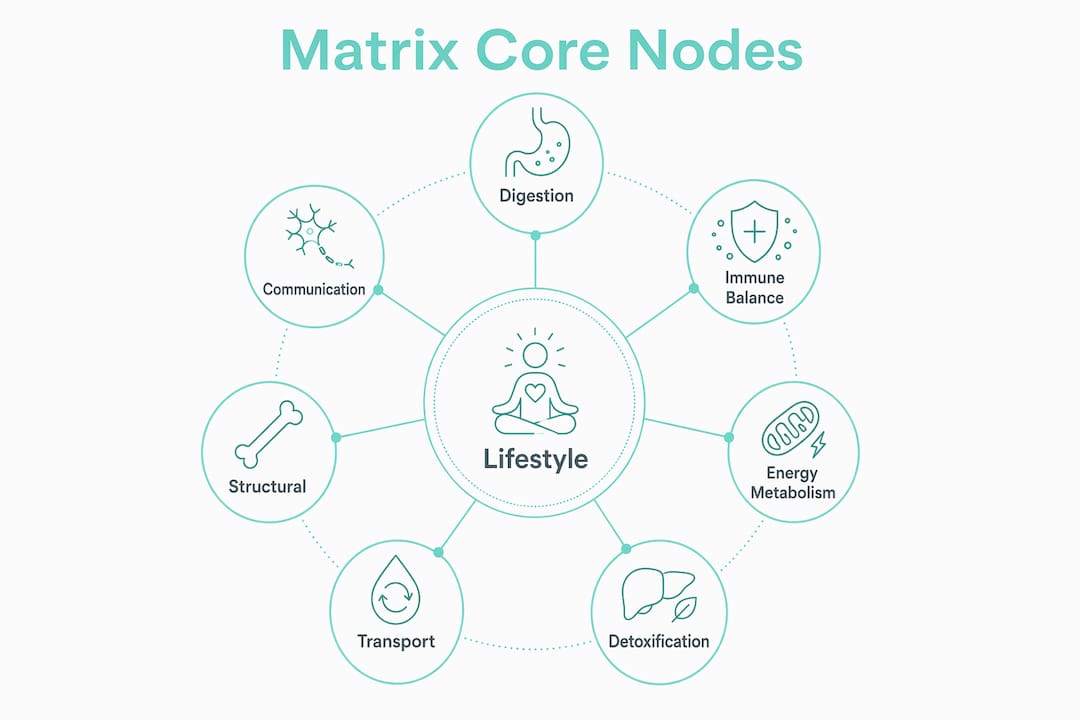
The matrix groups biological function into seven core nodes: digestion and assimilation, immune and inflammatory balance, energy metabolism, detoxification, transport (cardiovascular and lymphatic), communication (hormonal, neurotransmitter, and immune signaling), and structural integrity. Each node represents a domain where dysfunction can originate or propagate. A patient presenting with fatigue, brain fog, and joint pain, for example, may have imbalances across energy metabolism, immune regulation, and structural integrity simultaneously. The matrix makes those overlapping patterns visible.

What separates this framework from a standard intake form is its center. Lifestyle factors including nutrition, sleep, stress, relationships, and movement sit at the core of the matrix, not at the margins. This positioning is intentional. It signals that behavior change is not an afterthought in treatment. It is the foundation. Practitioners who internalize this design principle stop chasing isolated biomarkers and start addressing the conditions that created them.
The matrix also connects directly to patient outcomes by revealing how interrelated system imbalances drive illness development and maintenance, rather than pointing to a single cause that can be treated in isolation.
Core matrix nodes at a glance
| Matrix Node | Clinical Focus |
|---|---|
| Digestion and assimilation | Gut microbiome, nutrient absorption, intestinal permeability |
| Immune and inflammatory balance | Autoimmunity, chronic inflammation, infection history |
| Energy metabolism | Mitochondrial function, thyroid, blood sugar regulation |
| Detoxification | Liver pathways, environmental toxin burden, oxidative stress |
| Transport | Cardiovascular health, lymphatic drainage, circulation |
| Communication | Hormonal signaling, neurotransmitter balance, HPA axis |
| Structural integrity | Musculoskeletal health, cellular membrane function |
How does the ATM model integrate with the matrix?
The ATM model, which stands for Antecedents, Triggers, and Mediators, is the historical and contextual layer that gives the matrix its clinical depth. Without ATMs, the matrix captures a snapshot. With them, it captures a story.
ATM categories are defined precisely. Antecedents are long-term predisposing influences such as genetics, early childhood exposures, and family history. Triggers are specific initiating events, including infections, trauma, toxic exposures, or major life stressors. Mediators are the ongoing biological and psychosocial factors that perpetuate dysfunction, such as chronic inflammation, dysbiosis, or unresolved emotional stress. Together, these three categories help clinicians map how a disease developed over time, not just what it looks like today.
The integration of ATMs with the matrix creates a complete clinical picture by pairing the patient’s timeline with the current state of their biological systems. A practitioner might discover that a patient’s autoimmune condition (immune node) was triggered by a viral infection five years ago (Trigger), is perpetuated by ongoing gut permeability and stress (Mediators), and sits on a genetic background of immune dysregulation (Antecedent). That level of clarity is what makes personalized intervention possible.
Here is a practical sequence for applying ATMs during clinical assessment:
- Gather the full health timeline. Ask the patient to map major health events, illnesses, medications, and life stressors chronologically. This surfaces Antecedents and Triggers that a standard intake misses.
- Identify current Mediators. Use lab data, symptom patterns, and lifestyle review to pinpoint what is actively sustaining dysfunction right now.
- Map findings onto the matrix nodes. Place each ATM finding into the relevant biological system category to reveal which nodes are most burdened.
- Prioritize by clinical significance. Not every imbalance requires immediate intervention. Use the matrix to rank which nodes, if addressed first, will create the most downstream benefit.
- Revisit and update. As treatment progresses, the ATM picture shifts. Treat the matrix as a living document, not a one-time intake exercise.
Pro Tip: During your first patient intake, dedicate at least 10 minutes specifically to timeline construction before touching the matrix. Patients often do not connect past events to current symptoms until you ask directly. That conversation unlocks ATM data that no lab panel can provide.
How does the matrix support personalized treatment protocols?
The matrix is not a treatment plan. It is a clinical reasoning framework that guides data organization and protocol development. This distinction matters enormously in practice. Practitioners who mistake the matrix for a checklist end up with generic protocols. Those who use it as a reasoning scaffold build interventions that reflect the patient’s actual biology and life context.
Once the matrix is populated with a patient’s data, it reveals which nodes carry the heaviest burden and which lifestyle factors are most compromised. That prioritization directly informs where to intervene first. A patient with severe mitochondrial dysfunction and poor sleep will not respond optimally to a complex detoxification protocol until energy and sleep are stabilized. The matrix makes that sequencing logic explicit.
The framework also integrates with specialty testing and functional medicine timelines to deepen clinical insight. Organic acids testing, comprehensive stool analysis, hormone panels, and nutrigenomic data all feed into specific matrix nodes, enriching the picture rather than existing as isolated data points. Practitioners who use integrative nursing models alongside the matrix report stronger protocol coherence and better patient engagement.
Practical applications of the matrix in treatment planning include:
- Protocol sequencing: Determine which system imbalances to address first based on clinical burden and interdependencies.
- Shared decision-making: Use the visual matrix with patients to explain why certain interventions are prioritized, which increases adherence.
- Interdisciplinary communication: Share a populated matrix with collaborating providers, such as registered dietitians, physical therapists, or mental health clinicians, to align care goals.
- Progress tracking: Re-populate the matrix at follow-up visits to measure shifts in system burden and adjust protocols accordingly.
- Gap identification: Spot which nodes have insufficient data and direct targeted testing to fill those gaps before finalizing a protocol.
The matrix also supports individualized care by connecting biological systems and lifestyle factors that contribute to illness, making it far more powerful than any single-system assessment tool.
What challenges should practitioners expect when applying the matrix?
The matrix is a thinking tool, and like any thinking tool, its value depends entirely on the quality of reasoning applied to it. Clinician judgment and patient context are critical to interpretation and application. A practitioner who fills in every node without weighing clinical significance ends up with a cluttered map rather than a clear path forward.
One of the most common pitfalls is data overload. Complex patients generate enormous amounts of clinical information, and the matrix can become overwhelming if practitioners try to address every imbalance simultaneously. The solution is disciplined prioritization. Identify the two or three nodes with the strongest evidence of dysfunction and the clearest connection to the patient’s chief complaints, then build from there.
AI and technology tools are beginning to support matrix utilization by processing complex datasets, recognizing cross-system patterns, and assisting with personalized protocol recommendations. Platforms that integrate AI-assisted pattern recognition can help practitioners identify connections across nodes that might otherwise require hours of manual analysis. This is a meaningful development, particularly for solo practitioners or those managing high patient volumes.
Time constraints present another real challenge. A thorough matrix assessment ideally spans multiple visits, but clinical reality often demands faster turnaround. The comparison below illustrates how the matrix stacks up against a conventional assessment approach in terms of depth and time investment.
| Assessment Approach | Depth of Insight | Time Investment | Personalization |
|---|---|---|---|
| Conventional symptom-based | Isolated, system-specific | Lower | Minimal |
| Functional Medicine Matrix | Systems-wide, root cause | Higher | High |
| AI-assisted matrix | Systems-wide plus pattern recognition | Moderate with tech support | Very high |
Pro Tip: Do not attempt a full matrix assessment in a single 60-minute visit with a new complex patient. Use the first visit to build the timeline and gather lifestyle data. Reserve the matrix population for a dedicated follow-up. Patients feel heard, and you get better data.
Key takeaways
The Functional Medicine Matrix is the most effective clinical reasoning framework for organizing multisystem patient data, integrating ATM history, and building individualized treatment protocols for chronic and complex conditions.
| Point | Details |
|---|---|
| Matrix core structure | Seven biological nodes plus lifestyle factors at the center form the foundation of patient assessment. |
| ATM integration | Antecedents, Triggers, and Mediators contextualize patient history and reveal how disease developed over time. |
| Not a treatment plan | The matrix guides clinical reasoning and protocol prioritization, not direct prescriptive decisions. |
| Technology support | AI-assisted tools enhance pattern recognition across matrix nodes, reducing analysis time for complex cases. |
| Disciplined prioritization | Address the two to three most burdened nodes first rather than attempting to resolve every imbalance simultaneously. |
Why the matrix changed how I think about patient care
I have worked with complex chronic cases long enough to remember what assessment looked like before the matrix became central to my practice. It looked like a long list of problems with no clear hierarchy and no coherent story connecting them. The matrix did not just organize my thinking. It changed what questions I asked.
What strikes me most is how the matrix forces you to treat lifestyle as biology. Nutrition, sleep, and stress are not soft factors you address after the “real” clinical work. They sit at the center of the framework because they drive every node around them. Practitioners who resist that design are usually the ones who see the least durable outcomes.
The matrix’s greatest strength is enabling clinicians to see health as an interconnected whole rather than a collection of separate symptoms. I have seen this shift patient engagement dramatically. When you show someone a visual map of how their gut dysfunction, hormonal imbalance, and sleep disruption are feeding each other, they stop asking “which pill fixes this” and start investing in the process.
My honest caution: do not let the matrix become a ritual. It is a tool, not a protocol. The practitioners who get the best results are the ones who use it to ask better questions, not the ones who fill it in most completely.
— Lauren
Take your matrix skills from theory to clinical practice
If the matrix framework resonates with you, the next step is learning to apply it with confidence in real patient encounters. Functionalacademy’s Institute for Functional Nurses offers a fully accredited, board certification program built specifically for nurses and healthcare practitioners who want to implement functional medicine principles without starting over from scratch.
The program covers the matrix, ATM integration, specialty testing interpretation, and protocol development through a practical, clinically grounded curriculum. You learn how to attract and retain wellness clients while building a practice that delivers the kind of outcomes that conventional care cannot. If you are ready to practice at a level that matches your ambition, this is where that starts.
FAQ
What is the functional medicine matrix in simple terms?
The Functional Medicine Matrix is a clinical tool from the Institute for Functional Medicine that maps a patient’s health data across seven biological systems and core lifestyle factors to identify root causes of illness. It gives practitioners a structured way to see how different systems interact rather than treating each complaint in isolation.
How is the matrix different from a standard intake form?
A standard intake form collects symptoms and history sequentially. The matrix organizes that same data into interconnected biological nodes and lifestyle categories, revealing patterns and system-level imbalances that a linear intake process cannot surface.
What are the seven nodes of the Functional Medicine Matrix?
The seven nodes are digestion and assimilation, immune and inflammatory balance, energy metabolism, detoxification, transport, communication, and structural integrity. Lifestyle factors including nutrition, sleep, stress, and movement sit at the center as foundational drivers of all seven nodes.
How does the ATM model connect to the matrix?
The ATM model adds historical context by identifying Antecedents, Triggers, and Mediators that explain how a patient’s current system imbalances developed. Integrating ATMs with the matrix creates a complete clinical view that supports more precise intervention prioritization.
Can nurses use the Functional Medicine Matrix in clinical practice?
Yes. Nurses and advanced practice providers use the matrix to guide patient assessments, develop individualized care plans, and communicate across interdisciplinary teams. Programs like those offered by Functionalacademy train nurses specifically in matrix-guided care within an accredited certification framework.