
What Is a Functional Medicine Timeline for Clinicians
What Is a Functional Medicine Timeline for Clinicians
Most healthcare professionals hear “functional medicine timeline” and picture a simple horizontal chart with dates. That instinct undersells it by a mile. A functional medicine timeline, known clinically as the ATMs-structured patient narrative, is the foundational diagnostic tool of the functional medicine approach. It maps a patient’s entire life story, from prenatal exposures to present symptoms, into a coherent clinical picture that reveals root causes conventional intake forms will never surface. This article breaks down exactly how it works, why it matters, and how you can use it to change patient outcomes.
Table of Contents
- Key takeaways
- What is a functional medicine timeline: the ATMs framework explained
- How to build a functional medicine timeline
- Clinical utility of the functional medicine timeline
- Integrating timelines into personalized care plans
- Common challenges and how to overcome them
- My perspective on the power of timelines in functional practice
- Take your functional medicine skills to the next level
- FAQ
Key takeaways
| Point | Details |
|---|---|
| More than a chart | The functional medicine timeline is a structured patient narrative that surfaces root causes invisible to standard intake processes. |
| Built on the ATMs framework | Antecedents, triggers, and mediators give clinicians a structured way to categorize every event in a patient’s health story. |
| Requires extended intake time | First visits run 60 to 120 minutes or longer, making deep narrative collection both possible and practical. |
| Drives treatment sequencing | The timeline tells you WHICH problem to address first, not just what problems exist. |
| Evolves over time | Timelines are living documents updated with labs, journals, and follow-up visits to refine and optimize care. |
What is a functional medicine timeline: the ATMs framework explained
The clinical term you need to know is the ATMs framework. ATMs stands for Antecedents, Triggers, and Mediators. According to the ATMs framework, these three categories organize a patient’s health narrative into a coherent clinical story that connects life events to current symptoms.
Here is what each component actually means in practice:
- Antecedents are the predisposing factors that existed before symptoms appeared, often long before. These include prenatal exposures, birth events like C-section delivery or premature birth, childhood infections, genetic predispositions, early dietary patterns, and adverse childhood experiences. A patient with autoimmune disease might have an antecedent of formula feeding and multiple early antibiotic courses that altered their microbiome decades before their first flare.
- Triggers are the specific initiating events or exposures that pushed the patient from a predisposed state into active illness. A viral infection, a divorce, a significant occupational chemical exposure, or a traumatic injury can all serve as triggers. The trigger is the moment the system tipped. Without identifying it, treatment addresses consequences rather than causes.
- Mediators are the ongoing lifestyle or environmental factors that perpetuate the illness once triggered. Poor sleep, chronic psychological stress, a pro-inflammatory diet, sedentary behavior, or ongoing toxic exposure all function as mediators. They explain why a patient does not recover even after the original trigger resolves.
The power of this structure is relational. Antecedents explain susceptibility. Triggers explain onset. Mediators explain chronicity. Together, they transform a symptom list into a story with a beginning, a turning point, and a current chapter that can actually be rewritten.
How to build a functional medicine timeline
The intake process for a functional medicine assessment looks nothing like a conventional 15-minute new patient visit. First visits typically run 60 minutes to two or three hours, with follow-up visits lasting 30 to 60 minutes focused on labs and symptom progression. That time investment is not about billing. It is about getting the full story.
Here is how the process typically unfolds:
- Pre-visit questionnaires. Patients complete detailed intake forms before they ever meet the practitioner. These include medical history, symptom inventories, lifestyle assessments, and family history. Symptom scoring questionnaires sent ahead of the first visit improve priority-setting before the clinician begins timeline mapping.
- Medical record review. Lab results, imaging reports, specialist notes, and medication histories are reviewed to anchor the narrative in objective data and catch events patients may not think to mention.
- Narrative gathering. The practitioner guides the patient through their story chronologically, starting from birth or even preconception. Questions are open-ended and designed to elicit connections the patient has never been asked to make before. Many patients cry during this process. That is not a side effect. That is recognition.
- Collaborative timeline mapping. The practitioner and patient build the timeline together in real time, placing events on a visual chronology and identifying ATMs categories for each one. The patient is not a passive information source. They are a co-investigator.
- Discovery visit synthesis. After the intake data is organized, a dedicated discovery visit synthesizes findings into a working diagnosis and initial intervention priorities based on the timeline’s patterns.
Pro Tip: Ask patients to bring photos from different life stages to the intake visit. Images often unlock forgotten memories of illnesses, major stressors, or environmental changes that would otherwise never make it onto the timeline.
Clinical utility of the functional medicine timeline
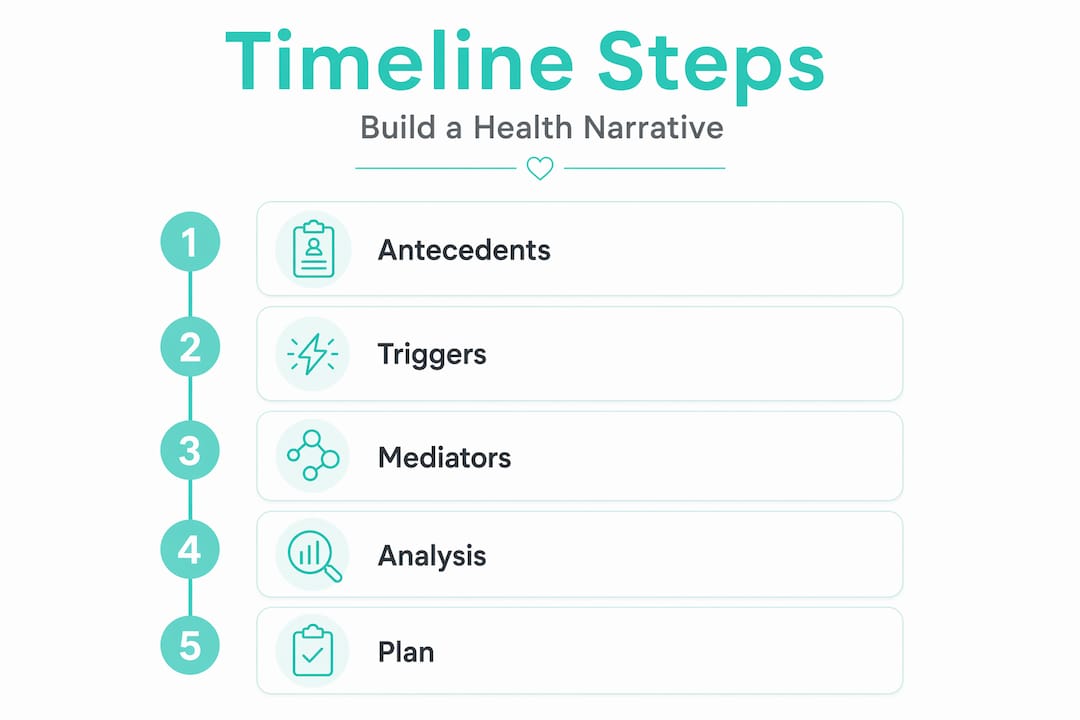
The timeline does not just describe a patient’s history. It tells you where to start treatment. That distinction separates functional medicine from conventional symptom management.

Treatment sequencing based on timeline analysis can dictate clinical response and prognosis, because addressing root causes upstream changes what is possible downstream. A patient presenting with fatigue, brain fog, and joint pain looks very different when you know their symptoms began six months after a mold-contaminated office exposure versus after a significant bereavement. Same symptom cluster. Completely different upstream drivers. Completely different intervention order.
Here is how the clinical utility plays out across two common scenarios:
| Scenario | Without timeline | With timeline |
|---|---|---|
| Autoimmune disease | Immunosuppressants to manage flares | Identify birth antecedents, antibiotic history as triggers, and sleep disruption as mediator. Address in sequence. |
| Chronic fatigue | Stimulants or antidepressants | Trace viral trigger, map cortisol dysregulation as mediator, prioritize adrenal and mitochondrial support first. |
The timeline also connects directly to the IFM Matrix, the Institute for Functional Medicine’s systems biology framework that organizes dysfunction across physiological nodes like assimilation, defense and repair, and energy production. Once you have categorized timeline events using ATMs, you can map them onto the Matrix to see which nodes are most burdened and sequence interventions accordingly.
Identifying upstream triggers before focusing on symptom relief is not optional in this model. It is the entire point. Addressing mediators like chronic sleep deprivation before expecting immune modulation therapies to work is the difference between a patient who improves and one who plateaus.
Pro Tip: Color-code your ATMs categories on the timeline document. Antecedents in blue, triggers in red, mediators in orange. This visual layering lets you see pattern clusters instantly without re-reading the entire narrative.
Integrating timelines into personalized care plans
Once the timeline is built, the real work begins. The timeline transitions from a diagnostic document into an intervention roadmap. Each identified mediator becomes a modifiable target. Each trigger suggests a system or organ that absorbed the initial insult and may need direct support.
Ongoing monitoring keeps the timeline alive and clinically useful over months of care:
- Symptom journals allow patients to track daily patterns that correlate with dietary, sleep, stress, or environmental variables. These journals add longitudinal data that a quarterly lab draw cannot capture.
- Biweekly or monthly check-ins create regular opportunities to assess which interventions are working and which mediators are proving more resistant than anticipated. Ongoing monitoring including repeated lab testing ensures the timeline evolves with the patient’s actual biology, not a static snapshot.
- Lab reviews tied to timeline events allow you to track biomarkers in the context of what you know about the patient’s triggers. An elevated hs-CRP means something different in a patient with a documented mold exposure history than in a patient with unresolved grief and poor sleep.
- Patient empowerment through the timeline is one of the underrated benefits of functional medicine. When patients can see their own story laid out visually, the connections between life events and symptoms become undeniable. That recognition is motivating in ways that a diagnosis code on a prescription pad never is.
This is where the integrative nursing practice model shines. Nurses trained in functional medicine bring unique relationship-building skills that make the timeline conversation feel safe and thorough, not clinical and rushed.
Common challenges and how to overcome them
Building an accurate timeline is harder than it sounds. Patient memory is imperfect, emotionally charged events are often minimized or avoided, and the sheer volume of information can feel unmanageable without a structured approach.
The most common challenge is recall gaps. Patients forget medications they took decades ago, infections they had in childhood, or work environments they left years back. These gaps are not failures. They are expected. Standardized questionnaires sent in advance give patients time to reflect, consult old records, and even ask family members, which substantially improves accuracy before the clinical conversation begins.
Another challenge is timeline oversimplification. Some clinicians treat the ATMs exercise as a one-time intake task rather than a living document. That instinct costs you diagnostic accuracy. A patient’s timeline at month six looks different than it did at intake, especially as they begin to process their own health story and recall previously suppressed events. Plan for at least one dedicated timeline review session at the three to six month mark.
Building trust is the other non-negotiable. Patients will not share the events that matter most, including abuse histories, addiction, or work-related shame, unless they feel genuinely safe. The therapeutic partnership is not a soft skill. It is a clinical requirement for timeline accuracy. Practitioners who attract and retain wellness clients know that the depth of the timeline directly reflects the depth of the relationship.
Pro Tip: Frame the timeline conversation as “telling your health story” rather than “answering intake questions.” That single reframe changes the emotional register of the entire visit and consistently produces richer, more complete narratives.
My perspective on the power of timelines in functional practice
I have sat with enough patients through their health stories to know that the timeline is not a clinical form. It is a turning point. The moment patients see their symptoms organized into a chronological narrative with identifiable causes, something shifts. They stop seeing themselves as randomly sick and start seeing themselves as someone with a story that makes sense and a future that can be different.
What I have seen clinicians get wrong most often is treating the timeline as a diagnostic step rather than an ongoing clinical relationship. You do not build it once and file it. You return to it. You challenge it. When a treatment is not working, I go back to the timeline first. Every time. There is almost always a mediator we underweighted or a trigger we treated too abstractly.
The other lesson I have learned the hard way is that treatment order matters enormously. Addressing gut permeability before resolving chronic psychological stress will produce limited results, because the mediator is actively undermining the intervention. The timeline tells you this IF you read it as a dynamic sequence rather than a list of problems to solve simultaneously.
If you are a healthcare professional considering functional medicine training, I want to be direct with you: understanding the timeline is not a supplementary skill. It IS the method. Everything else you learn in functional medicine plugs into this framework.
— Lauren
Take your functional medicine skills to the next level
You now understand what a functional medicine timeline is and why it is the diagnostic backbone of personalized care. The real question is whether you have the training to build and interpret one with clinical confidence.
Functionalacademy’s fully accredited online program at the Institute for Functional Nurses is designed exactly for healthcare professionals like you. The curriculum teaches you how to gather patient narratives, apply the ATMs framework, sequence interventions, and incorporate timelines into ongoing care plans, all within a format that fits your existing practice. Board Certification-eligible, clinically grounded, and built for real practitioners ready to deliver root-cause medicine. Your patients are waiting for a provider who can finally connect the dots for them.
FAQ
What is a functional medicine timeline in simple terms?
A functional medicine timeline is a structured patient narrative that maps life events, exposures, and health changes from birth to the present to identify the root causes of chronic illness. It uses the ATMs framework to categorize antecedents, triggers, and mediators.
How long does it take to build a functional medicine timeline?
The initial timeline is built during an extended intake process that typically runs 60 minutes to three hours, depending on complexity. The timeline continues to evolve throughout ongoing care as new information emerges.
What is the difference between triggers and mediators in the ATMs framework?
Triggers are the specific events that initiated symptom onset, while mediators are the ongoing factors like poor sleep or chronic stress that keep the illness active. Both must be identified and addressed for lasting clinical improvement.
How does the functional medicine timeline improve treatment outcomes?
By identifying upstream drivers before initiating therapy, the timeline allows practitioners to sequence interventions in an order that produces actual resolution rather than symptom suppression. Addressing root causes first changes the entire treatment trajectory.
Can nurses and non-physician practitioners use functional medicine timelines?
Yes. The functional medicine approach is applicable across all healthcare disciplines. Nurses and allied health professionals trained in functional medicine are particularly well positioned to conduct deep narrative interviews and build therapeutic partnerships that make timeline accuracy possible.