
Types of Functional Diagnostic Tests Every Clinician Should Know
Types of Functional Diagnostic Tests Every Clinician Should Know
The primary types of functional diagnostic tests clinicians use are advanced blood and metabolic panels, stool and PCR microbiome testing, hormone testing (serum, saliva, and DUTCH), organic acids testing (OAT), SIBO breath testing, food sensitivity assays, and toxin or heavy-metal panels. Each category answers a different clinical question, and none of them replace conventional diagnostics. They extend the picture beyond what a standard panel flags as “normal.”
You’ll reach for these tools most often with patients presenting:
- Persistent fatigue with unremarkable standard labs
- Chronic GI symptoms unexplained by endoscopy or colonoscopy
- Suspected hormone disruption (perimenopause, adrenal complaints, cycle irregularities)
- Unexplained cognitive fog or metabolic dysfunction
Pro Tip: The test you order matters less than the question you’re asking. Match the panel to the clinical hypothesis first, then interpret results against symptoms, not just reference ranges. Functional lab data means little without training to integrate it clinically.
Key Takeaways
Correctly matching a functional diagnostic test to a specific clinical question, and interpreting the result within trained clinical context, is what separates useful functional testing from expensive noise.
| Point | Details |
|---|---|
| Match test to hypothesis | Order panels tied to a specific clinical question, not reflexively across every patient. |
| Sequence from cheap to complex | Start with standard panels like thyroid and fasting insulin before escalating to OAT or DUTCH. |
| Confirm food sensitivities | Pair IgG or MRT testing with structured elimination and reintroduction to confirm true intolerances. |
| Prepare patients for breath testing | Low-fermentation diet and no antibiotics beforehand prevent false negatives on SIBO testing. |
| Invest in interpretation skills | Accredited training in complex panel interpretation reduces misdiagnosis risk from nonstandardized reference ranges. |
Table of Contents
- Types of Functional Diagnostic Tests for Metabolic and Cardiovascular Risk
- Stool Testing and Gut Microbiome Analysis
- Hormone Testing: Serum, Saliva, and DUTCH Compared
- Organic Acids Testing: What Urine Reveals About Metabolism
- SIBO Breath Testing: Method and Common Pitfalls
- Food Sensitivity and Intolerance Testing: IgG, MRT, and Elimination
- Environmental Toxin and Heavy Metal Testing
- Building a Clinical Framework for Test Selection
- Why Accredited Training Changes How You Use These Tests
- What Clinicians Consistently Get Wrong About Functional Testing
- Sources
Types of Functional Diagnostic Tests for Metabolic and Cardiovascular Risk
Standard lipid panels miss a lot. Advanced metabolic panels dig into markers that flag risk years before conventional labs catch up.
The markers worth prioritizing include:
- ApoB, LDL-P, and Lp(a) — particle number and genetic lipid risk that total cholesterol alone won’t show
- hs-CRP — a low-grade inflammation marker tied to cardiovascular and metabolic disease
- Fasting insulin paired with fasting glucose — catches insulin resistance long before fasting glucose crosses a diabetic threshold
- Full thyroid panel — TSH, free T3, free T4, reverse T3, and thyroid antibodies, rather than TSH alone
Peer-reviewed research on advanced metabolic markers supports using these markers for better cardiometabolic risk stratification than routine screening alone provides. The common pitfall: ordering these tests without a hypothesis. A fasting insulin drawn on every patient generates noise. A fasting insulin drawn on a patient with visceral weight gain and brain fog generates a diagnosis.
Pro Tip: Pull ApoB and fasting insulin together whenever a patient has a family history of early cardiac events but a “clean” lipid panel. That combination catches what LDL cholesterol misses.
Stool Testing and Gut Microbiome Analysis
PCR-based stool panels detect pathogen DNA directly, which is faster and more sensitive than culture-based methods for identifying bacterial, parasitic, and viral causes of chronic GI symptoms. That precision is the main reason PCR has largely replaced culture for this indication.
The markers that actually change your treatment plan:
- Calprotectin — distinguishes inflammatory processes from functional GI complaints
- Pancreatic elastase — flags exocrine pancreatic insufficiency
- Secretory IgA — reflects mucosal immune activity
- Zonulin — an intestinal permeability marker, though its clinical validity is still debated
Order a GI-MAP-style panel when a patient has chronic diarrhea, bloating, or abdominal pain that hasn’t responded to first-line treatment, or when you suspect a parasitic or bacterial infection standard stool culture wouldn’t catch. Clinical reviews on stool testing support calprotectin and secretory IgA as genuinely actionable markers when results align with the clinical picture.
Pro Tip: Ignore the microbiome “diversity score” on most consumer-facing reports. It’s compositional data with weak reference populations. Focus on pathogen detection and inflammatory markers instead.
Hormone Testing: Serum, Saliva, and DUTCH Compared

These three modalities aren’t interchangeable, and picking the wrong one wastes a patient’s money and your diagnostic window.
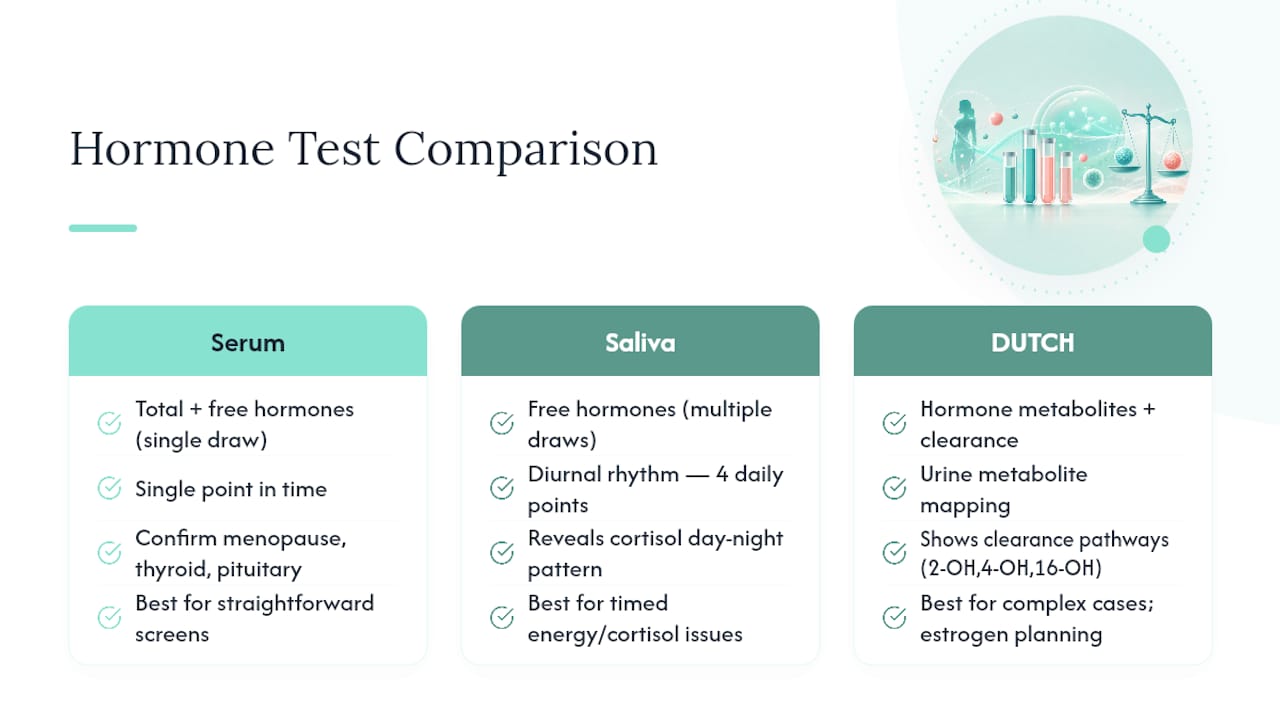
Serum testing measures total and free hormone levels at a single point in time. It’s the right call for confirming menopause status, screening thyroid hormones, or evaluating suspected pituitary dysfunction. Salivary cortisol testing captures the diurnal rhythm across four points in a day, which single-draw serum cortisol simply can’t show. That makes it useful for patients describing energy crashes at predictable times or wired-but-tired patterns suggestive of HPA-axis dysregulation.
DUTCH testing goes further, mapping hormone metabolites and clearance pathways rather than just circulating levels. Comparative research on hormone testing methods confirms DUTCH and salivary profiles each offer distinct diagnostic value that serum testing alone misses. DUTCH is particularly useful when planning estrogen-modulating interventions, since it shows which clearance pathway (2-OH, 4-OH, 16-OH) a patient favors, information that affects both risk and treatment choice.
Reserve DUTCH for complex endocrine presentations. A straightforward menopause consult doesn’t need urine metabolite mapping.
Organic Acids Testing: What Urine Reveals About Metabolism
A single urine OAT panel can surface 70+ metabolic markers spanning mitochondrial function, B-vitamin status, neurotransmitter turnover, and microbial byproducts from yeast and bacterial overgrowth.
That breadth is both the strength and the trap. High-yield uses include:
- Unexplained fatigue that doesn’t map to thyroid or anemia
- Cognitive symptoms with normal neurological workups
- Persistent mood or energy complaints resistant to standard treatment
- Suspected mitochondrial dysfunction in patients with exercise intolerance
Research on organic acids testing confirms OAT provides a genuine window into mitochondrial and B-vitamin metabolism, but the same research flags a real problem: reference ranges vary meaningfully across labs, and clinical meaning isn’t standardized the way it is for a basic metabolic panel. A single elevated marker rarely tells you anything useful in isolation. Patterns across several related markers do. This is exactly the kind of test that produces false confidence in untrained hands and genuine clinical insight in trained ones.
SIBO Breath Testing: Method and Common Pitfalls
Hydrogen and methane breath testing remains the standard functional approach for diagnosing small intestinal bacterial overgrowth, and the substrate you choose changes what you’re actually measuring.
- Choose the substrate. Lactulose reaches the colon and tests the full small bowel; glucose is absorbed earlier and may miss distal overgrowth.
- Collect breath samples at fixed intervals, typically every 15 to 20 minutes over two to three hours.
- Interpret against validated thresholds for hydrogen and methane rise, since methane-dominant patients often present as constipation-predominant.
- Correlate with symptoms, not the number alone. A borderline rise in a symptomatic patient still warrants treatment.
Clinical gastroenterology guidance on breath testing outlines how substrate choice, timing, and pre-test diet directly affect result accuracy. Patients need a low-fermentation diet the day before testing and should avoid antibiotics or prokinetics for at least two weeks prior, or you’ll get a false negative that sends you chasing the wrong diagnosis.
Pro Tip: A patient who “fails” a low-FODMAP trial but never had breath testing may not have SIBO at all. Test before you commit them to months of dietary restriction.
Food Sensitivity and Intolerance Testing: IgG, MRT, and Elimination
IgE testing measures true allergic response and has solid diagnostic validity. IgG testing measures antibody exposure, which may reflect recent food exposure rather than clinical intolerance, and its evidence base for guiding elimination diets is genuinely mixed. Mediator Release Testing (MRT) attempts to measure a broader inflammatory response to food compounds, with a smaller but growing evidence base behind it.
Here’s the practical reality: no lab test replaces a structured elimination and reintroduction protocol for confirming food-symptom relationships. Testing can help you prioritize which foods to remove first, cutting weeks off a lengthy elimination trial, but the elimination and controlled reintroduction is what actually confirms the diagnosis.
A workable clinical sequence looks like this:
- Order targeted testing to generate a shortlist of likely triggers
- Run a monitored elimination phase, typically three to four weeks
- Reintroduce one food at a time, tracking symptoms
- Confirm true intolerances before recommending long-term restriction
Skipping the reintroduction step is the single most common error, and it leaves patients on unnecessarily restrictive diets indefinitely.
Environmental Toxin and Heavy Metal Testing
Blood and urine assays reliably measure lead, mercury, arsenic, and cadmium, and these remain the gold-standard matrices for toxicology when exposure is suspected. Broader “environmental toxin” panels that screen for dozens of compounds simultaneously are more exploratory. They’re useful for generating hypotheses in patients with unexplained multisystem symptoms, but they rarely change immediate management on their own.
Order targeted heavy metal testing when:
- Occupational or environmental exposure history is present (well water, industrial work, older housing with lead paint)
- Symptoms suggest a specific toxicity pattern (peripheral neuropathy, cognitive changes, GI complaints without another cause)
- A patient has high fish consumption and neurological symptoms consistent with mercury exposure
Timing matters here. Urine testing after a provoking agent (chelation challenge) is controversial and not well validated for chronic, low-level exposure assessment. Unprovoked urine or blood testing is the more defensible starting point for most patients, and it’s what you’ll need to counsel patients on clearly before ordering anything more aggressive.
Building a Clinical Framework for Test Selection
Random test-ordering is expensive and generates false positives that create more clinical noise than clarity. A sequencing framework solves that.
- Start with the presenting complaint. Fatigue points first toward thyroid panel, fasting insulin, and possibly OAT. GI symptoms point toward stool PCR testing and, if bloating dominates, SIBO breath testing. Hormone complaints point toward serum screening first, escalating to DUTCH only for complex presentations.
- Order the cheapest, highest-yield test first. A full thyroid panel and fasting insulin cost far less than a DUTCH or OAT panel and often answer the question outright.
- Escalate only when first-line results don’t explain the symptom picture. This is where OAT, DUTCH, and specialty stool panels earn their cost.
- Document your reasoning for each order, including what a positive or negative result would change in your treatment plan.
Cost matters to patients directly, since functional testing is often cash-pay, with individual panels frequently landing in the low hundreds of dollars and inconsistent insurance coverage. Be upfront about that before ordering, and be honest that results sometimes require follow-up testing to interpret fully. This kind of systems-based assessment approach tends to produce better long-term care plans than reflexive panel-ordering, but only when the sequencing is deliberate.
Pro Tip: Before ordering any specialty panel, ask yourself: “If this comes back abnormal, what will I actually do differently?” If you don’t have an answer, you’re not ready to order it yet.
Why Accredited Training Changes How You Use These Tests
Ordering a DUTCH panel or an OAT test is the easy part. Interpreting 70-plus organic acid markers against a patient’s full clinical picture, without standardized reference ranges to lean on, is where most clinicians without dedicated training get stuck.
This is precisely the gap accredited functional medicine education is built to close. Structured coursework in this space typically covers:
- Interpreting complex, multi-marker panels (OAT, DUTCH, comprehensive stool panels) in clinical context rather than in isolation
- Building individualized care plans from lab data instead of generic protocols
- Applying evidence-informed frameworks rather than relying on manufacturer marketing claims about a given panel
The Institute for Functional Nurses structures its board-certification pathways (FIM-P, BC-FMP, BC-FMWC) around case-based learning specifically so clinicians practice interpreting these panels against real patient presentations, not textbook scenarios. CEU-eligible modules mean you’re building certification credit while developing skills you use the same week in your own practice.
Misinterpretation risk is real. A zonulin result read as gospel, or an IgG panel treated as diagnostic rather than exploratory, leads to unnecessary restriction and patient distrust. Training closes that gap directly, and it’s the difference between ordering tests and actually practicing functional medicine.
What Clinicians Consistently Get Wrong About Functional Testing
The conventional advice on functional testing treats every panel as equally valuable, and that’s the core problem. Ordering a DUTCH test on every hormone complaint, or an OAT panel on every fatigued patient, isn’t thorough practice. It’s expensive pattern-matching without a hypothesis behind it.
What the evidence actually supports is narrower and more useful: a handful of markers (fasting insulin, hs-CRP, ApoB, calprotectin) carry strong, reproducible clinical signal, while broader panels like microbiome composition reports or exploratory toxin screens generate more noise than direction unless they’re pointed at a specific question. The gap isn’t in the technology. It’s in the interpretation skill sitting behind the requisition form.
I’d push back on one more thing: treating test literacy as optional CE. The clinicians getting the best outcomes from functional testing aren’t the ones ordering the most panels. They’re the ones who can look at a DUTCH metabolite pattern or an OAT result and connect it to a treatment plan a patient can actually follow. That skill isn’t intuitive, and it isn’t taught in most conventional programs. It has to be built deliberately.
This article is general information, not a substitute for advice from a qualified doctor. Consult a qualified healthcare professional about your own circumstances before acting on anything here.
Sources
- PubMed: Relevant review on advanced metabolic markers
- PubMed: Clinical review on stool testing and markers
- PubMed: Comparative hormone testing methodologies
- NCBI PMC article on organic acids testing and interpretation
- What Is Functional Medicine Testing? A Full Breakdown