Board Aligned Functional Medicine Training for Primary Care Clinicians
Board Aligned Functional Medicine Training for Primary Care Clinicians
Accredited, board-certification-aligned functional-medicine training for primary-care clinicians already exists, and it delivers skills you can use in your next patient visit, not someday. Programs like the Institute for Functional Nurses combine CEUs, board pathways, and hands-on clinical application so nurses, NPs, and physicians can practice root-cause medicine inside their current setting. What follows is the evidence behind that claim, how to pick a program, and how to put it to work.
TL;DR:
- Functional medicine training for primary-care clinicians is accredited, self-paced, and focused on clinically applicable skills like SMA design and team-based care.
- Evidence shows group-based functional medicine improves patient outcomes and reduces costs compared to individual visits, especially with dietitian and coach involvement.
- Look for programs with credible accreditation, recognized board-certification pathways, practical coursework, and real case study components before enrollment.
- Implementing functional medicine effectively requires careful documentation, appropriate billing codes, and adherence to scope-of-practice regulations within your licensing framework.
- Starting small with a pilot cohort and tracking outcome measures such as PROMIS scores can validate the value of integrating functional medicine into your practice.
Table of Contents
- What Does Primary Care Functional Medicine Mean for Clinicians?
- What Does the Evidence Say About Outcomes?
- Accredited Training and Certification: What to Look For
- How to Bring Functional Medicine Into Your Practice
- Choosing the Right Program: A Quick Checklist
- How Do You Track Patient Outcomes in a Functional-Medicine Model?
- What Are the Legal and Regulatory Considerations?
- What Should You Actually Do Next?
- Get Started With an Accredited Program Built for Clinicians
- Sources
What Does Primary Care Functional Medicine Mean for Clinicians?
Primary care functional medicine is a systems-biology approach to diagnosis and treatment, built around finding and addressing root causes instead of managing symptoms one prescription at a time. Some institutions frame it as an operating system for value-based primary care, one that treats the microbiome, hormone signaling, and energy production as interconnected systems rather than isolated complaints.

For clinicians, that means longer visits, more follow-up touchpoints, and support from a broader care team than a typical 15-minute primary-care appointment allows. A functional-medicine intake often runs longer than a typical visit, with structured follow-ups scheduled rather than advising to “come back if it’s not better.”
A clinician-focused curriculum reflects that shift. Expect coursework in advanced nutrition science, lifestyle medicine, functional lab interpretation, case management strategy, and behavior-change counseling. This is not consumer wellness content repackaged for licensed professionals. It is clinical application training built to work inside an existing scope of practice, whether you’re a registered nurse coordinating care, an NP prescribing and managing plans, or a physician overseeing a multidisciplinary team.
What Does the Evidence Say About Outcomes?
The strongest signal comes from a Cleveland Clinic cohort study. Patients seen in a functional medicine center showed significantly greater improvements in PROMIS Global Physical Health scores at 6 and 12 months compared with matched family medicine patients, and a meaningfully higher share reached a clinically significant change threshold. The number needed to treat for one additional patient to reach that threshold was 11, which is a strong effect size for a primary-care intervention.
A second study, published in BMJ Open, compared delivery models directly. Shared medical appointments (SMAs) delivering functional-medicine care produced larger PROMIS improvements, greater weight loss, and lower per-patient delivery cost than one-on-one visits.
- SMA patients showed larger gains on both physical and mental health PROMIS scales.
- Cost to deliver care ran lower in the SMA cohort ($1,549 vs. $1,633 per patient) despite more total caregiver hours per patient.
The takeaway: group-based functional-medicine care outperformed individual visits on outcomes and cost in this matched analysis, though the studies rely on single-center cohorts rather than large multi-site trials, so longitudinal data across diverse populations is still needed. Most successful implementations also relied on dietitian and health coach involvement, not the clinician working solo.
Accredited Training and Certification: What to Look For
Not every functional-medicine course is built for licensed clinicians, and not every certificate carries weight with employers or credentialing bodies. Three signals separate a serious accredited program from a content library with a certificate at the end.
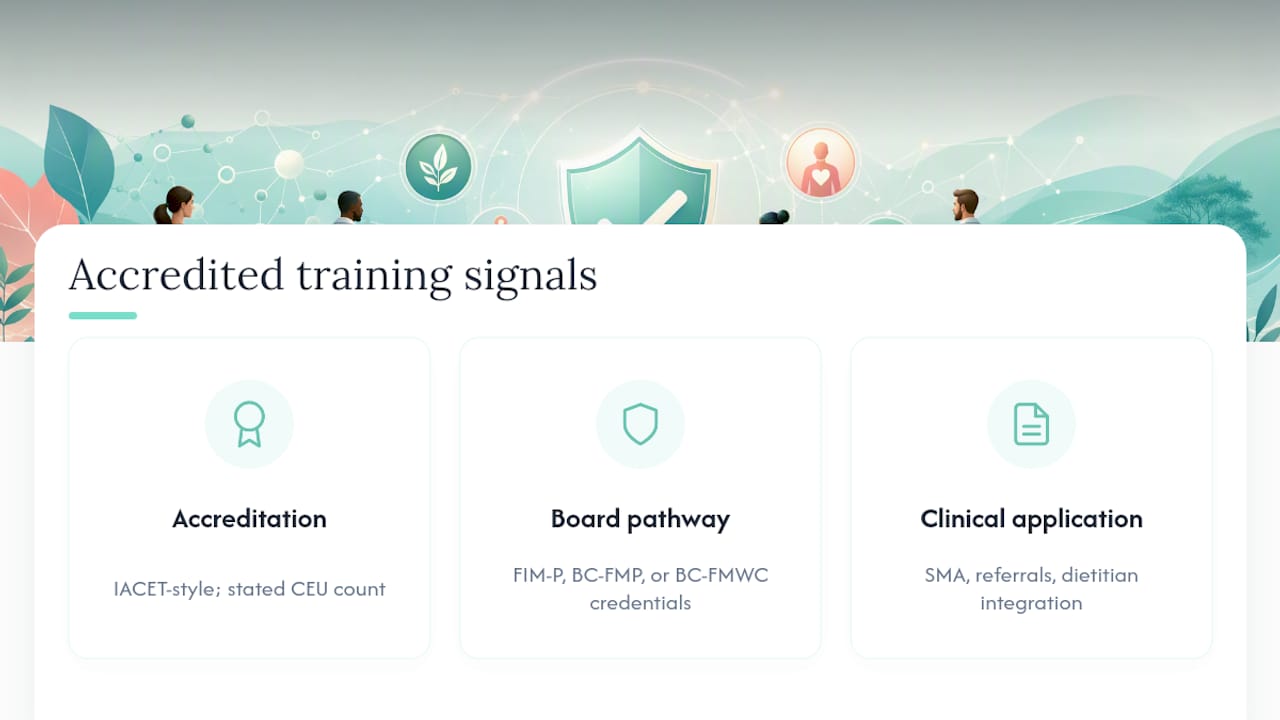
Accreditation and CEU structure. Look for IACET-style accreditation and a stated CEU count that satisfies your state board’s continuing-education requirements. A program that can’t tell you its CEU total or accrediting body is a program you should skip.
A board-certification pathway. Credentials like FIM-P, BC-FMP, or BC-FMWC signal that a program leads somewhere professionally recognizable, not just a personal-interest certificate.
Clinical applicability. The coursework should map directly onto primary-care workflows: SMA design, referral pathways, and how to bring in a dietitian or health coach, not abstract theory disconnected from a 20-patient day.
Typical timelines run several months to a year depending on pace, since most programs are self-paced with supervised case-study components. Costs vary by certification level and bundled coaching support, so compare total investment against the board-certification value and marketability gain, not just sticker price.
The Institute for Functional Nurses builds its accredited online program around these exact markers: CEU-bearing coursework, board-certification pathways, and clinical-application modules that walk clinicians through real case scenarios rather than lecture-only content.
Pro Tip: Ask any program for a sample case study before enrolling. If they can’t show you what a graded clinical application assignment looks like, you don’t yet know what you’re paying for.
How to Bring Functional Medicine Into Your Practice
Certification only pays off once it changes what happens in the clinic. Three delivery models fit different practice realities, and most clinicians end up using a mix.
- One-on-one visits work for complex intake and initial workup, where a 60-minute functional-medicine consult replaces or extends a standard appointment.
- Multidisciplinary follow-up brings in a registered dietitian or health coach for adherence and lifestyle-plan reinforcement between clinician visits.
- Shared medical appointments group 6 to 12 patients with similar goals (weight management, metabolic syndrome, autoimmune conditions) into a single facilitated session, cutting per-patient cost while increasing education time.
Team composition matters as much as the model. A dietitian handles nutrition-plan detail, a health coach manages behavior-change check-ins, and the clinician retains ownership of diagnosis, lab interpretation, and prescribing decisions. This division of labor is what let the BMJ Open cohort run SMAs at lower cost without sacrificing outcomes.
Documentation needs to preserve medical necessity even in a group setting: individual assessment notes, personalized plan elements, and outcome measures tied to each patient’s chart, not a shared group note. Where your payer structure allows it, group-visit billing codes can offset SMA costs, though coverage varies by plan and specialty, so verify with your billing team before scheduling a cohort.
Pro Tip: Pilot your first SMA with a cohort of three to five patients before scaling. Breakeven is achievable even at that size, and a small pilot lets you fix scheduling and documentation kinks before you’re running six patients through the same friction points.
For scheduling structure and patient-flow logistics, operational guidance on streamlining primary-care access covers how to weave dietary coaching and stress-management touchpoints into an already-full calendar without adding staff.
Choosing the Right Program: A Quick Checklist
Comparing accredited programs gets easier when you run each one through the same short list of questions.
- Accreditation and CEUs: Is the accrediting body named, and does the CEU count satisfy your state’s renewal requirements?
- Board-certification pathway: Does completion lead to a recognized credential, or just a certificate of attendance?
- Clinical mentorship: Are there graded case studies or supervised clinical application, not just video modules?
- Curriculum fit: Does the coursework address primary-care realities (SMAs, referral coordination, team-based care) rather than solo-practitioner theory?
- Time and cost: Is the completion timeline realistic against your current caseload, and does the price reflect the certification’s professional value?
- Alumni outcomes: Can the program point to graduates who’ve successfully integrated the model into an existing practice?
Ask vendors directly about mentorship availability and whether they can share a sample case study. Red flags include vague accreditation claims, no measurable graduate outcomes, and marketing that leans entirely on testimonials with no curriculum detail. Clinicians who complete accredited, board-aligned training consistently report more confidence delivering nutrition and lifestyle interventions, which tracks with why the checklist above weighs clinical application so heavily.
How Do You Track Patient Outcomes in a Functional-Medicine Model?
Functional-medicine care generates more data points than a standard visit, and that data is only useful if you’re capturing it consistently. Standardized instruments beat ad hoc symptom checklists because they let you compare a patient against their own baseline and against population norms.
PROMIS measures (Global Physical Health and Global Mental Health) are the most validated tool in the functional-medicine literature, and they’re quick enough to administer at intake and at each follow-up without disrupting visit flow. Tracking a 5-point or greater change on PROMIS GPH gives you a defensible, clinically meaningful benchmark rather than a subjective “patient feels better” note.
Beyond PROMIS, track a small set of objective markers tied to the patient’s specific goals: weight and body composition trends, relevant lab panels repeated at defined intervals, and adherence markers like session attendance for SMA cohorts or coaching check-ins. Consistency matters more than volume. Three well-tracked metrics beat ten inconsistently recorded ones.
Build outcome tracking into your documentation template from day one rather than retrofitting it later. A simple structure works: baseline score, 30-day check-in, 90-day reassessment, with each entry tied to the specific intervention that changed (diet protocol adjustment, new supplement, referral added). Over a full patient panel, this creates the kind of before-and-after data that justifies the model to skeptical colleagues, payers, and eventually your own clinical judgment about what’s actually working versus what merely sounds good on paper.
What Are the Legal and Regulatory Considerations?
Scope of practice governs everything here, and functional medicine does not expand it. An RN practicing functional-medicine principles still practices within RN scope; an NP still needs the same prescribing authority and collaborative agreements their state requires. Certification signals competency and training, not a new legal license to diagnose or prescribe beyond your existing credential.
Documentation compliance gets more complicated in group settings. Each patient in an SMA needs an individualized note reflecting their own assessment, plan, and response to treatment, even though the education portion was delivered to a group. Payers and state boards both expect to see personalized medical necessity in the chart, not a templated note copied across every attendee.
Billing accuracy matters just as much. Group-visit and shared-medical-appointment billing codes exist, but coverage and reimbursement rules vary by payer and by state, so confirm applicable codes with your billing or compliance team before running a cohort rather than after. Supplement and lab recommendations should stay within your scope and your state’s regulations on ordering and interpreting specialty labs, some of which require specific certifications or physician oversight depending on the test.
Informed consent deserves explicit attention in a functional-medicine model, since patients may receive nutrition, supplement, and lifestyle recommendations alongside conventional treatment. Document that discussion clearly, and keep referral pathways to registered dietitians, behavioral health providers, or specialists well documented so accountability across the care team is traceable if a chart is ever reviewed.
What Should You Actually Do Next?
The evidence here is stronger than most clinicians assume, and the biggest barrier isn’t the science. It’s finding protected time to build the skill set and the nerve to pilot something new inside a schedule that’s already full.
Start with three moves: review two or three accredited curricula side by side using the checklist above, block real calendar time for coursework instead of hoping it happens between patients, and pilot a small SMA or co-visit model with a cohort of three to five patients before scaling further. Track PROMIS or a comparable outcome measure from day one so you have real numbers, not impressions, when you decide whether to expand.
If you want a second set of eyes on a curriculum or a workflow question, clinical teams at functional-medicine education providers may field those conversations regularly. Start small, measure honestly, and let the results make the case.
— Lauren
Get Started With an Accredited Program Built for Clinicians
The Institute for Functional Nurses gives busy primary-care clinicians a direct path to board-certification-aligned training without requiring a leave of absence from your practice. The program is fully online and self-paced, built around CEU-bearing coursework, board-certification pathways (FIM-P, BC-FMP, BC-FMWC), and clinical-application modules that mirror the real case scenarios covered earlier, from SMA design to team-based follow-up.
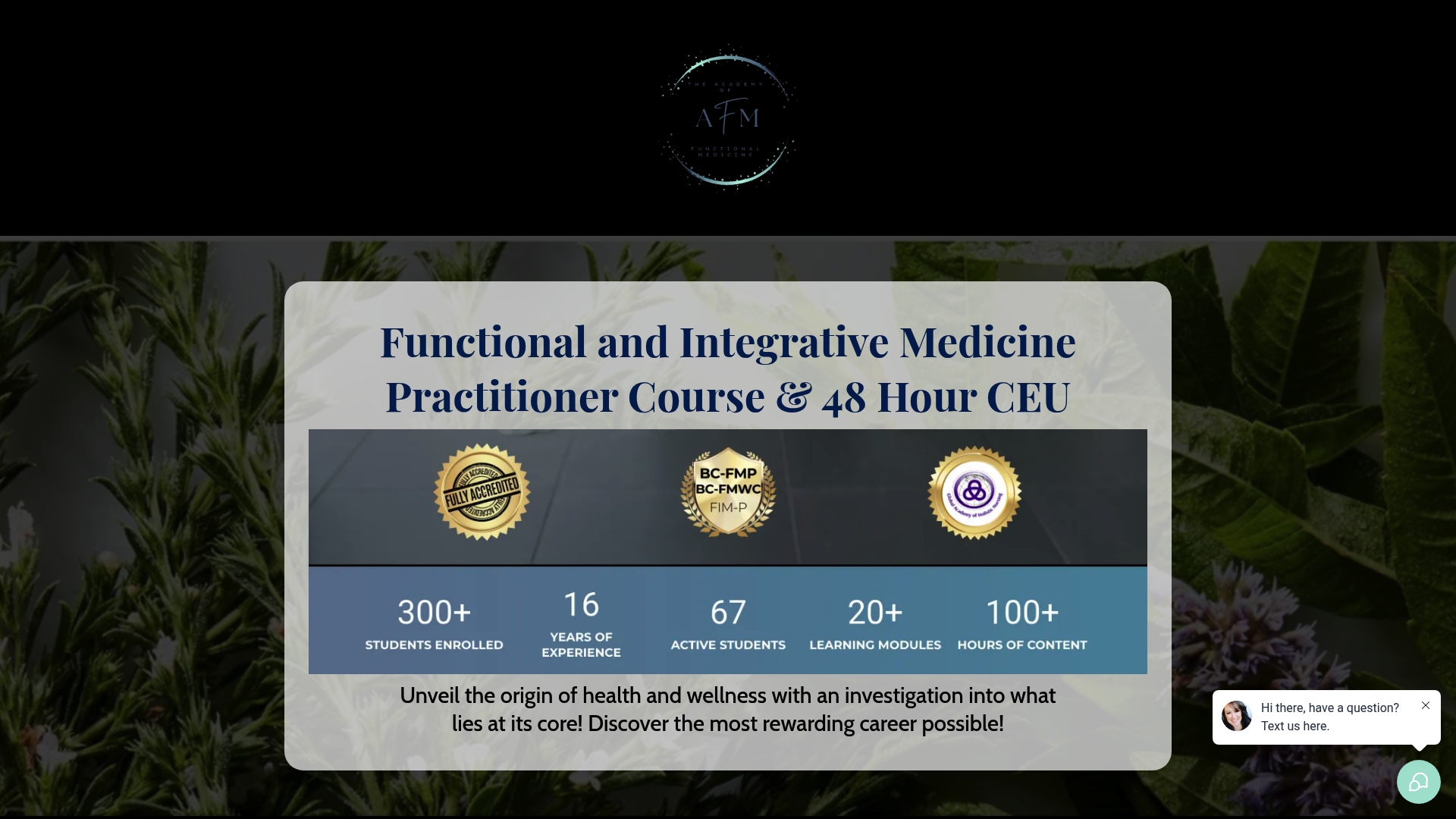
It’s built for RNs, NPs, physicians, and other licensed clinicians who want the credential and the practical skill set at the same time, not one without the other. If you’re ready to see how the curriculum maps onto your own patient panel, review the program details and enrollment options and find the certification track that fits your role.
This article is general information, not a substitute for advice from a qualified doctor. Consult a qualified healthcare professional about your own circumstances before acting on anything here.