
How Nurses Transition to Entrepreneurship Successfully
How Nurses Transition to Entrepreneurship Successfully
You spent years mastering clinical skills, and now you’re wondering if there’s more. Understanding how nurses transition to entrepreneurship is not just about swapping scrubs for a business suit. It’s about a complete reinvention of how you think, earn, and lead. Most nurses assume their clinical expertise is enough to launch a thriving business. It’s not. The missing piece is rarely knowledge. It’s identity. This guide covers the real work: business models built for nurses, funding strategies that actually fit your stage, the mindset overhaul that separates struggling nurse business owners from successful ones, and how to make the leap without burning down your financial safety net.
Table of Contents
- Key takeaways
- How nurses transition to entrepreneurship: the real starting point
- The mindset shift that changes everything
- Practical steps to launch your healthcare business
- Funding options for nurse entrepreneurs
- Balancing clinical work and your new business
- My honest take on what actually holds nurses back
- Build your nurse-led practice with Functionalacademy
- FAQ
Key takeaways
| Point | Details |
|---|---|
| Mindset shift is non-negotiable | Clinical excellence alone won’t build a business. You must rewire how you see authority, pricing, and leadership. |
| Start with the right business model | Align your niche with clinical expertise and personal passion to build something sustainable from day one. |
| Bootstrap before seeking investors | Most nurse entrepreneurs start with bootstrapping to validate their idea before pursuing outside capital. |
| Keep clinical work during early stages | Staying PRN or part-time gives you financial stability and real-world feedback while your business grows. |
| Identity recalibration drives long-term success | Separating your nurse identity from your founder identity is the inner work that determines whether your business thrives or stalls. |
How nurses transition to entrepreneurship: the real starting point
Nurse entrepreneurship is broader than most people realize. A nurse entrepreneur is any registered nurse who builds a business using clinical knowledge, healthcare expertise, or patient care experience as the foundation. Business ownership offers nurses genuine autonomy, diversified income streams, leadership roles, and the kind of schedule flexibility the hospital system rarely provides.
The range of viable business models is wide. You are not limited to one path:
- Consulting and advisory services for hospitals, insurance companies, or legal firms needing clinical expertise
- Health coaching or wellness coaching focused on chronic disease management, weight loss, or lifestyle transformation
- Private practice or telehealth clinics offering direct patient care outside the traditional system
- Home health agencies providing skilled nursing or personal care services
- Digital products and online courses teaching other nurses or educating patients on specific health topics
- Integrative or functional medicine practices blending root-cause clinical care with personalized wellness programs
The secret to picking the right model is not chasing the most profitable option. It’s finding the intersection of what you know deeply, what you genuinely care about, and where a real gap exists in your local or online market. A nurse with ten years in oncology who builds a cancer recovery coaching program will outperform a nurse who launches a generic wellness business simply because it seemed trendy.
Pro Tip: Before committing to a business model, spend 30 days talking to potential clients. Ask what they struggle with most and what they’ve already tried. Their answers will tell you more than any market research report.
Consider how integrative nursing approaches can become the backbone of a differentiated practice that attracts clients who want more than symptom management. Nurses who specialize in whole-person care have a built-in competitive edge in the growing wellness economy.
The mindset shift that changes everything
This is where most nurse entrepreneurship guides go quiet. They give you the business tactics but skip the identity work. And that’s exactly why so many nurses launch businesses and then quietly shrink back to full-time clinical roles within a year.
Clinical training creates a specific kind of conditioning that actively works against entrepreneurial success. You were trained to follow protocols, defer to physicians, document everything for liability, and wait for institutional approval before acting. That conditioning saved lives in the hospital. In business, it will quietly kill your momentum.
“Entrepreneurial readiness depends heavily on reprogramming internal narratives about worth, authority, and visibility.” The nurses who build thriving businesses are not the most clinically skilled. They are the ones who do the belief work first.
The most common internal blocks nurses face when starting a business include:
Waiting for permission. You are used to a chain of command. In business, there is no attending physician to approve your decision. You ARE the decision-maker. The sooner you own that, the faster you move.
Undervaluing services. Nurses are socialized to give. Charging $300 an hour for a coaching session can feel morally wrong when you spent years earning $40 an hour at the bedside. That discomfort is not a signal to lower your prices. It is a signal to do the inner work around worth.
Fear of visibility. Building a business requires you to be seen: on social media, in your community, on podcasts, in front of cameras. Many nurses find this deeply uncomfortable. The founder consciousness shift means owning your authority publicly, not just privately.
Pro Tip: Write down every belief you hold about money, authority, and what nurses “should” do. Then ask yourself: did I choose this belief, or was it handed to me by the healthcare system? That question alone can unlock years of stalled progress.
Successful nurse entrepreneurs create systems that generate value independent of their time, rather than simply trading more hours for more dollars. That requires thinking like a founder, not like an employee.
Practical steps to launch your healthcare business
Knowing you want to build something is one thing. Actually building it is another. Here is a clear sequence that works for nurses starting a business from scratch.
Step 1: Identify and validate your niche. Do not skip this. Talk to real people in your target market before you build anything. Confirm that the problem you want to solve is one they are actively trying to fix and willing to pay for.
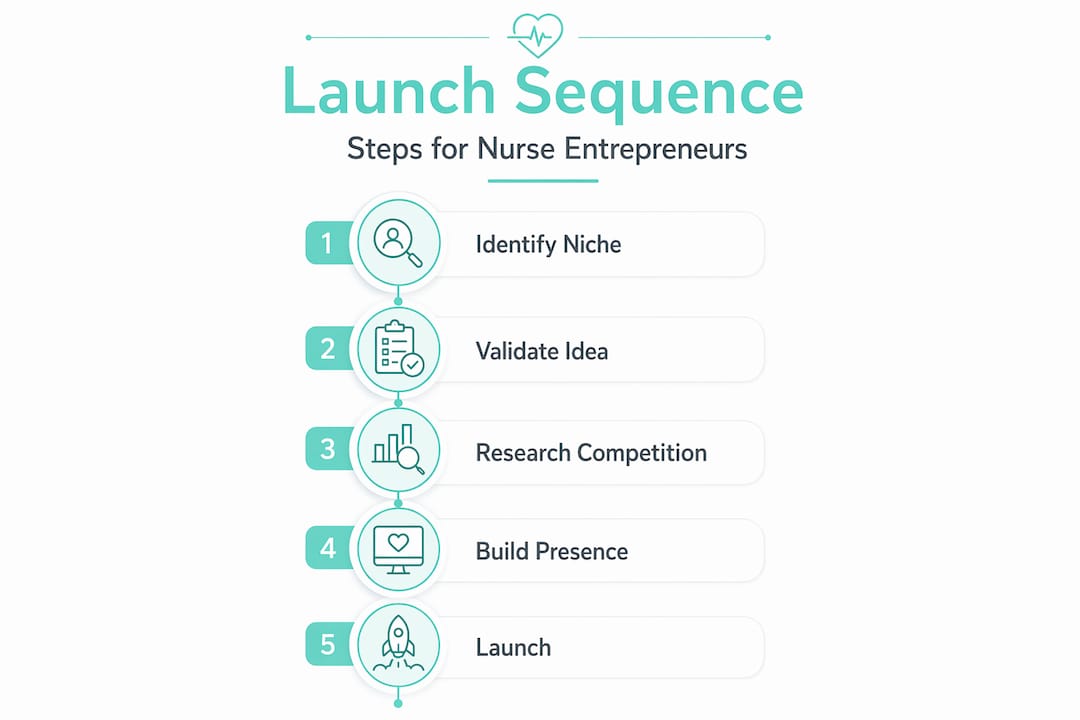
Step 2: Research the competitive space. Look at what other nurse entrepreneurs, health coaches, and wellness practitioners in your niche are offering. Identify gaps. Price points matter here too. Know what the market will bear before you set your rates.
Step 3: Build a business plan. This does not need to be a 40-page document. It needs to cover your core services, pricing structure, projected expenses, revenue targets for the first 12 months, and your marketing strategy. Keep it lean but specific.
Step 4: Handle the legal and structural foundations.
- Choose a business structure (LLC is the most common starting point for solo nurse entrepreneurs)
- Register your business with your state
- Obtain professional liability insurance specific to your business model
- Consult a healthcare attorney if you are offering clinical services outside a traditional employment arrangement
- Understand your state’s scope of practice regulations
Step 5: Build your online presence. A professional website, a consistent social media presence, and a clear message about who you serve and how you help them are non-negotiable in 2026. Nurses who want to attract wellness clients that actually stay need a brand identity that communicates trust and specificity from the first click.
Step 6: Launch iteratively. Do not wait until everything is perfect. Launch a minimum viable version of your service, serve your first clients well, collect feedback, and refine. The nurses who wait for perfection never launch.

Funding options for nurse entrepreneurs
Money is where many nurses freeze. The good news is that most healthcare service businesses do not require significant startup capital. The funding path you choose should match your business model and growth stage.
| Funding Type | Best For | Key Consideration |
|---|---|---|
| Bootstrapping | Service-based businesses, coaching, consulting | Lowest risk, proves concept before spending big |
| Angel investors | Early-stage scaling with proven traction | Give up equity, need a compelling pitch |
| Venture capital | Scalable digital health startups | High growth expectations, significant equity loss |
| Accelerators and incubators | Nurses building tech-enabled health businesses | Mentorship and network access alongside funding |
| Business loans (SBA) | Home health agencies, brick-and-mortar practices | Requires solid business plan and credit history |
Bootstrapping is the optimal starting point for most nurse entrepreneurs, especially those launching consulting, coaching, or telehealth services. Your overhead is low. Your expertise is the product. You do not need a $50,000 investment to start a health coaching practice. You need a laptop, a scheduling tool, and paying clients.
The order of funding matters: bootstrap first, validate your minimum viable product with real revenue, then pursue angel investors or accelerators if your model justifies scaling. Nurses who chase outside investment before proving their concept waste time and often give away equity they will regret losing.
Senior care franchise owners earn an average of $155,000 annually by leveraging proven brand systems, which illustrates that higher startup costs can come with faster revenue timelines in certain healthcare models. Franchising is worth considering if you want a structured path with built-in brand recognition.
Pro Tip: Before approaching any investor, spend 90 days generating revenue with your own resources. Nothing makes a pitch more compelling than showing a paying customer base, even a small one.
Balancing clinical work and your new business
You do not have to quit nursing to become a nurse entrepreneur. In fact, quitting too early is one of the most common and costly mistakes nurses make in this transition.
Staying PRN or part-time at a hospital or clinic during the early stages of your business gives you several real advantages:
- Financial stability while your business revenue is still inconsistent
- Clinical credibility that strengthens your brand and reassures potential clients
- Real-world feedback loops where ongoing patient interactions help you refine your business offerings
- A professional network of colleagues who may become referral sources or early clients
- Reduced psychological pressure so you can make business decisions from a place of strategy rather than desperation
The dual-path approach also gives you time to test your business model before betting everything on it. A nurse who works two clinical shifts per week and spends the rest of her time building her telehealth practice has a very different risk profile than one who quits cold and burns through savings in six months.
Time management becomes critical here. Treat your business hours as sacred. Block them on your calendar the same way you would block a hospital shift. Many nurses find that maintaining clinical roles while building their business actually accelerates their transition because the contrast between the two worlds sharpens their motivation and clarifies their vision.
My honest take on what actually holds nurses back
I’ve watched nurses with extraordinary clinical skills build businesses that stall out at $2,000 a month. And I’ve watched nurses with average clinical backgrounds build six-figure practices within 18 months. The difference is almost never knowledge. It’s almost always belief.
What I’ve seen consistently is that the healthcare system does something subtle but powerful to nurses over time. It teaches you to make yourself small. To defer. To ask before acting. To measure your worth by how much you sacrifice rather than how much you create. That programming runs deep, and it does not disappear just because you filed an LLC.
The nurses I’ve seen break through are the ones who treat the inner work as seriously as the business tactics. They hire coaches. They join communities of other nurse entrepreneurs. They do the uncomfortable work of examining what they believe about money, authority, and whether they deserve to be well compensated. The mentorship impact on career transitions is real and measurable. Do not try to figure this out alone.
My honest advice: stop waiting until you feel ready. Readiness is a feeling that comes AFTER you take action, not before. Your clinical skills are an extraordinary foundation. But you have to be willing to build something new on top of them, and that requires letting go of the identity that got you this far.
— Lauren
Build your nurse-led practice with Functionalacademy
If you are serious about making this transition, you need more than motivation. You need a structured path that combines clinical depth with real business application.
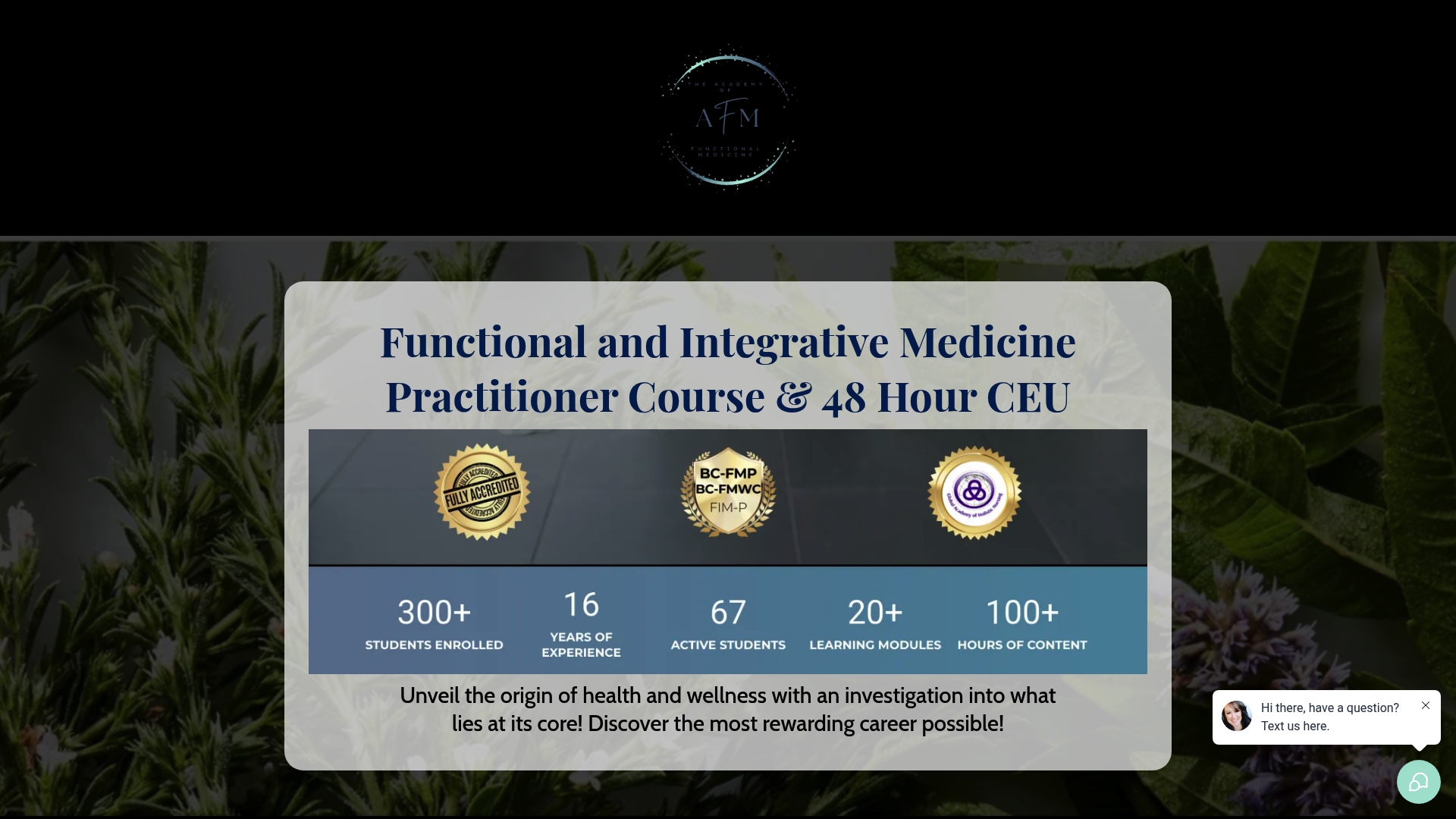
Functionalacademy’s Institute for Functional Nurses gives registered nurses exactly that. The program is fully accredited for Board Certification and built specifically for nurses who want to launch or expand healthcare practices grounded in functional and integrative medicine. You will learn how to identify root causes of illness, build personalized care protocols, and position yourself as a high-value practitioner in a market that is hungry for this approach. The program blends clinical education with the practical knowledge you need to attract and retain clients. Whether you are starting from scratch or adding a new specialty to an existing practice, Functionalacademy gives you the credentials, the skills, and the community to move forward with confidence. Explore the program and take the next step toward the practice you have been building toward.
FAQ
What does a nurse entrepreneur actually do?
A nurse entrepreneur uses clinical expertise to build and run a business, which can range from health coaching and consulting to private practice, home health agencies, or digital health products. The key distinction is ownership and independence rather than employment.
How long does it take to transition from nursing to entrepreneurship?
Most successful nurse entrepreneurs spend six to eighteen months building their business while maintaining clinical roles before transitioning fully. The timeline depends on your business model, savings, and how quickly you validate paying clients.
Do nurses need a business degree to start a healthcare business?
No. Clinical expertise combined with targeted business education and mentorship is enough to launch successfully. Many nurse entrepreneurs learn business fundamentals through courses, coaching programs, and peer communities rather than formal degrees.
What are the biggest challenges for nurse entrepreneurs?
The most significant challenges for nurse entrepreneurs are mindset-related, specifically undervaluing services, waiting for permission, and fear of visibility. Structural challenges like licensing, liability insurance, and scope of practice regulations are real but solvable with the right legal guidance.
Is bootstrapping realistic for starting a business as a nurse?
Yes. Most nurse-led service businesses, including coaching, consulting, and telehealth, have low startup costs and are well suited to bootstrapping. The priority is validating your offer with real clients before investing heavily in infrastructure or seeking outside funding.