
How Functional Medicine Differs from Symptom Management
How Functional Medicine Differs from Symptom Management
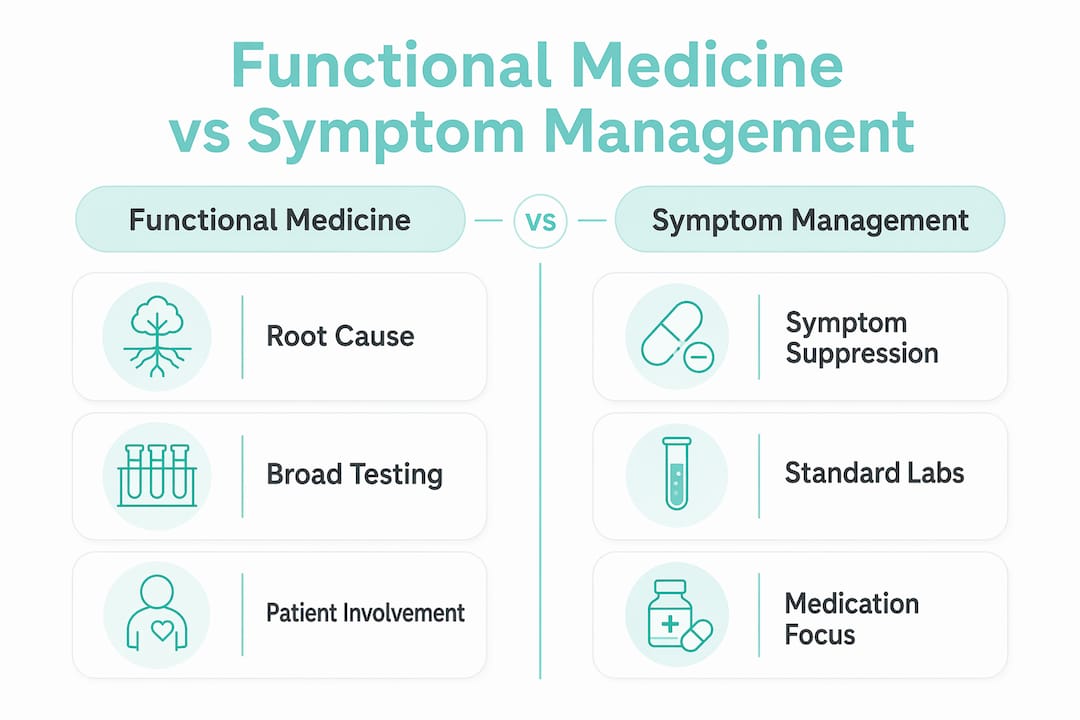
Functional medicine is defined as a root-cause-oriented clinical model that identifies and corrects the underlying physiological drivers of disease rather than suppressing downstream symptoms. Understanding how functional medicine differs from symptom management is the defining question reshaping modern clinical practice, especially for practitioners treating patients with chronic, multi-system conditions. Where conventional symptom management asks “what disease does this patient have?”, functional medicine asks "why is this happening in this patient?" That single shift in clinical logic changes everything: the intake process, the diagnostic panels ordered, the treatment plan built, and the timeline expected.
How functional medicine differs from symptom management in clinical approach
The most visible difference between functional medicine and conventional symptom management appears in the first clinical encounter. Initial visits in functional medicine typically run 60 to 90 minutes, compared to the 10 to 18 minutes standard in conventional practice. That time gap is not administrative padding. It reflects a fundamentally different clinical objective: building a longitudinal patient timeline that maps symptoms, exposures, lifestyle patterns, and physiological shifts across the patient’s entire life history.
Conventional symptom management compartmentalizes by diagnosis and specialty. A patient presenting with fatigue, joint pain, and brain fog might see a rheumatologist, a neurologist, and an endocrinologist, each treating their slice of the presentation in isolation. Functional medicine treats that same patient as a single interconnected system, using systems biology to identify where upstream dysfunction is generating multiple downstream signals simultaneously.
Here is what the clinical intake process looks like in functional medicine versus conventional care:
- Functional medicine: Detailed timeline reconstruction covering antecedents, triggers, and mediators; review of diet, sleep, stress, toxin exposure, and relationships
- Conventional symptom management: Chief complaint, symptom duration, relevant history, and physical exam focused on the presenting diagnosis
- Functional medicine: Personalized treatment plan built from physiological driver mapping, not diagnosis-based protocols
- Conventional symptom management: Standardized protocol applied based on confirmed diagnosis, with specialist referral for outliers
Pro Tip: When you first integrate functional medicine intake methods, start by adding a structured timeline questionnaire to your existing new-patient forms. You will capture years of clinical data in writing before the patient even sits down.
The conventional diagnosis becomes a starting point, not an endpoint, in functional medicine. Two patients with identical IBS diagnoses may receive completely different interventions because their underlying drivers, one rooted in gut dysbiosis and the other in chronic stress and cortisol dysregulation, are entirely distinct.
How does diagnostic testing differ between the two approaches?
Standard laboratory panels in conventional medicine are designed to detect diagnosable disease. Reference ranges flag pathology. If a patient’s thyroid-stimulating hormone falls within range, the conventional conclusion is “no thyroid disease.” Functional medicine asks a different question: is this patient’s physiology operating optimally, or is it functioning in a suboptimal range that predicts future dysfunction?
The testing panels used in functional medicine are broader and more targeted simultaneously. Where a conventional workup might include a complete blood count, a comprehensive metabolic panel, and a lipid panel, a functional medicine assessment adds gut microbiome analysis, nutrient status markers like magnesium and vitamin D, inflammatory markers including high-sensitivity C-reactive protein and homocysteine, heavy metal screening, and genetic variants affecting methylation or detoxification. Functional medicine uses broader testing panels including stool analysis, thyroid panels, and inflammatory markers that conventional labs routinely omit.
| Testing dimension | Conventional symptom management | Functional medicine |
|---|---|---|
| Primary goal | Detect diagnosable disease | Identify suboptimal physiology and upstream drivers |
| Reference ranges | Population-based pathology thresholds | Optimal physiological function ranges |
| Panel scope | Standard CBC, CMP, lipid panel | Gut microbiome, nutrient status, genetic variants, inflammation markers |
| Interpretation focus | Rule in or rule out diagnosis | Map physiological patterns to root causes |
| Retesting frequency | As symptoms warrant | Scheduled reassessment to track driver resolution |
This distinction matters enormously for chronic illness management. Patients who have been told their labs are “normal” for years often carry significant physiological dysfunction that standard panels simply are not designed to detect.
Treatment philosophies: root cause resolution versus symptom suppression
Symptom management relies primarily on pharmaceuticals and procedures that interrupt the symptom pathway. A beta-blocker controls heart rate. A proton pump inhibitor reduces stomach acid. An SSRI modulates serotonin availability. These are effective, often necessary interventions. The clinical problem arises when symptom suppression becomes the final destination rather than a bridge to root cause resolution.

Suppressing symptoms without addressing drivers risks persistent dysfunction. Symptoms are biologic signals, not the enemy. When you silence the signal without correcting the source, the underlying driver continues generating dysfunction, often expressing through new symptom patterns that appear unrelated to the original complaint. Functional medicine treats symptom recurrence as evidence that upstream causes remain unresolved, prompting reassessment rather than medication escalation.
The treatment toolkit in functional medicine is deliberately broad. Functional medicine treatments involve patient behavior change, lifestyle modification, targeted nutrition, and customized supplementation as primary interventions, with pharmaceuticals used selectively and strategically. The functional medicine matrix framework organizes these interventions across seven physiological nodes, making it possible to address multiple drivers within a single coherent plan.
Pro Tip: When presenting a functional medicine treatment plan to a patient accustomed to prescription-based care, frame lifestyle and nutrition interventions as precision tools, not lifestyle advice. Patients respond differently when they understand that a specific dietary change is targeting a specific physiological driver.
Patient participation is not optional in functional medicine. It is the mechanism of change. Tailored interventions and patient engagement are central to durable outcomes, which means the practitioner’s role shifts from prescriber to clinical partner and educator.
What are the expected timelines and outcome measures?
Conventional symptom management delivers measurable relief quickly. A corticosteroid reduces inflammation within days. An antibiotic clears an infection within a week. That speed is a genuine clinical advantage for acute conditions. The problem is that practitioners and patients alike have been conditioned to expect the same timeline from chronic condition management, and that expectation does not translate.
Functional medicine protocols typically span 4 to 12 weeks for initial physiological improvements and 6 to 12 months for full resolution of complex, multi-system conditions. This extended timeline reflects the biological reality of restoring function rather than suppressing signals. Rebuilding gut integrity, correcting nutrient deficiencies, and rebalancing the HPA axis take time measured in months, not days.
| Timeline phase | Functional medicine | Conventional symptom management |
|---|---|---|
| Initial response | 4 to 12 weeks for measurable physiological shifts | Days to weeks for symptom suppression |
| Full resolution | 6 to 12 months for complex cases | Ongoing medication maintenance, often indefinite |
| Outcome tracking | Symptom scores plus lab markers and functional assessments | Symptom presence or absence, diagnostic recurrence |
| Reassessment schedule | Iterative, every 4 to 8 weeks | As-needed based on symptom return |
Practitioners integrating functional medicine need to build timeline expectations into clinical communication from the first visit. Patients who understand the biological rationale for a longer protocol show significantly better adherence than those who receive a plan without context.
Practical implications for clinicians integrating functional medicine
Functional medicine is not a replacement for conventional care. It is most accurately understood as a complementary clinical layer that addresses what symptom management cannot: the upstream drivers generating chronic, recurring, or unexplained presentations. Integration of both models yields the best patient outcomes, particularly for populations where conventional care has plateaued.
The patient populations who benefit most from functional medicine integration include:
- Chronic multi-system presentations: Patients with fatigue, pain, cognitive symptoms, and metabolic dysfunction occurring simultaneously, where no single specialty has produced resolution.
- Autoimmune and inflammatory conditions: Where immune dysregulation requires driver mapping across gut health, toxin burden, and stress physiology rather than immunosuppression alone.
- Metabolic syndrome and cardiometabolic risk: Where lifestyle, nutrition, and microbiome factors are primary drivers that pharmaceuticals address only partially.
- Patients with normal conventional labs and persistent symptoms: Where suboptimal physiology is driving dysfunction below the diagnostic threshold of standard panels.
- Optimization beyond disease management: Patients who are not sick by conventional standards but are not functioning at their physiological potential.
Functional medicine applies pattern-based clinical logic, treating recurring symptom loops as evidence of unresolved upstream drivers. This reframes the clinical encounter from reactive to proactive, and it requires practitioners to develop systems-based thinking alongside their existing diagnostic skills. Collaboration across specialties remains valuable, but the functional medicine practitioner holds the integrative thread that connects the patient’s full physiological picture.
Key takeaways
Functional medicine produces durable outcomes by correcting upstream physiological drivers, while symptom management provides rapid relief by interrupting downstream signals. Both approaches serve distinct clinical purposes, and the most effective practitioners know when to apply each.
| Point | Details |
|---|---|
| Root cause vs. symptom suppression | Functional medicine targets upstream drivers; symptom management interrupts downstream signals for rapid relief. |
| Extended clinical intake | Functional medicine visits run 60 to 90 minutes to build a longitudinal patient timeline, versus 10 to 18 minutes in conventional care. |
| Broader diagnostic panels | Functional medicine uses gut microbiome, nutrient status, and genetic variant testing beyond standard CBC and CMP panels. |
| Longer treatment timelines | Expect 4 to 12 weeks for initial improvements and 6 to 12 months for complex case resolution in functional medicine. |
| Best-fit patient populations | Chronic, multi-system, and unexplained symptom presentations benefit most from functional medicine integration alongside conventional care. |
Why I believe the “either/or” framing is the biggest mistake clinicians make
I have watched practitioners position functional medicine and conventional symptom management as opposing philosophies, and that framing costs patients. The reality I have observed clinically is that the two models answer different questions. Conventional medicine asks “what is wrong right now?” Functional medicine asks “why did this go wrong, and what needs to change to prevent it from recurring?” Those are not competing questions. They are sequential ones.
The most common pitfall I see is practitioners adopting functional medicine language without changing their clinical logic. They add a few supplements to an existing protocol and call it integrative. That is not functional medicine. Real integration means rebuilding the intake process, expanding the diagnostic lens, and committing to the longer timeline that root cause resolution requires. It also means being honest with patients that the first few weeks of a functional medicine protocol may not feel dramatically different from where they started.
Setting realistic expectations is not pessimism. It is the foundation of adherence. Patients who understand that their gut lining took years to degrade will not expect it to heal in two weeks. The practitioners who communicate this well retain patients through the full protocol and see the outcomes that make this work worth doing. The lifestyle medicine approach to chronic disease is not a soft alternative to real medicine. It is the mechanism by which real, lasting physiological change occurs.
— Lauren
Take your functional medicine skills to the next level with Functionalacademy
You already understand the clinical gap between symptom management and root cause care. Now build the skills to close it. Functionalacademy, through the Institute for Functional Nurses, offers a fully accredited Board Certification program designed specifically for registered nurses and healthcare practitioners who are ready to implement evidence-based functional medicine in real clinical settings.
The program covers functional medicine matrix frameworks, advanced diagnostic interpretation, patient timeline construction, and the practical communication strategies that drive adherence in complex cases. You will not just learn the theory. You will apply it. Visit Functionalacademy to explore the certification program and start building the clinical competency your patients need from you right now.
FAQ
What is functional medicine in simple terms?
Functional medicine is a patient-centered clinical model that identifies and addresses the root causes of disease rather than managing symptoms alone. It uses detailed patient history, advanced diagnostic testing, and personalized interventions to restore physiological function.
How does functional medicine differ from conventional symptom management?
Functional medicine asks why a patient’s physiology has broken down and corrects upstream drivers, while conventional symptom management focuses on relieving or suppressing the presenting symptoms through diagnosis-based protocols. The clinical intake, testing panels, treatment tools, and expected timelines all differ significantly between the two approaches.
How long does functional medicine take to show results?
Initial physiological improvements typically appear within 4 to 12 weeks, with full resolution of complex, multi-system conditions taking 6 to 12 months. This timeline reflects the biological process of correcting root causes rather than suppressing symptoms.
Which patients benefit most from functional medicine?
Patients with chronic multi-system conditions, autoimmune presentations, metabolic dysfunction, and persistent symptoms despite normal conventional labs benefit most from functional medicine. It is also effective for patients seeking optimization beyond the absence of diagnosable disease.
Can functional medicine and conventional medicine be used together?
Yes. Functional medicine complements conventional care and is most effective when integrated alongside it, particularly for chronic conditions where symptom management alone has not produced resolution. The two models answer different clinical questions and work best in combination.