
Which Clinician Credentials Matter: Functional vs Integrative Medicine
Which Clinician Credentials Matter: Functional vs Integrative Medicine
Integrative medicine treats the whole person by blending conventional care with evidence-based complementary therapies like acupuncture or meditation. Functional medicine takes that same whole-person mindset but adds intensive diagnostics to find the root cause of chronic disease. If you want coordinated support alongside your regular doctor, integrative care usually fits. If you have persistent, multisystem symptoms that basic workups haven’t explained, functional medicine’s deeper testing is often the better move.
TL;DR:
- Functional medicine requires more extensive testing, often including gut, hormone, and food sensitivity panels, which can significantly increase upfront costs.
- Integration of therapies in integrative medicine focuses on coordinating complementary treatments with existing diagnoses, often involving standard labs and less invasive assessments.
- Credentials such as Institute for Functional Medicine certification or board certification through recognized programs signal higher provider quality and training.
- Insurance coverage for functional medicine testing is limited, making it essential to verify coverage and consider using HSAs or FSAs to manage expenses.
- Lifestyle medicine lays a solid foundation before pursuing costly testing, and verifying provider credentials should be your priority to ensure responsible, effective care.
Table of Contents
- Functional Vs Integrative Medicine: What Each Philosophy Actually Believes
- What Does A Visit Actually Look Like For Each Approach?
- Who Provides This Care And What Credentials Signal Real Training?
- Will Insurance Cover Functional Or Integrative Medicine?
- When Should You Choose Integrative Over Functional Medicine?
- How Do You Prepare For Your First Appointment?
- How Institute For Functional Nurses Training Addresses The Credential Gap
- Where The Advice Usually Falls Short
- Sources
Functional Vs Integrative Medicine: What Each Philosophy Actually Believes
Here’s the split that most articles gloss over: integrative medicine is fundamentally about breadth, while functional medicine is about depth. Neither is “alternative” in the dismissive sense. Both build on conventional science, just from different entry points.
Integrative medicine combines conventional treatments with evidence-based complementary therapies, such as acupuncture, yoga, or massage, to address a patient’s physical, emotional, and social needs at once. A provider practicing this way isn’t replacing your cardiologist or your antidepressant. They’re adding tools around your existing care and coordinating them so nothing works against anything else.
Functional medicine narrows the lens and goes deeper. It’s a systems-biology approach: instead of asking “what medication treats this symptom,” it asks “what upstream process, gut dysfunction, hormone imbalance, chronic inflammation, is driving multiple symptoms at once.” That question demands more testing, more time, and more data before a treatment plan gets built.
Both models share a foundation, though: lifestyle medicine’s six pillars, nutrition, movement, sleep, stress management, avoiding risky substances, and social connection. Neither integrative nor functional care works well without that base in place.
Where they diverge and align:
- Scope: Integrative is broad and therapy-focused; functional is narrow and diagnosis-focused.
- Starting point: Integrative often starts with your existing diagnosis; functional often starts by questioning it.
- Shared ground: Both prioritize personalized, whole-person care over one-size-fits-all protocols.
- Shared reliance: Both lean on lifestyle medicine as the baseline patients build from.
What Does A Visit Actually Look Like For Each Approach?
Walk into an integrative appointment and a functional medicine appointment, and you’ll notice the difference within the first ten minutes.
- Intake length and depth. An integrative visit often runs a moderate length sufficient to cover your current diagnoses, medications, stress levels, and interest in complementary therapies. A functional medicine intake tends to be longer, often much more detailed, mapping your full health timeline back to childhood, family history, and environmental exposures.
- Diagnostics ordered. Integrative providers generally work with standard labs plus targeted additions like vitamin panels. Functional medicine practitioners often order expanded panels: gut microbiome testing, food sensitivity panels, hormone and adrenal testing, or organic acid testing, aiming to build what practitioners call a functional medicine report connecting the dots.
- Therapies offered. Integrative care might sequence acupuncture alongside your existing prescriptions, or add guided meditation to a cancer treatment plan. Functional medicine builds a multi-domain protocol, often nutrition changes, targeted supplementation, and sleep or stress interventions, based on the specific drivers your testing revealed.
- Time and cost. Both approaches ask for more time than a standard 15-minute conventional visit. Functional medicine’s expanded testing tends to add more upfront cost, which matters when you’re planning your budget for care.
Who Provides This Care And What Credentials Signal Real Training?
Credentials matter more here than in most areas of medicine, because “functional medicine” and “integrative medicine” aren’t protected job titles the way “cardiologist” is. Anyone can print business cards.
Physicians, nurse practitioners, registered nurses, and health coaches all practice under both banners. The differentiator isn’t the degree behind their name. It’s the training they completed after it.
Look for these signals:
- Institute for Functional Medicine (IFM) certification, widely recognized as a rigorous functional medicine training pathway.
- American College of Lifestyle Medicine (ACLM) certification, which anchors care in the six evidence-based pillars.
- Board certification through an accredited program, showing the provider met a defined competency standard rather than completing a weekend seminar.
Pro Tip: Ask any provider directly which organization certified them and how many training hours the program required. A vague answer, “I’ve studied this for years”, is itself useful information.
Will Insurance Cover Functional Or Integrative Medicine?
Set your expectations early: a meaningful share of this care comes out of your own pocket, and that’s not a hidden flaw, it’s how the reimbursement system currently works.
Expanded functional medicine testing, gut panels, hormone testing, food sensitivity workups, is frequently not covered because insurers classify it as experimental or not medically necessary under current guidelines. Integrative services fare somewhat better when a credentialed provider bills them under a covered code, acupuncture for chronic pain is one example that sometimes qualifies.
To manage the cost:
- Ask your provider’s office to verify coverage before ordering expensive panels.
- Use a health savings account (HSA) or flexible spending account (FSA) where eligible.
- Request itemized testing so you can prioritize the highest-value labs first.
When Should You Choose Integrative Over Functional Medicine?
The decision usually comes down to one question: are you managing a known condition, or hunting for an unknown cause?
- Choose integrative medicine when you already have a diagnosis and want coordinated support, someone managing cancer treatment who wants acupuncture for nausea, or someone with anxiety who wants mind-body therapy alongside their psychiatrist’s care.
- Choose functional medicine when you’ve been through conventional workups, bloodwork looks “normal,” and you still have fatigue, digestive issues, brain fog, or other symptoms spanning multiple body systems that haven’t resolved.
- Start with lifestyle medicine regardless. Before committing to costly functional testing, foundational changes to sleep, nutrition, and stress often resolve or clarify symptoms, making any later testing more targeted and less expensive.
- Combine both when it makes sense. A patient with autoimmune symptoms might use functional testing to identify triggers, then use integrative therapies like stress-reduction coaching to manage the condition long-term.
How Do You Prepare For Your First Appointment?
Walking in prepared saves you money and gets you a more useful first visit.
- Bring a written symptom timeline, when things started, what makes them better or worse.
- List every medication, supplement, and prior diagnosis, even ones that seem unrelated.
- Ask directly: what will this test tell us, what’s the evidence behind it, and what does it cost?
- Ask what happens if the test result is normal, and what the next step would be.
Pro Tip: Before agreeing to any supplement protocol, ask your provider to name the specific deficiency or imbalance it’s addressing. “General support” is not an answer, it’s a stall.
How Institute For Functional Nurses Training Addresses The Credential Gap
Because functional medicine training varies so widely, the credential behind your provider’s recommendation matters as much as the recommendation itself. The Institute for Functional Nurses built its program around that exact problem, giving nurses and clinicians a structured path to board-certification readiness, continuing education units, and real clinical application rather than theory alone.

That structure matters for patient safety. A practitioner who learned to interpret a functional medicine report through accredited coursework is far less likely to over-order testing or misread results than one working from podcasts and conference notes. If you’re a patient, ask your provider where they trained. If you’re a clinician considering this path, understanding how functional medicine training translates into outcomes is a reasonable next step before enrolling anywhere.
Where The Advice Usually Falls Short
Most comparisons of functional and integrative medicine stop at definitions and never get to the part readers actually need: what to do Monday morning. That’s the gap worth naming.
The conventional advice, “try lifestyle changes first, then see a specialist if needed”, isn’t wrong, but it’s incomplete. It skips the credential question entirely, and that’s where patients get burned. An unaccredited practitioner ordering $2,000 worth of testing isn’t practicing functional medicine responsibly; they’re practicing expensive guesswork with better branding.
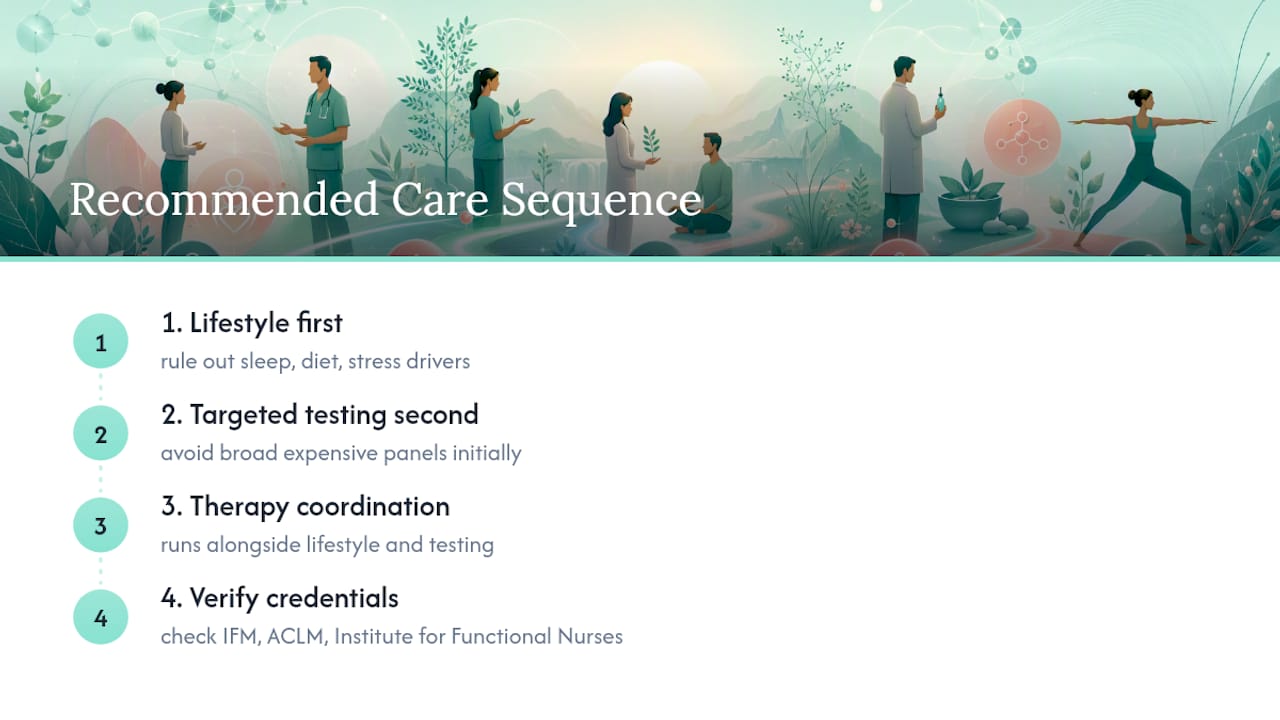
What the research actually supports is sequencing: lifestyle medicine first, targeted testing second, and therapy coordination running alongside both. Skipping straight to extensive panels before ruling out sleep, diet, and stress as drivers wastes money more often than it should.
If you take one thing from this, verify training before you verify test results. A provider’s credentials, whether through IFM, ACLM, or a program like the Institute for Functional Nurses, tell you more about the quality of care you’re about to receive than any glossy website ever will.
— Lauren
This article is general information, not a substitute for advice from a qualified doctor. Consult a qualified healthcare professional about your own circumstances before acting on anything here.