
Functional vs Holistic Medicine: A Clear 2026 Guide
Functional vs Holistic Medicine: A Clear 2026 Guide
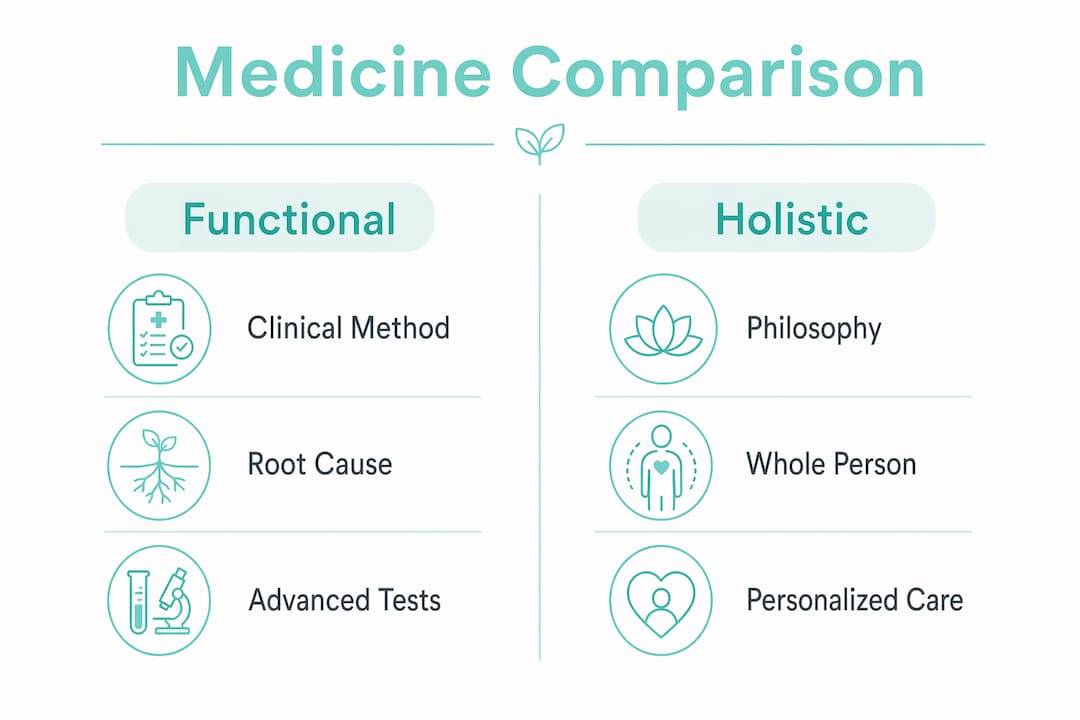
Functional medicine is defined as a clinical framework that identifies and treats the root causes of disease using personalized, data-driven, systems-biology methods. Holistic medicine, by contrast, is a philosophy that treats the whole person, including mind, body, and spirit, rather than a structured clinical methodology. Understanding what is functional vs holistic medicine matters because the two terms are widely confused, yet they operate on fundamentally different levels. One is a clinical system. The other is an attitude. Both have real value, and knowing the difference helps patients and clinicians make better decisions about care.
What are the core principles of functional medicine?
Functional medicine asks a different question than conventional care. Instead of “what drug treats this disease?”, it asks “why does this person have this disease?” That shift drives every part of how functional medicine works in practice.
The clinical process starts with time. Functional medicine consultations run 60–90 minutes, compared to the 11–15 minutes typical in conventional primary care. That extended time supports a thorough health history and a personalized patient timeline, which maps symptoms, exposures, and life events across years, not just the current complaint. Clinicians trained through the Institute for Functional Medicine (IFM) use this timeline as a core diagnostic tool.
Testing in functional medicine is targeted, not reflexive. Advanced diagnostics like microbiome sequencing or organic acids testing are ordered only when results will directly inform clinical decisions. That discipline keeps care focused and avoids the trap of running panels for their own sake.
The core clinical focus areas include:
- Nutrition and diet: Food as a primary driver of inflammation, gut health, and metabolic function
- Genetics and epigenetics: How gene expression responds to environment and lifestyle
- Microbiome health: The relationship between gut bacteria and systemic disease
- Environmental exposures: Toxins, mold, and chemical burdens that conventional labs often miss
- Lifestyle factors: Sleep, stress, movement, and social connection as measurable health inputs
Treatment plans are adjusted at 4–12 week intervals, integrating new test results only when they change the clinical picture. Patients should expect a long-term commitment to lifestyle change, not a quick pharmaceutical fix.
Pro Tip: When evaluating a functional medicine practitioner, ask specifically about IFM certification. The term “functional medicine” is not legally protected, so training quality varies widely across providers.
How does holistic medicine differ as a philosophy?
Holistic medicine is a philosophy, not a clinical methodology. Any clinician, whether a family physician, a nurse practitioner, or an acupuncturist, can adopt a holistic attitude regardless of specialty or technique. That flexibility is both its strength and its limitation.
The holistic approach views health as extending well beyond lab ranges. Psychological, social, and spiritual factors carry equal weight alongside physical symptoms. A holistic clinician treating chronic fatigue, for example, will explore grief, relationship stress, and spiritual disconnection alongside cortisol levels. That breadth of focus is genuinely valuable and often missing from conventional care.
Key characteristics of the holistic medicine approach include:
- Whole-person orientation: Mind, body, and spirit are treated as inseparable
- Strong patient-clinician relationship: The therapeutic relationship itself is considered part of treatment
- Flexible framework: No single diagnostic protocol or required testing standard
- Broad applicability: Works across conventional medicine, naturopathy, integrative nursing, and complementary approaches
- Prevention focus: Lifestyle and emotional wellness are prioritized before disease develops
The absence of a standardized clinical framework means holistic medicine can look very different from one practitioner to the next. Two clinicians who both call themselves holistic may use entirely different tools, tests, and treatment philosophies. That variability is worth understanding before a patient chooses a provider.
Functional vs holistic medicine: key differences and overlaps

Functional medicine provides a structured, measurable clinical framework. Holistic medicine is an attitudinal approach any practitioner can adopt. That single distinction explains most of the differences between the two models.
| Feature | Functional medicine | Holistic medicine |
|---|---|---|
| Core nature | Clinical methodology | Philosophy and worldview |
| Diagnostic tools | Advanced, targeted lab testing | Varies widely; often minimal testing |
| Framework | Systems biology, root cause analysis | Whole-person orientation |
| Credentialing standard | IFM certification | No universal standard |
| Patient engagement | Active partnership with data-driven plans | Relationship-centered, flexible |
| Best suited for | Chronic, complex, multi-system conditions | Broad wellness and prevention contexts |
The overlap between the two models is real and significant. Both reject the idea that treating a symptom equals treating a patient. Both prioritize prevention, lifestyle factors, and individualized care. Both push back against the 15-minute appointment model that dominates conventional medicine. A functional medicine practitioner almost always holds a holistic attitude. A holistic practitioner, however, does not necessarily use functional medicine’s clinical tools.
Practical examples make this clearer. A patient with autoimmune thyroid disease sees a functional medicine clinician who orders microbiome sequencing, maps a 10-year health timeline, and adjusts a nutrition protocol at 8-week intervals. That same patient sees a holistic practitioner who explores stress, spiritual wellbeing, and emotional history without ordering advanced labs. Both approaches add value. Neither is wrong. They simply operate at different levels of clinical specificity.
Pro Tip: The most effective care often blends both. A clinician who holds a holistic philosophy AND uses functional medicine’s diagnostic tools can address root causes while keeping the whole person in view. Look for practitioners who do both, not just one.
When should you choose functional vs holistic medicine?
The right choice depends on the clinical picture, the patient’s goals, and the level of diagnostic depth required. Neither model fits every situation equally well.
Functional medicine is the stronger choice in these scenarios:
- Chronic, complex conditions: Autoimmune disease, metabolic syndrome, irritable bowel syndrome, and chronic fatigue respond well to root cause investigation. A 2019 JAMA Network Open study found that functional medicine patients reported improved quality of life compared to those receiving conventional care, particularly in complex cases.
- Multi-system presentations: When symptoms span multiple organ systems and conventional workups return normal results, functional medicine’s systems-biology lens often finds patterns that standard care misses.
- Patients ready for lifestyle commitment: Functional medicine requires long-term commitment to lifestyle change. Patients who want a prescription and nothing more are not good candidates.
- Clinicians seeking a structured framework: Medical professionals who want a reproducible, evidence-based clinical system benefit from IFM-certified training and the functional medicine patient timeline approach.
- Cases where conventional care has plateaued: Functional medicine complements conventional medicine rather than replacing it, making it ideal when standard treatment has reached its limits.
Holistic medicine fits well when the goal is broad wellness, prevention, or emotional and spiritual support alongside physical care. It works across many clinical settings and does not require the same time or financial investment as a full functional medicine workup. Patients who want a clinician who sees them as a whole person, without necessarily needing advanced diagnostics, often thrive in a holistic care environment.
Integrative clinics increasingly combine both models with conventional medicine. That three-way blend, conventional diagnostics plus functional root cause analysis plus holistic philosophy, represents the direction that forward-thinking healthcare is heading. The benefits of lifestyle medicine are well documented, and both functional and holistic approaches draw heavily on those principles.
Key Takeaways
Functional medicine is a structured, data-driven clinical system focused on root causes, while holistic medicine is a philosophy any clinician can adopt to treat the whole person across mind, body, and spirit.
| Point | Details |
|---|---|
| Functional medicine is a clinical system | It uses systems biology, advanced testing, and 60–90 minute consultations to find root causes. |
| Holistic medicine is a philosophy | Any clinician can adopt it regardless of specialty; it has no universal diagnostic standard. |
| Both prioritize whole-person care | Prevention, lifestyle, and individualized treatment are central to both models. |
| IFM certification matters | The term “functional medicine” is unprotected, so credentials signal real training quality. |
| Blending both approaches works best | Clinicians who combine functional methods with a holistic mindset deliver the most complete care. |
Why I think the either/or framing misses the point entirely
Most articles on this topic treat functional and holistic medicine as competing options. I disagree with that framing. After years of working with clinicians who practice both, I have seen that the real question is not which model to choose. It is how to use each one at the right moment.
Functional medicine gives you a rigorous, repeatable clinical framework. When a patient comes in with five years of unexplained fatigue, a detailed health timeline and targeted lab work will find things that a philosophical conversation about mind-body balance simply cannot. That specificity matters. It is what separates a good outcome from a frustrating one.
But functional medicine without a holistic attitude can become cold and mechanical. I have watched clinicians run excellent labs and build perfect protocols, then lose the patient entirely because the relationship felt transactional. Patients do not follow plans they do not believe in. The holistic philosophy, the genuine interest in who this person is beyond their biomarkers, is what keeps patients engaged long enough for the functional work to pay off.
The clinicians I respect most hold both simultaneously. They ask “why does this person have this disease?” AND “who is this person as a whole human being?” Those two questions are not in competition. They are the same question asked at different levels of resolution.
— Lauren
Functionalacademy: training built for clinicians who want both
Medical professionals who want to practice functional medicine with real clinical depth need more than a weekend workshop. The Institute for Functional Nurses at Functionalacademy offers a fully accredited, board certification program built specifically for registered nurses and healthcare practitioners.
The curriculum covers root cause investigation, advanced diagnostic interpretation, nutrition, lifestyle medicine, and patient timeline mapping, all designed for direct clinical application. You do not need to leave your current practice to complete it. Functionalacademy’s program is built for working clinicians who want to add functional medicine skills without starting over. If you are ready to deliver the kind of care that actually changes patient outcomes, this is the credential that gets you there.
FAQ
What is the main difference between functional and holistic medicine?
Functional medicine is a structured clinical methodology that uses advanced diagnostics and systems biology to find root causes of disease. Holistic medicine is a philosophy that any clinician can adopt, emphasizing whole-person care across mind, body, and spirit without a required diagnostic framework.
Can a practitioner use both functional and holistic medicine?
Yes. Many clinicians combine functional medicine’s data-driven clinical tools with a holistic philosophy that addresses psychological, social, and spiritual health. This combination often produces the most complete patient outcomes.
Is functional medicine evidence-based?
Functional medicine is patient-centered and evidence-based, using targeted lab testing and personalized treatment plans. A 2019 JAMA Network Open study found that functional medicine patients reported improved quality of life compared to those in conventional care settings.
How do I know if a functional medicine practitioner is qualified?
Look for IFM certification from the Institute for Functional Medicine. The term “functional medicine” is not legally protected, so credentials are the clearest signal of standardized, rigorous training.
Is holistic medicine the same as alternative medicine?
No. Holistic medicine is a philosophy about treating the whole person and can be practiced within conventional, integrative, or alternative frameworks. Alternative medicine refers to treatments used instead of conventional care, which is a separate and distinct category.