
6–9 Month Functional Medicine Study Plan for Clinicians with Mentors
6–9 Month Functional Medicine Study Plan for Clinicians with Mentors
The most effective functional medicine study plan pairs a sequenced curriculum with mentored clinical practice, not solo reading. Most working clinicians should target the standard several-month track: modules first, personal lab work second, supervised case practice third. Your next step is simple. Pick a structured program with built in mentorship, or adopt the week-by-week template below and start this Monday.
TL;DR:
- A structured, mentorship-based study plan with a clear sequence significantly improves competency over solo reading, especially when tailored to weekly availability.
- The standard six- to nine-month track is most practical for full-time clinicians, combining core modules, specialty topics, case practicum, and exam preparation.
- Curriculum mastery requires grounding in systems biology, functional lab analysis, clinical formulation, and practice management, with verification of actual patient outcome improvements.
- Certification options differ: nurses and NPs usually pursue certificates or fellowships, while physicians may opt for more intensive fellowship programs, depending on patient complexity and scope.
- Incorporating supervised case work, mentor reviews, and portfolio building during training enhances exam success and real-world clinical application.
Table of Contents
- Functional Medicine Study Plan Templates You Can Copy Today
- What Should Be On Your Functional Medicine Curriculum Checklist?
- Which Certification Pathway Fits Your License?
- Why Mentorship And Case Practice Beat Solo Reading
- How Much Time Should You Actually Budget Each Week?
- How To Prepare For The Certification Exam
- What Actually Separates A Good Program From A Good Sales Page
- Ready To Start Your Functional Medicine Certification Program?
- Where To Verify Credential And Evidence Standards
- Sources
- FAQ
Functional Medicine Study Plan Templates You Can Copy Today
Every clinician’s timeline depends on hours available per week and how fast you need board eligibility. Below are three drop-in templates. Pick one, adjust the math to your schedule, and put it on your calendar today.
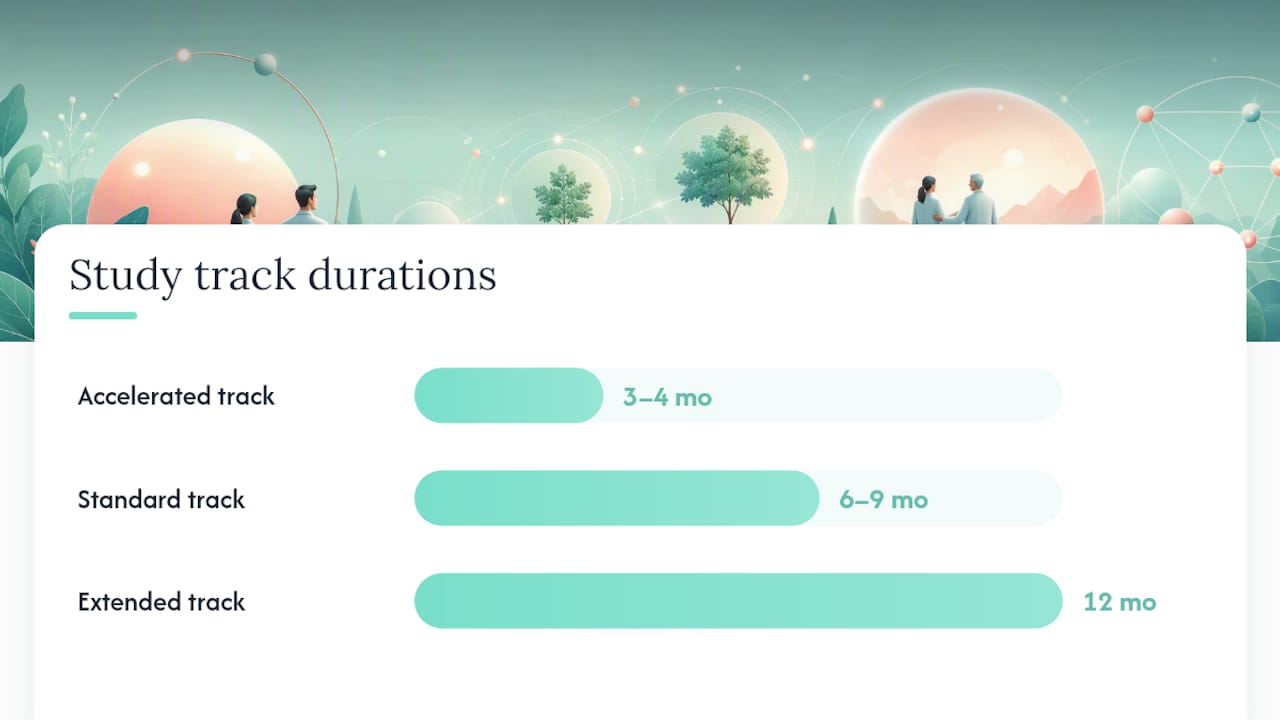
1. Accelerated track (3 to 4 months, a significant number of hours per week) This suits nurse practitioners between clinical rotations or clinicians on a planned leave.
- initial weeks: Systems biology and functional lab foundations, plus your first personal lab panel.
- following weeks: Gut, hormone, and immune modules with mentor case reviews every other week.
- later weeks: Case formulation practicum, treatment plan drafting, mock exam questions daily.
- final weeks: Portfolio finalization, oral exam simulation, certification application.
2. Standard track (6 to 9 months, 8 to 10 hours per week) This is the realistic default for a full-time clinician holding down a regular caseload.
- Months 1 to 2: Core systems curriculum plus lab interpretation basics.
- Months 3 to 4: Specialty modules (environmental health, hormone balance, nutrition science) with monthly grand rounds.
- Months 5 to 6: Case-based practicum, multiple supervised lab interpretations, mentor sign-off on a small number of full case workups.
- Months 7 to 9: Exam prep, practice question banks, portfolio assembly, and scheduling your certification exam.
3. Extended track (12 months, 4 to 6 hours per week) Built for clinicians managing heavy shift work or family obligations who need flexibility over speed.
- Quarter 1: Foundations and one personal lab panel with self-review.
- Quarter 2: Systems and lab modules, one mentor session monthly.
- Quarter 3: Case practicum, slower pace, two mentor reviewed cases.
- Quarter 4: Exam prep, portfolio, and application submission.
Every template splits time three ways: reading and modules, personal lab and case work, and mentor or peer contact. A single clinical shift is often enough to complete one micro-task, like reviewing a comprehensive stool panel or drafting a one-page treatment rationale for a mentor’s feedback.
Pro Tip: Block your mentor sessions on the calendar before you schedule anything else that month. Study time gets sacrificed first when a clinic day runs long; mentor slots rarely get rebooked once missed.
What Should Be On Your Functional Medicine Curriculum Checklist?
A functional medicine curriculum built for clinical competence, not just credential collection, covers five domains. Treat this as a gate: don’t advance to case practicum until each box has real evidence behind it, not just a completed video.
- Systems biology: metabolic and mitochondrial function, endocrine and hormone signaling, gastrointestinal and microbiome health, immune and inflammatory pathways, neuroendocrine and stress physiology, environmental and toxicant exposure.
- Functional lab categories: comprehensive stool analysis, organic acids testing, food sensitivity and elimination protocols, hormone panels (adrenal, thyroid, sex hormone), micronutrient and oxidative stress markers. Understanding how to read and act on micronutrient deficiencies in a real patient chart matters more than memorizing reference ranges.
- Clinical competencies: case formulation using a root-cause framework like the functional medicine matrix, individualized treatment planning, and structured monitoring intervals for reassessment.
- Practice management basics: scope of practice boundaries for your license type, documentation standards for functional protocols, and informed consent language for non-conventional interventions.
Curriculum sequencing that mirrors real certificate programs (foundation modules, then lab mastery, then protocol development, then supervised application) tends to produce clinicians who can actually interpret labs under supervision rather than just recognize terminology on a multiple choice exam. If you’re weighing how this training changes actual patient care, it helps to look at documented outcome improvements from functional medicine approaches before committing your hours.
Which Certification Pathway Fits Your License?
Three main routes exist, and they are not interchangeable. Certificate programs (self-paced, module-based, typically $2,000 to $6,000, three to twelve months) suit registered nurses and health coaches who want a defined credential without a residency commitment. Fellowship-style training, like academic programs that blend asynchronous coursework with residential retreats and grand rounds, suits physicians and nurse practitioners wanting deeper mentorship. Board prep tracks fit clinicians who already hold foundational functional medicine knowledge and need focused exam readiness.
- Registered nurses and NPs: certificate or fellowship track, prerequisite is an active nursing license, typical outcome is a board certification credential (such as BC-FMP or FIM-P style designations).
- Health coaches: certificate programs with defined scope of practice guidance, since coaches cannot diagnose or prescribe regardless of certification.
- Physicians: fellowship-style programs like the UCI Integrative and Functional Medicine Fellowship, which combines hybrid learning with residential experiential components.
Decide based on three things: your patient population’s complexity, your current scope of practice, and whether you want a business-building credential or a purely clinical one. A board certification credential also tends to shift earning potential for nurses specifically, which matters if you’re weighing the cost against career trajectory.
Why Mentorship And Case Practice Beat Solo Reading
A 2024 review of clinical training programs found that combining theory with experiential learning, mentorship, and supervised practice produces measurably better translation of knowledge into clinical skill than self-directed study alone. Reading a module on hormone pathways teaches concepts. Presenting a real case to a mentor and defending your treatment rationale teaches judgment.
Structure mentorship into your plan with three formats:
- Monthly small-group grand rounds, where multiple clinicians present cases and receive peer and mentor feedback.
- One-on-one mentor reviews of your own case write-ups, ideally biweekly during your practicum phase.
- Personal lab analysis, running your own comprehensive panels and interpreting them before a mentor checks your work, which builds both technical skill and patient-side empathy.
Simulated patient encounters and role-reversal exercises, where you play the patient receiving a functional medicine consult, reveal blind spots that reading never will. A tool like MedScrub’s clinical case-prep platform can help you build and reinforce case studies between mentor sessions, since repetition on realistic patient scenarios is what makes case formulation automatic rather than effortful.
Pro Tip: Require yourself to complete multiple supervised lab interpretations before you sit any certification exam. Clinicians who skip this step tend to pass the written exam and then freeze on their first real patient case.
How Much Time Should You Actually Budget Each Week?
Match your weekly hours to your clinical load, not to an idealized version of your schedule.
- Full-time clinicians (30+ patient hours weekly): budget several study hours weekly and expect the typical several-month track.
- Part-time or reduced-schedule clinicians: budget more study hours weekly and a faster completion timeline becomes realistic.
- Clinicians on leave or between roles: a high number of hours weekly supports the fastest completion, but don’t skip mentor sign-off just to hit a deadline.
- Accelerate when: you finish practice questions above 85% accuracy on the first attempt for a topic area.
- Extend when: clinical demands spike for more than two consecutive weeks. Push the timeline rather than cutting mentor sessions.
Milestone checks belong at the end of each module, not just before the final exam. A mentor sign-off on a small number of full case workups before you enter exam prep catches gaps early, when they’re cheap to fix.
How To Prepare For The Certification Exam
Exam prep works best when it’s built around a portfolio, not a cram session. Prioritize practice question banks by topic weight. Systems biology and lab interpretation typically carry more exam weight than practice management content, so spend proportionally more repetition there.
- Build a verification portfolio as you go: case logs with de-identified patient details, lab reviews with your interpretation notes, and completed treatment plans with outcome tracking.
- Run mock oral exams with a study partner or mentor if your program doesn’t offer a live oral component. Remote learners can simulate this over video call using real case scenarios.
- Flag common pitfalls early: rushing lab interpretation questions, underpreparing on practice management and scope-of-practice content, and skipping mock orals because they feel less urgent than written review.
- If you fail a section, remediate by re-running the specific case type that tripped you up with a mentor, not by rereading the whole module.
Clinicians who assemble their portfolio during the practicum phase, rather than scrambling afterward, consistently report smoother exam windows because the documentation habit is already built.
What Actually Separates A Good Program From A Good Sales Page
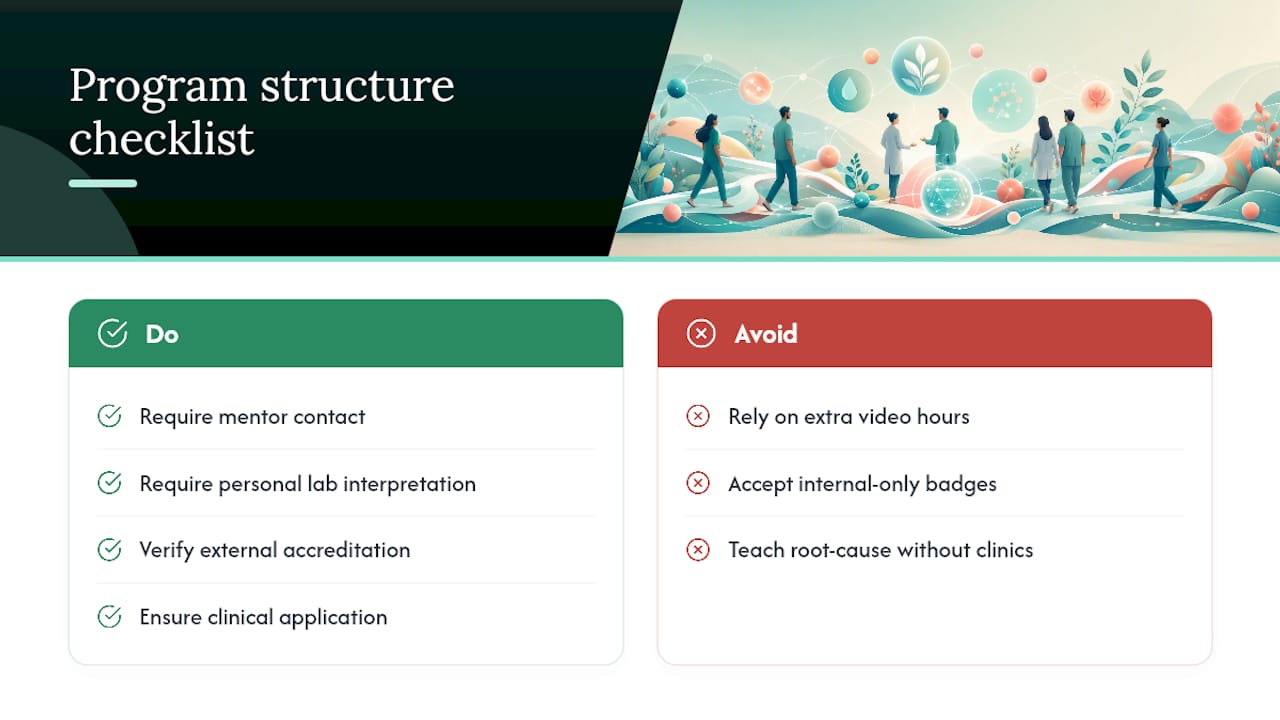
Plenty of functional medicine programs promise transformation. Fewer actually build in the structural pieces that convert coursework into a skill you can use on Monday morning with a real patient in front of you. The research on clinical education is consistent here: mentorship, case-based learning, and supervised practice are what move knowledge from a textbook into your hands, not additional video hours.
When evaluating any program, including your own study plan, ask whether it has mandatory mentor contact, whether it requires personal lab interpretation before certification, and whether accreditation is verifiable through a recognized body rather than an internal badge. Root-cause focus matters, but only if the program pairs it with clinical application you can point to in a job interview or a specialty-focused expansion, like integrative oncology support. Growing patient demand for integrative approaches makes this training valuable. Whether it makes you competent depends entirely on the structure behind it.
— Lauren
Ready To Start Your Functional Medicine Certification Program?
An effective functional medicine certification program is built around sequenced modules, mentor contact, and clinical application, rather than a static video library you work through alone.
Self-paced modules that align with systems biology, lab mastery, and case formulation checklists, with CEU credit built into the curriculum, can help hours count toward ongoing licensure requirements, not just a certificate. Mentorship and grand rounds woven into the pacing rather than offered as a bolt-on extra provide accountability at each milestone for standard several-month training tracks. Clinicians comparing formats against other functional nursing programs often find the structural differences come down to exactly this: how much supervised practice is actually built into the timeline. If you’re ready to see how the curriculum sequencing lines up with your license type and schedule, visit the Institute for Functional Nurses program page and request the full program details.
Where To Verify Credential And Evidence Standards
- Check continuing education legitimacy through the Accreditation Council for Continuing Medical Education, which sets the framework most CEU-approved programs reference.
- Review credentialing standards from bodies like NCCAOM and the National Board for Health & Wellness Coaching to understand how national certification frameworks operate outside functional medicine specifically.
- For program structure examples, the UCI SSIHI fellowship curriculum outlines a hybrid model worth benchmarking against any program you’re considering.
This article is general information, not a substitute for advice from a qualified doctor. Consult a qualified healthcare professional about your own circumstances before acting on anything here.
Sources
- PMC article: evidence on clinical education and experiential learning
- NIH news release on rising use of complementary health approaches
- ACCME — Accreditation Council for Continuing Medical Education
- NCCAOM — certification standards for complementary health practitioners
FAQ
What Are The 5 R’s Of Functional Medicine?
The 5 R’s framework (Remove, Replace, Reinoculate, Repair, Rebalance) guides treatment sequencing for gut and systemic imbalances, and it typically appears early in a functional medicine curriculum’s gastrointestinal module.
How Do I Study Functional Medicine As A Working Clinician?
Pair a sequenced curriculum covering systems biology and lab interpretation with mentored case practice, following a structured timeline like the standard a standard several-month track rather than studying materials in isolation.
What Is The Controversy With Functional Medicine?
Critics point to inconsistent regulation and variable evidence quality across functional lab testing and protocols, which is why choosing a program with verifiable accreditation and a mentorship-based clinical practicum matters more than picking the cheapest certificate option.
What Are The Four Pillars Of Functional Medicine?
Most frameworks describe the four pillars as root-cause investigation, personalized treatment planning, systems-based thinking across body systems, and patient-centered partnership in care decisions.
How Long Does It Take To Get Functional Medicine Certified?
Timelines range from three to four months on an accelerated track to twelve months on an extended schedule, with most working clinicians completing certification in six to nine months.