
Provider Number First: Functional Medicine Preceptorships for Nurses
Provider Number First: Functional Medicine Preceptorships for Nurses
Accredited online functional medicine preceptorships absolutely can deliver the CEUs, supervised case-mentorship, and board-certification prep clinicians need, but only when the program publishes a real provider number and documents mentorship hours in writing. One program is built around exactly that structure. Your next move: request the syllabus and ask for a sample CEU certificate before you enroll anywhere.
TL;DR:
- Accredited programs must provide a valid provider number and document mentorship hours in writing to qualify for CEUs and board certification preparation.
- Supervised mentorship involves documented case logs, live case rounds, and one-on-one supervision, with careful record-keeping essential for credentialing.
- Verify CEU hours, provider number status, and mentorship structure before enrollment, and request sample certificates and detailed contact hour breakdowns.
- Most programs combine self-paced modules with periodic live mentorship, making them suitable for full-time clinicians balancing clinical work and study.
- Successful graduates build portfolios of documented case reviews and mentorship logs, which support credentialing, job applications, or practice development.
Table of Contents
- What Counts as a Functional Medicine Preceptorship?
- Who Actually Benefits From This Kind of Training?
- How Do You Verify Accreditation and CEU Hours?
- What Does Supervised Case-Mentorship Actually Look Like?
- How Should You Choose a Program?
- How Long Does It Take and What Does It Cost?
- What Do Graduates Actually Say About These Programs?
- A Practitioner’s Take on Making This Work
- Get Board-Certified Without Leaving Your Current Job
- Where to Verify Program Claims
- Sources
- FAQ
What Counts as a Functional Medicine Preceptorship?
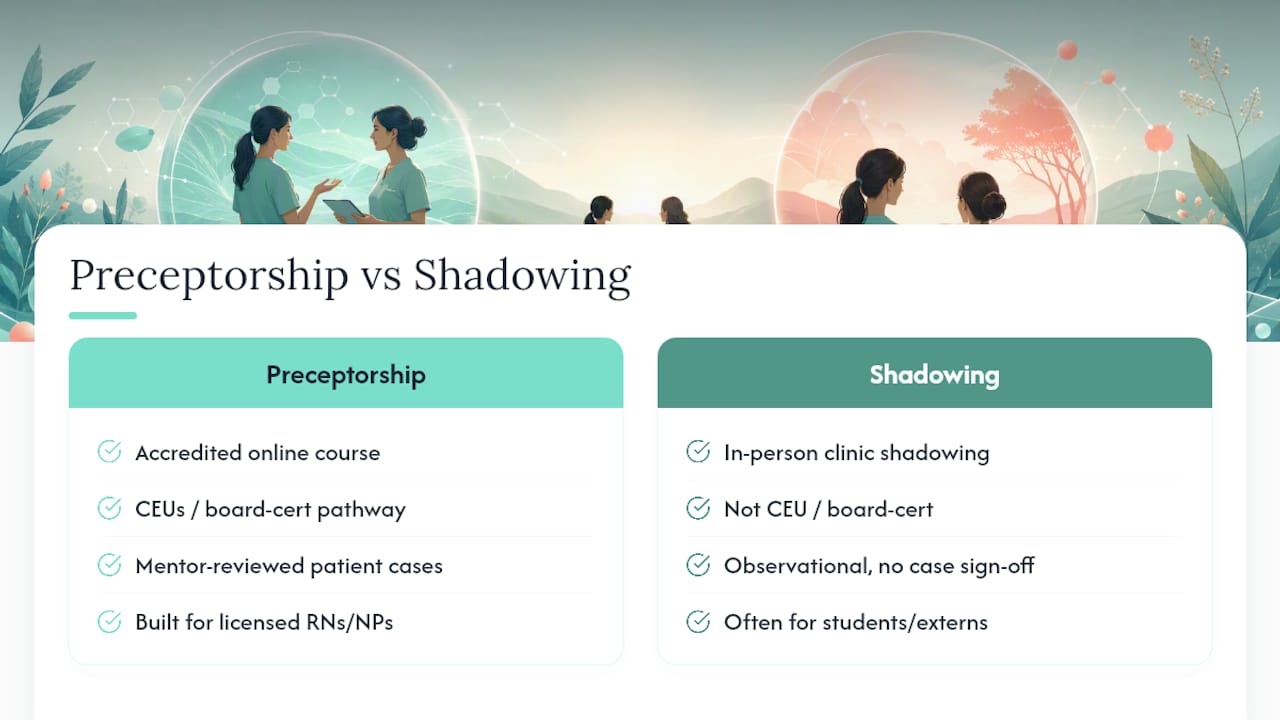
A functional medicine preceptorship, in the way that matters for your license and your career, is an accredited online board-certification course paired with supervised clinical case-mentorship. It is not a shadowing rotation where you follow a physician through an exam room. That version of “preceptorship” belongs to a different conversation entirely.
For nurses and clinicians building functional medicine into an existing license, the model looks like this: self-paced or cohort coursework, documented CEU or contact hours, and a mentor who reviews your actual patient case work and signs off on it. That combination is what qualifies as legitimate clinical mentorship in functional medicine.
This distinction matters because search results blur the two constantly. If a program description mentions “hands-on rotations” or “shadowing a preceptor in clinic,” you’re looking at a different animal. The programs covered here are built for working RNs, NPs, and licensed practitioners who need CEUs, board-cert pathways, and mentor-reviewed case experience without leaving their current job.
Who Actually Benefits From This Kind of Training?
Registered nurses and NPs gain systems-level thinking, lab interpretation skills, and the ability to manage chronic, multifactor cases that conventional visits rarely have time to address. That skill set translates directly into how you talk to patients and how employers see you.
Functional medicine credentials work as an add-on to your license, not a replacement for it. Professional bodies like AANP and ANCC do not currently recognize functional medicine as a separate nursing specialty, so this training operates as advanced continuing education that deepens what you already do. That framing matters when you’re deciding how to market yourself, since board certification tends to increase earning potential precisely because it signals a distinct, documented skill set.
Three groups get the most out of this route: busy clinicians who need flexible, self-paced structure; nurse entrepreneurs building a wellness practice who need credibility with patients they want to keep; and primary care clinicians who want deeper case management tools than a weekend seminar provides.
How Do You Verify Accreditation and CEU Hours?
Ask for the provider number before you ask about price. A legitimate CEU provider, whether ANCC-approved or accredited through another recognized body, will hand over that number without hesitation. If a program is vague about who approved its contact hours, that’s your answer.
Contact hours should be reported the same way every reputable continuing education program reports them: a specific number, tied to specific modules, with a certificate issued on completion. One nursing-focused functional medicine course, for example, lists 101 contact hours across 12 modules with monthly live web meetups, giving you a benchmark for what a serious program discloses upfront.
Board-certification pathways add another layer. Some preceptorships map directly toward recognized credentials; others function as standalone CEU training. Clinicians should verify whether hours count toward license renewal or a specific certification track before assuming they will.
Run through this before you pay tuition:
- Request the exact provider number and confirm it independently.
- Ask for a sample CEU certificate from a recent graduate.
- Get the total contact hours in writing, broken out by module.
- Confirm whether hours apply to board-cert prep or general CE credit.
Pro Tip: Call your state board directly and ask whether the provider number is currently active. Programs rarely lie outright, but expired or lapsed approvals happen more often than you’d think.
What Does Supervised Case-Mentorship Actually Look Like?
Curriculum in strong functional medicine programs tends to follow a recognizable arc: the Functional Medicine Matrix as an organizing framework, systems biology, metabolic and hormonal health, lab interpretation, and case formulation. Mentorship is where the coursework becomes clinical skill.
Credible programs document mentorship through a mix of activities:
- Live case rounds where a mentor walks a cohort through real patient scenarios.
- Mentor-reviewed case logs, where you submit a write-up and get direct feedback.
- One-on-one supervision sessions for harder or ambiguous cases.
- Lab interpretation workshops tied to actual patient data.
- Documented implementation plans that show how you applied a recommendation.
Mentor-reviewed case logs and live case rounds form the backbone of what most programs count as supervised clinical hours. What gets logged is usually the case write-up itself, mentor comments, and a dated sign-off, not just attendance at a webinar.
Pro Tip: Save every mentor-reviewed case log yourself, even if the program keeps its own records. You’ll want that portfolio when you apply for a new role or renew a board certification down the line.
How Should You Choose a Program?
Run every candidate program through the same short list. Accreditation status, total CEU hours, mentorship format, faculty credentials, a sample syllabus, and the refund policy cover the essentials.
Ask admissions these questions directly, and don’t accept a vague answer:
- What is the mentor-to-learner ratio in case review sessions?
- Can I see a sample case log from a recent graduate?
- What is the exact CEU provider number, and is it currently active?
- How are supervised hours documented and delivered to me on completion?
Programs that dodge specifics on mentorship structure or CEU reporting are worth walking away from. A nursing-specific course structured around reflective practice and scope-aware case scenarios shows you what transparent curriculum design looks like in practice: modules, meetup cadence, and hours are all stated plainly, not buried in marketing copy.
Vague mentorship claims, missing provider numbers, and unclear CEU reporting are the three red flags that should stop you before you enroll.
How Long Does It Take and What Does It Cost?
Self-paced programs typically let you move through coursework on your own schedule, while cohort-based models set fixed timelines with group case rounds. Expect to budget several hours a week if you’re working full time, more if the program includes live sessions you can’t reschedule.
Cost bands vary widely depending on what’s included. IFM-aligned board certification sits at the top end as the recognized gold standard, while shorter certificate programs offer a faster, lower-cost on-ramp that many working RNs and NPs use before deciding whether to pursue a longer pathway.
What drives cost up:
- One-on-one mentorship time versus group case rounds.
- Total CEU or contact hours included in tuition.
- Direct faculty access versus recorded content only.
- Bundled extras like toolkits or business coaching add-ons.
Ask any program about payment plans or partial scholarships before you assume the sticker price is fixed. Shorter certificate programs frequently give working clinicians a practical, lower-cost starting point if the full IFM pathway isn’t realistic yet.
What Do Graduates Actually Say About These Programs?
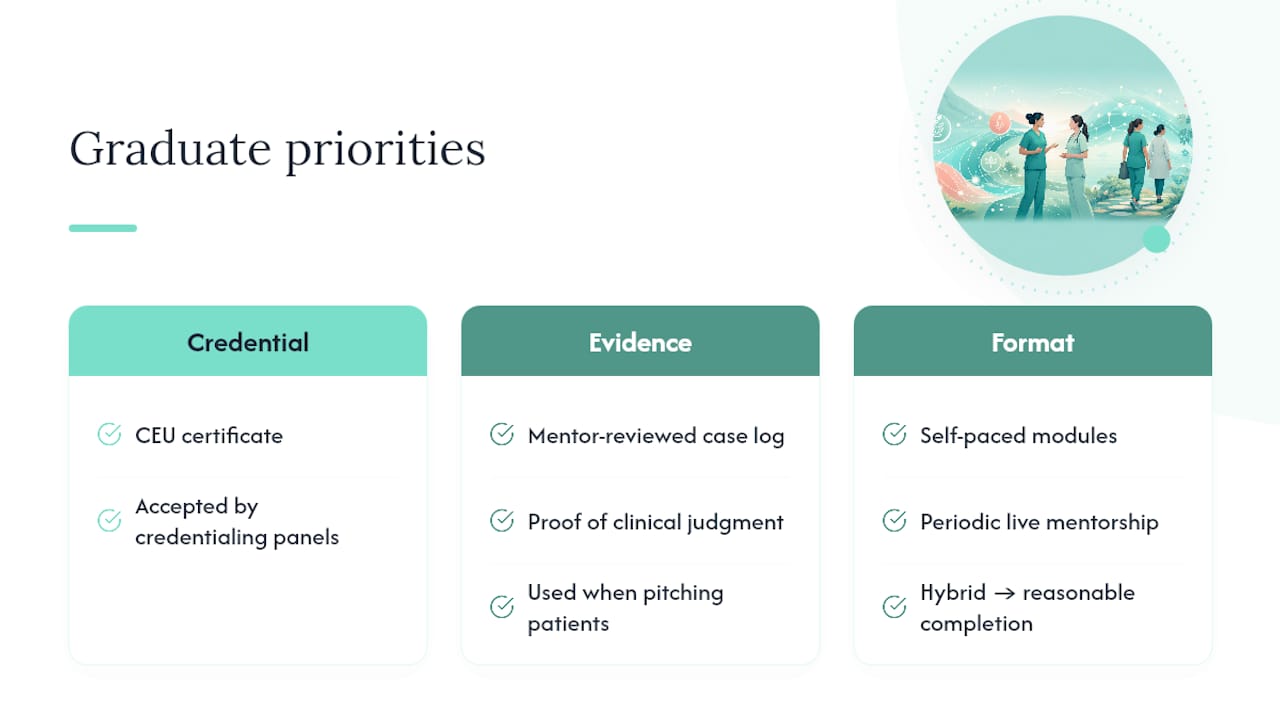
The pattern among clinicians who complete accredited functional medicine preceptorships is consistent: they value programs that hand them both a CEU certificate and a documented case-review trail. That combination gives them something to point to when a hospital credentialing committee or an insurance panel asks how they got there.
Nurses building independent wellness practices report a similar theme. The mentor-reviewed case log becomes proof of clinical judgment, not just proof of attendance. That distinction shows up when they’re pitching themselves to new patients or applying for a role that specifically lists functional medicine training as a preferred qualification.
Working clinicians consistently favor a hybrid structure: self-paced modules for flexibility, combined with periodic live mentorship or cohort case rounds for real supervised interaction. That balance seems to be what keeps completion rates reasonable among people who are also holding down full clinical schedules.
None of this is unique to one program. But it does tell you what to look for: a completion story that includes a documented mentorship trail, not just a certificate of attendance.
A Practitioner’s Take on Making This Work
Balancing a full clinical schedule with coursework comes down to picking a format that matches your actual week, not your ideal one. Self-paced modules with monthly live mentorship tend to survive real life better than a rigid weekly cohort schedule.
One program builds its clinical integration around that mentor-reviewed case model, giving learners a documented record they can carry into credentialing conversations. [Lauren’s credentials and program-specific graduate outcomes: to be added.]
Graduates who stick with mentor-reviewed case logs tend to walk away with more than a certificate. They walk away with a portfolio.
— Lauren
Get Board-Certified Without Leaving Your Current Job
One program pairs accredited board certification with several dozen CEU contact hours, built specifically so nurses and licensed clinicians can integrate functional medicine into practice they already have, without stepping away from their current role for months at a time.
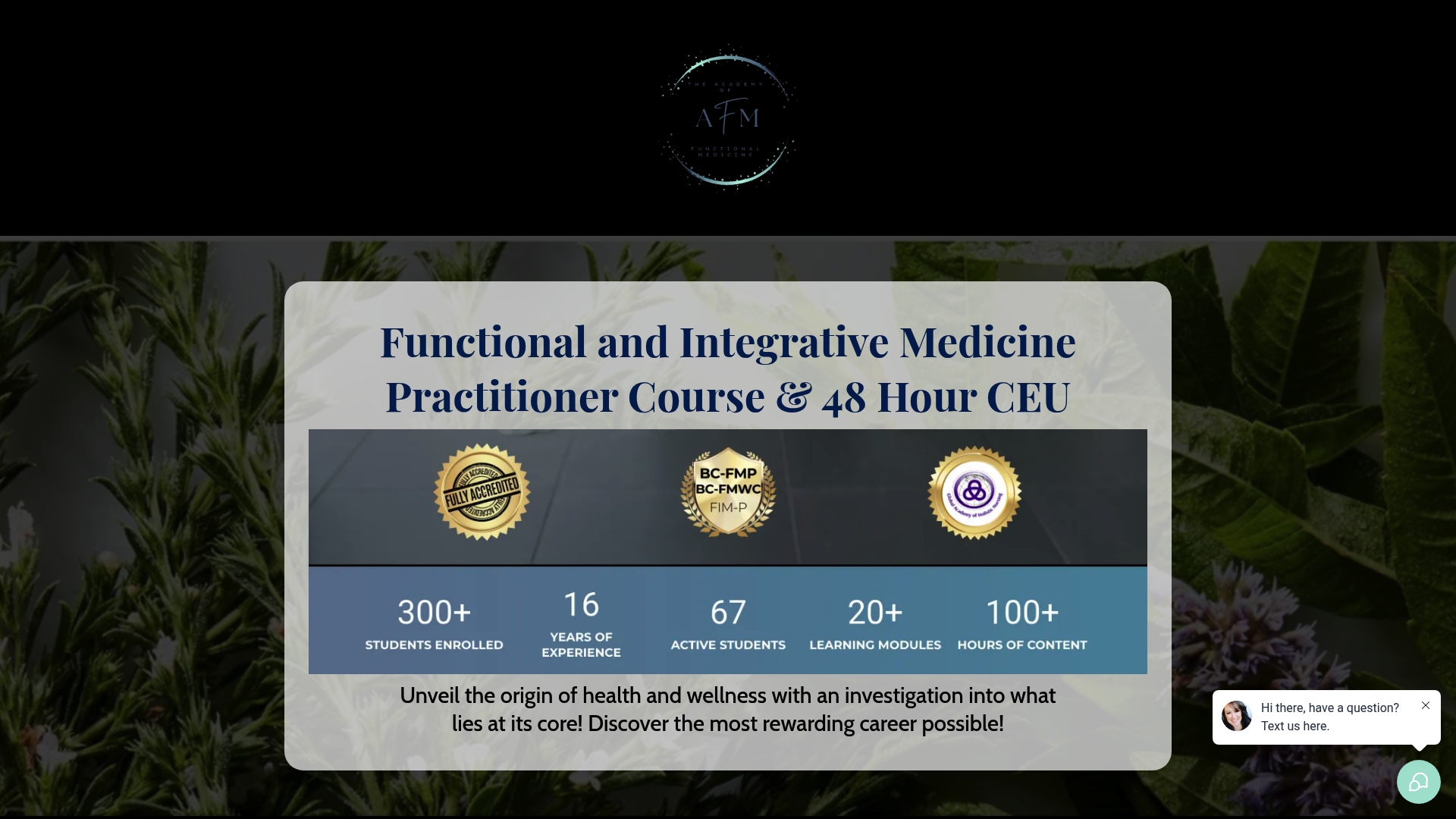
The course blends practical clinical application with flexible, self-directed pacing. A free 4-day functional medicine course is available for nurses and practitioners who want to test the framework before committing. Weekly live business coaching and marketing support designed specifically for functional medicine start-ups is offered as an add-on for nurse entrepreneurs building their own practice.
Request the full syllabus or speak with admissions directly at Functionalacademy to see the CEU breakdown, mentorship structure, and enrollment options, including available payment plans.
Where to Verify Program Claims
Cross-check any program’s claims before you enroll:
- How functional medicine improves patient outcomes for context on clinical credibility.
- Documentation education standards for why accurate case documentation matters to your credibility.
This article is general information, not a substitute for advice from a qualified doctor. Consult a qualified healthcare professional about your own circumstances before acting on anything here.
Sources
FAQ
What Is a Functional Medicine Preceptorship?
It’s an accredited online board-certification course combined with supervised clinical case-mentorship, distinct from in-person clinical rotations. One program structures its coursework with CEU-bearing classes paired with mentor-reviewed case work.
How Many CEU Hours Should I Expect?
Total hours vary by program; one nursing-focused course reports 101 contact hours across 12 modules. One practitioner course includes 48 CEU contact hours, so always confirm the exact total in writing before enrolling.
Does Functional Medicine Training Replace My Nursing License?
No. Functional medicine credentials supplement your existing license as advanced continuing education rather than replacing or creating a separate recognized specialty. You still practice under your current scope, just with deeper clinical tools.
How Much Does a Functional Medicine Preceptorship Cost?
Cost varies by mentorship intensity and included CEU hours, with shorter certificate programs generally priced below full IFM-level pathways. Functionalacademy does not publish a fixed tuition figure online, so current pricing and payment plan options are available directly through Functionalacademy.
Can I Complete a Preceptorship While Working Full Time?
Yes, most accredited programs use self-paced modules with periodic live mentorship sessions built around working clinicians’ schedules. Expect a weekly time commitment of several hours, more during weeks with live case rounds or mentor check-ins.