
Clinician's 5 Minute Checklist to Verify Functional Medicine Pass Rates
Clinician’s 5 Minute Checklist to Verify Functional Medicine Pass Rates
Most functional medicine pass-rate claims are verifiable, but only when you check the certifying body directly rather than a program’s marketing page. The authoritative documents are exam information packets and official candidate resources published by the certifying organization itself. If a program cites a number, your first move is simple: ask for the source PDF or the certifying body’s published cohort data before you enroll.
TL;DR:
- Public pass rates from certifying bodies like NBHWC are reliable when confirmed by official exam information packets and cohort details, unlike vague provider claims.
- Verify pass rates by requesting source documents, cohort size, testing periods, and confirmation from certifying organizations directly to avoid misleading statistics.
- Small cohort sizes and missing timeframes can distort pass rates, making higher or lower percentages unreliable indicators of program quality.
- Eligibility requirements such as clinical experience or coursework greatly influence who sits the exam and can skew pass rate comparisons between programs.
- Transparency and detailed documentation are crucial; programs like the Institute for Functional Nurses provide accreditation and curriculum data upfront for informed enrollment decisions.
Table of Contents
- Which Functional Medicine Certifications Have Public Pass-Rate Data?
- How to Verify a Functional Medicine Certification’s Pass Rate
- What Actually Moves a Pass Rate Up or Down
- Eligibility Requirements That Shape Who Even Takes the Exam
- The Pass-Rate Figures You’ll Actually Encounter
- What a Pass Rate Actually Tells You (and What It Doesn’t)
- How We Report Outcomes and What We’re Willing to Show You
- Where the Institute for Functional Nurses Fits Into Your Decision
- Where to Check First
- Sources
Which Functional Medicine Certifications Have Public Pass-Rate Data?
Not every credential clinicians encounter publishes the same level of detail, and knowing the landscape saves you time. Here’s where things stand across the major players:
- NBHWC maintains the most transparent public infrastructure of the group, with official candidate resources and an exam information packet anyone can download.
- IBFMC (International Board for Functional Medicine Certification) is a newer certifying board, and its reporting practices are still developing. Don’t assume the absence of published figures means poor outcomes; it more likely means the audit trail simply hasn’t matured yet.
- ABOIM and A4M/ABAARM both operate in a space where reporting practices vary widely by organization. Many credentialing bodies in integrative and functional medicine don’t routinely publish audited pass rates the way medical specialty boards affiliated with the ABMS do.
Here’s the reality clinicians need to sit with: the absence of a public pass rate is not automatically a red flag. Some well-established certifying bodies publish eligibility requirements and exam content in detail while keeping pass-rate figures internal. That’s a reporting choice, not necessarily evidence of a weak program. The red flag is a provider quoting a specific number with no certifying-body trail behind it at all.
Cross-referencing aggregator sites can help you scan the field quickly, but sites like Functional Medicine Finder compile figures from mixed sources, some audited, some not. Treat any list like that as a starting point for research, never as the final word.
How to Verify a Functional Medicine Certification’s Pass Rate
You don’t need a research background to run this checklist. You need five minutes and a willingness to ask direct questions before you hand over tuition money.
- Ask for the certifying-body source. Request the exam packet link or the specific page where the pass rate is published, not just a number pasted into an email.
- Get the cohort size and timeframe. A rate quoted without either is close to meaningless. “92% pass rate” means little if you don’t know whether that’s 12 people or 1,200, or whether it covers one testing cycle or five years.
- Request independent confirmation. Where possible, contact the certifying body directly rather than relying solely on what the training provider tells you.
- If the figure is provider-supplied, ask for anonymized score distributions. A legitimate program can usually share aggregate, de-identified performance data. One that gets defensive or vague is telling you something.
- Watch for small cohorts and missing timeframes. Both are classic ways a technically true number gets used to mislead.
Sample language you can send directly to a program administrator: “Can you share the certifying body’s exam information packet or a public source confirming the pass rate you’ve quoted, along with the cohort size and testing period it reflects?”
Pro Tip: Keep in mind that programs can’t hand over individually identifiable candidate records. HIPAA limits what health data can be shared, even in an educational context, so ask for anonymized cohort metrics rather than individual results.
What Actually Moves a Pass Rate Up or Down
A high number sounds reassuring until you understand what’s baked into it. Several factors shape pass rates independent of how good the training actually is.
- Selection bias. A program with strict prerequisites and an application screen will naturally post different numbers than one with open enrollment, because the candidate pool starts out stronger.
- Exam format. Clinically integrated exams that test applied decision-making tend to produce different pass patterns than theory-heavy tests built around recall.
- Clinical experience requirements. Programs that require documented clinical encounters before candidates sit the exam change who’s eligible in the first place, which can raise pass rates while extending the time it takes to get certified.
- Cohort size and reporting window. Small cohorts swing wildly. A program that certifies 15 people a year can post a 100% or 60% pass rate depending on how two or three test-takers performed, and neither number tells you much about program quality on its own.
None of these factors are inherently good or bad. They’re context, and context is exactly what a bare percentage strips away.
Eligibility Requirements That Shape Who Even Takes the Exam
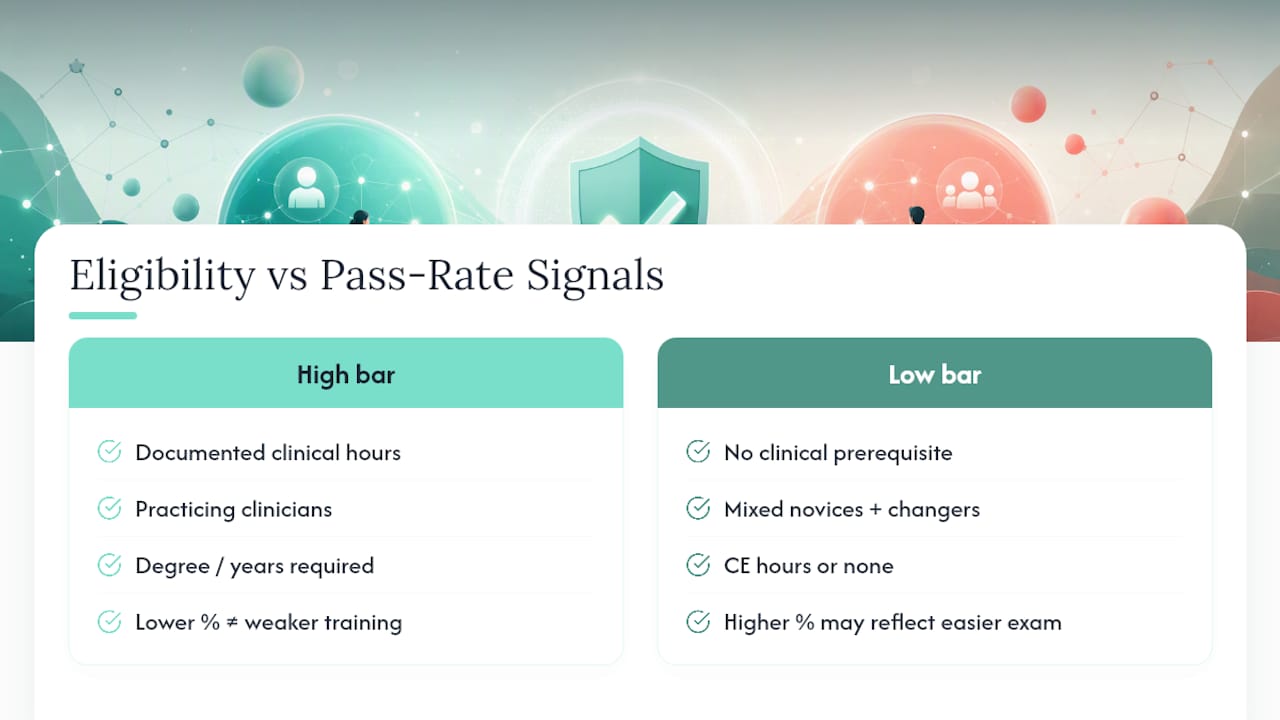
Pass rates don’t exist in a vacuum. They’re downstream of who was allowed to sit the exam in the first place, and eligibility rules vary more than most clinicians expect.
Some credentials require documented clinical encounters before you can even register, which filters out anyone still building hands-on hours. That single requirement changes the entire denominator. A candidate pool made up entirely of practicing clinicians with logged patient encounters will typically perform differently than a pool that includes career-changers with no clinical background yet.
Other programs set prerequisite coursework, minimum degree requirements, or a specific number of continuing education hours before candidates qualify to test. If you’re comparing two credentials and one requires two years of documented practice while the other has no clinical prerequisite at all, don’t be surprised when their pass rates diverge. That gap often says more about who was allowed in the door than about which program taught better.
This matters directly for you: if a program’s eligibility bar is low, a strong pass rate might reflect an easier exam more than rigorous training. If the eligibility bar is high, a lower percentage might still represent excellent training applied to a harder, more experienced candidate pool. Read the eligibility requirements as carefully as the number itself. A resource like integrative nursing practice is worth reviewing if you’re trying to gauge where your own clinical background fits into a given program’s prerequisites.
The Pass-Rate Figures You’ll Actually Encounter
Here’s what clinicians realistically run into when researching functional medicine and integrative credentials. NBHWC stands apart because its documentation is public and structured, giving you an actual packet to reference rather than a marketing claim to take on faith.
IBFMC, being a newer certifying board, doesn’t yet have the same depth of published historical data. That’s not a knock against the credential. Newer boards need testing cycles and time to build a reportable track record, and expecting five years of audited data from an organization that’s only been active for two is unrealistic.
ABOIM and A4M/ABAARM sit in a middle zone. Some years and some cohorts get referenced in third-party write-ups or conference materials. However, audited, standing public pass-rate reports comparable to what medical specialty boards publish are inconsistent across the integrative medicine space generally.
The honest summary: don’t expect a clean, universal percentage you can drop into a comparison table. Expect variation in what’s published, when, and how rigorously. Your job is to weigh a specific credential’s documentation on its own terms, not assume every functional medicine credential reports the same way a state medical board does.
What a Pass Rate Actually Tells You (and What It Doesn’t)
A pass rate is a snapshot, not a verdict on program quality. It tells you what percentage of a specific cohort passed a specific exam during a specific window. It does not tell you whether the curriculum builds real clinical competence, whether graduates go on to build sustainable practices, or whether the training translates into better patient outcomes.
Selection bias is the biggest distortion. A program that screens applicants heavily before admission will post a higher number almost by definition, regardless of teaching quality, because weaker candidates never got the chance to test in the first place.
Cohort size is the second distortion. Percentages from small groups are statistically unstable.
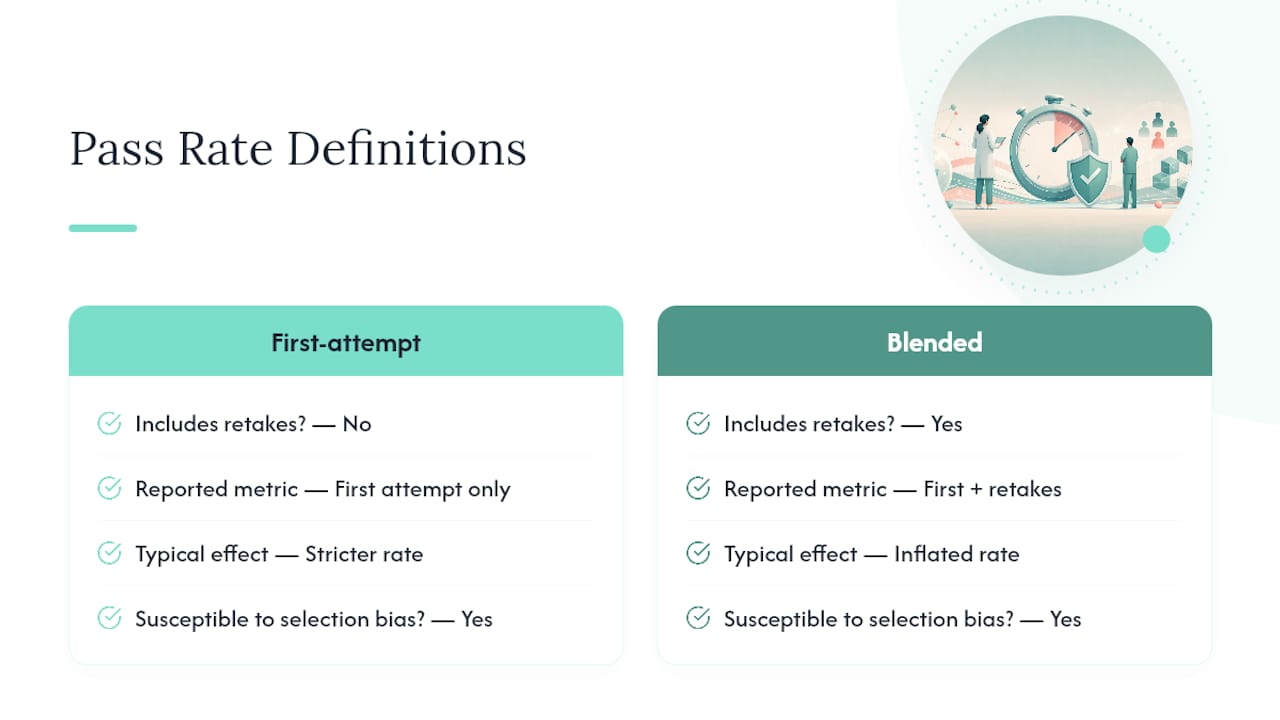
Reporting methods are the third. Some organizations report first-attempt pass rates only. Others blend first-attempt and retake numbers into a single figure, which inflates the percentage compared to a program reporting first-attempt data alone. Two programs can genuinely have equivalent outcomes and post different numbers purely because of how they define “pass rate.” Ask which definition a program is using before you compare it to anything else.
None of this means pass rates are useless. It means they’re one data point among several, sitting alongside eligibility requirements, curriculum structure, and how well a program prepares you for the clinical application you’ll actually do after certification. A deeper look at how functional medicine improves patient outcomes tells you more about long-term program value than any single percentage will.
How We Report Outcomes and What We’re Willing to Show You
Transparency shouldn’t be optional in this field, and Functionalacademy treats outcome documentation as something readers can actually request rather than take on faith. We provide accreditation details, curriculum maps, and cohort-level information to prospective students who ask, structured the same way we’d want a certifying body to structure it for us.
If you want to see how our program aligns with certifying-body requirements before enrolling, reach out and ask for the documentation directly. We can also connect prospective students with graduates who are willing to speak about their own certification experience. Verification shouldn’t require a leap of faith, and we’d rather you check our claims than simply believe them.
— Lauren
Where the Institute for Functional Nurses Fits Into Your Decision
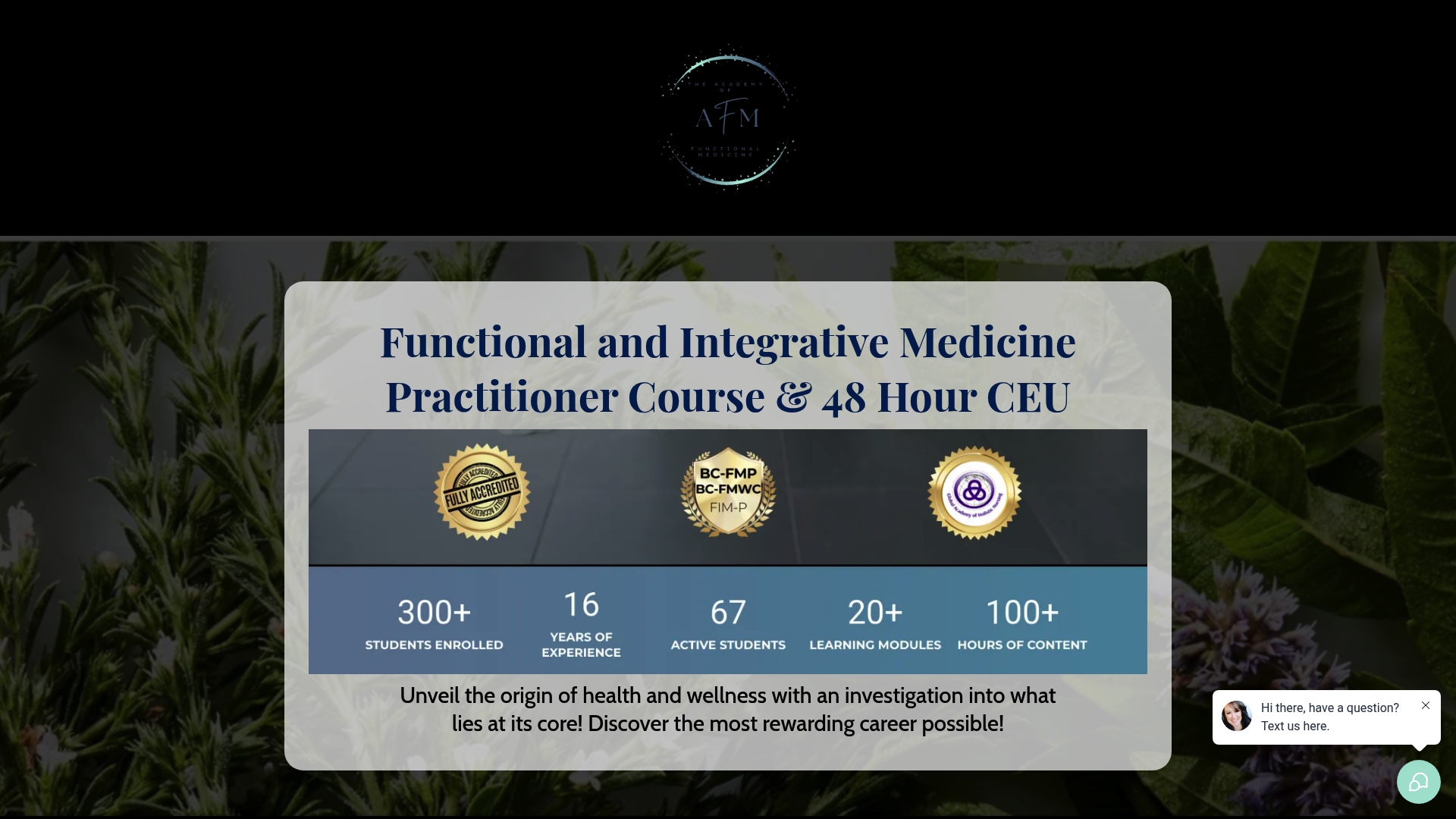
You’ve just read how to separate a real pass-rate claim from a marketing number. Here’s the concrete difference at the Institute for Functional Nurses: our certification pathways, including FIM-P, BC-FMP, and BC-FMWC, are built around documented clinical application rather than theory alone, and we structure our curriculum to align directly with the requirements certifying bodies actually publish.
We provide prospective students with accreditation documentation and curriculum maps before enrollment, not after. That means you can request the specifics that matter to your decision, cohort structure, clinical application requirements, and how our program maps to certification standards, before you commit a dollar. If you’re a nurse or licensed healthcare professional weighing your options, the clearest next step is to visit the Institute for Functional Nurses program page and request the outcome documentation directly. Certification decisions carry real career weight, including the income and marketability gains covered in why board certification increases nurse income, so verify first, then enroll with confidence.
Where to Check First
Start with these primary resources before trusting any secondhand claim:
- NBHWC official site and its exam information packet
- ABMS for board-certification context
- HHS HIPAA guidance on what candidate data programs can lawfully share
- Career-path context from Flexible Nursing Careers if you’re mapping certification against a broader career plan
Sources
Two very different things get called a “pass rate,” and clinicians deserve to know which one they’re looking at. A certifying-body published rate comes directly from the organization that administers the exam. You’ll typically find it referenced in an exam information packet, a candidate handbook, or occasionally a public press release tied to a specific testing cycle.
A provider self-reported claim is a different animal entirely. It’s a number a training program puts on its own sales page, usually with no cohort size, no timeframe, and no link to independent documentation. That sentence tells you nothing about how many students, over what period, or measured by whom.
Acceptable evidence looks like this:
- NBHWC
- NBHWC exam information packet (2026)
- HHS — HIPAA privacy laws and regulations
- Functional Medicine Finder — Best functional medicine board certifications (2026)
The NBHWC publishes exactly this kind of documentation, which is why it remains the benchmark other credentials get measured against. Its exam information packet lays out content domains, candidate eligibility, and administrative detail that a marketing claim simply can’t replicate. When a number can’t be traced back to something resembling that packet, treat it as unverified until proven otherwise.