
6 Functional Medicine Myths That Mislead Patients (What Evidence Says)
6 Functional Medicine Myths That Mislead Patients (What Evidence Says)
Some functional medicine practices, especially the emphasis on diet, sleep, and stress reduction, rest on solid evidence. Others don’t. Routine overtesting, invented diagnoses like “adrenal fatigue,” and one-size-fits-all supplement stacks are among the most repeated claims, and they’re the ones with the weakest scientific backing. The myths below break down exactly where the line sits.
TL;DR:
- Many functional medicine practices overuse testing and supplements without solid evidence, especially for vague diagnoses like leaky gut or adrenal fatigue.
- Credentials and clinical rationale are key: verify that tests are ordered for specific, evidence-based reasons and that practitioners hold legitimate medical licenses.
- Functional medicine should complement, not replace, conventional care, and any practitioner discouraging referrals to specialists is a warning sign.
- Lifestyle interventions such as diet, sleep, and stress reduction are the most evidence-backed components, while supplement stacks and unvalidated tests are often driven by financial incentives.
- The strongest institutional critique is that certain functional medicine practices are deemed potentially harmful and ineligible for professional training credit, highlighting the importance of evidence-based approaches.
Table of Contents
- The Functional Medicine Myths That Confuse Patients Most
- Common Functional Medicine Misconceptions, Debunked
- Why These Myths Persist
- How to Evaluate a Functional Medicine Practitioner
- What the Research Actually Shows
- Why Functionalacademy Takes an Evidence-First Approach
- Beyond the Myths: A More Honest Read on Functional Medicine
- Sources
- FAQ
The Functional Medicine Myths That Confuse Patients Most
Functional medicine markets itself as “root cause” care: instead of prescribing a pill for a symptom, a practitioner looks at diet, sleep, stress, gut health, and genetics to find what’s driving the problem upstream. That framing sounds reasonable, and it’s part of why functional medicine myths spread so easily. The model borrows heavily from systems biology, the idea that the body operates as an interconnected network rather than a set of isolated organ systems.
In practice, a functional medicine visit usually means an extended intake, expanded lab panels beyond a standard checkup, and a personalized plan built around nutrition, movement, sleep hygiene, and sometimes supplements. This overlaps with integrative medicine, which also blends conventional and complementary approaches, but functional medicine leans harder into individualized testing and “systems” mapping. It’s not conventional care’s opposite. It’s a different lens applied on top of, or sometimes instead of, standard diagnostic workups.
Common Functional Medicine Misconceptions, Debunked
Here’s where the claims get tested against the evidence.
1. “Functional Medicine Isn’t Evidence-Based At All”
This one is half right. Critics have documented that functional medicine leans on vaguely defined concepts and extensive, nonstandard testing, and the American Academy of Family Physicians has ruled functional medicine practices ineligible for certain course credits over concerns about potential patient harm. But the underlying goal, looking for upstream drivers of chronic illness, is not itself pseudoscience. The evidence gap is real for specific FM protocols, not for the entire concept of personalized care. Practical tip: ask any practitioner which parts of your plan are backed by clinical trials and which are theoretical.
2. “Functional Medicine Is Just Supplements”
Reputable functional medicine care leads with food, sleep, movement, and stress management, not pills. Lifestyle-first interventions have strong evidence across many chronic conditions when delivered according to established guidelines. The myth persists because some practices sell supplement stacks as the main event instead of a supporting piece. Practical tip: be wary if your first visit ends with a cart of products rather than a food and sleep plan.
3. “It Rejects Conventional Medicine”
Major clinical centers push back hard on this. Cleveland Clinic describes its functional medicine model as patient centered and collaborative, working alongside conventional clinicians rather than replacing them. Institutional programs like this treat functional medicine as an add on layer of nutrition and lifestyle focus, not a substitute for surgery, medication, or emergency care. Practical tip: any practitioner who discourages you from seeing a specialist for a serious symptom is a red flag, not a root-cause finder.
4. “Functional Medicine Promises Miracle Cures”
Testimonial-driven marketing is common in this space, and it’s where functional medicine earns its “pseudoscience” reputation. Anecdote is not data. Individualized plans, by design, are hard to test in randomized controlled trials, which means dramatic before-and-after stories often substitute for actual trial evidence. Practical tip: discount any promise of reversing a chronic disease in weeks. Real physiological change from diet and lifestyle typically takes months.
5. “It’s Only For Complex, Chronic Cases”
Functional medicine’s lifestyle-focused tools, better sleep, targeted nutrition, movement, stress reduction, have broad applicability, not just for people with unexplained fatigue or multiple diagnoses. Plenty of people use it as an adjunct to standard care for prevention or general wellness. The chronic-case-only framing is more marketing niche than clinical reality.
6. “Adrenal Fatigue and Leaky Gut Are Established Diagnoses”
Neither term is recognized as a formal medical diagnosis. Analyses from Science-Based Medicine and McGill’s Office for Science and Society point to reliance on vaguely defined concepts like these as a central problem with the field. Increased intestinal permeability is a real, studied phenomenon in specific conditions, but “leaky gut syndrome” as a catch-all diagnosis for fatigue, brain fog, or weight gain isn’t backed by that research. Practical tip: if a diagnosis doesn’t appear in mainstream medical references, ask directly what test confirmed it and what the normal range is.
Why These Myths Persist
Myths about holistic health don’t spread by accident. A few forces keep them alive:
- Rebranding. Complementary and alternative approaches get relabeled with clinical-sounding language, which makes older, less-tested practices seem new and rigorous.
- Overtesting economics. Extensive lab panels generate incidental abnormal results, and Science-Based Medicine has documented how those minor deviations get reframed as meaningful imbalances, driving costly follow-up treatment.
- Anecdote and confirmation bias. A patient who feels better after a new protocol credits the protocol, not the placebo effect, the natural course of illness, or the extra attention from a longer visit.
- Financial incentives. Supplement sales and proprietary test panels create a built-in reason to expand testing and treatment beyond what evidence supports.
How to Evaluate a Functional Medicine Practitioner
Credentials matter more than titles in this space. An MD, DO, NP, or PA with formal functional medicine training through an accredited program is a different proposition than someone using “functional medicine practitioner” as an unregulated title with no clinical license behind it.
Some tests are legitimately useful: standard metabolic panels, thyroid function tests, and inflammatory markers ordered for a clear clinical reason. Others are overused: extensive food sensitivity panels, unvalidated hormone “zoning,” and micronutrient tests sold as bundled packages with little clinical utility.
Watch for these red flags before committing to a plan:
- Detox programs promoted as necessary for general health.
- Blanket supplement stacks recommended before any testing happens.
- Tests sold in bundled packages rather than ordered individually for a specific concern.
- No referral to conventional specialty care when your symptoms warrant it.
Before you agree to testing, ask three questions: What is the clinical rationale for this specific test? What will change in my treatment if the result is abnormal? What’s the total cost and expected timeline for results?
Pro Tip: If a practitioner can’t answer what changes with an abnormal result before you’ve paid for the test, that’s your answer about whether the test is necessary.
Serious or acute symptoms, chest pain, sudden neurological changes, unexplained weight loss, belong with a conventional specialist first. Functional medicine works best as a complement to that care, not a detour around it.
What the Research Actually Shows
The evidence picture splits into two camps that mostly talk past each other. Critics point to a real structural problem: functional medicine’s tendency to overtest and interpret minor abnormalities as meaningful drives costs upward without matching benefit, and the American Academy of Family Physicians has flagged specific FM practices as carrying potential for patient harm.
Proponents counter with a legitimate scientific rationale of their own. Systems biology and genomics research supports the idea that individualized approaches have biological grounding, even though translational evidence for many specific FM protocols is still catching up. Part of the disconnect is methodological: personalized, multi-variable treatment plans are genuinely difficult to test in a standard randomized controlled trial, which is the gold standard for most other medical evidence.
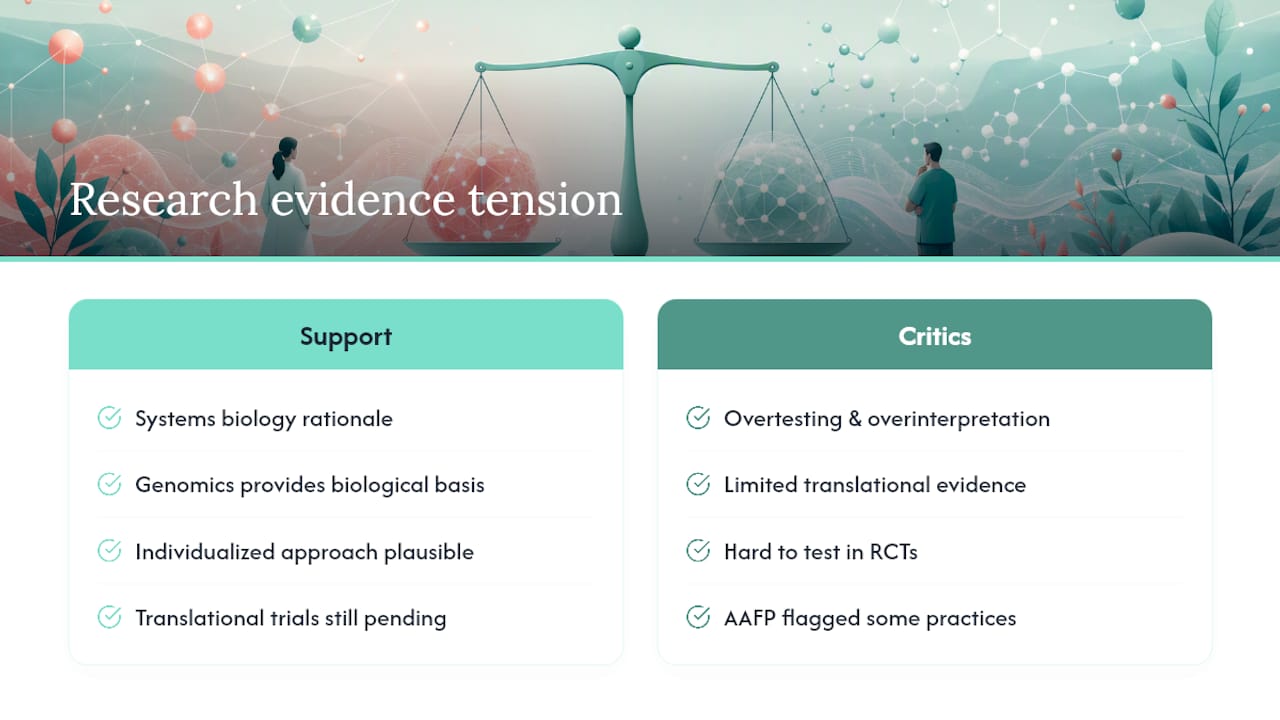
The one number worth remembering: the American Academy of Family Physicians has specifically ruled certain functional medicine practices ineligible for professional course credit over patient-harm concerns. That’s a concrete institutional judgment, not a vague criticism, and it’s the strongest single data point against treating every FM claim as settled science.
Why Functionalacademy Takes an Evidence-First Approach
The Institute for Functional Nurses exists because this gap between marketing and evidence is exactly what nurses and practitioners need training to navigate. Board-certified, accredited education distinguishes practitioners who apply functional medicine to improve patient outcomes responsibly from those trading on the label alone. Functionalacademy builds its coursework around clinical application, not anecdote, because patients deserve practitioners who know the difference between a food-first intervention and an unproven test panel.
If you’re a nurse or healthcare practitioner who wants to practice functional medicine without falling into the myths above, formal training matters. Functionalacademy’s Functional and Integrative Medicine Practitioner Course & 48 Hour CEU gives working clinicians an accredited path to board certification built around practical, evidence-first clinical skills rather than marketing claims. The program includes an introductory course option and offers live business coaching for practitioners developing their own functional medicine practice.
Beyond the Myths: A More Honest Read on Functional Medicine
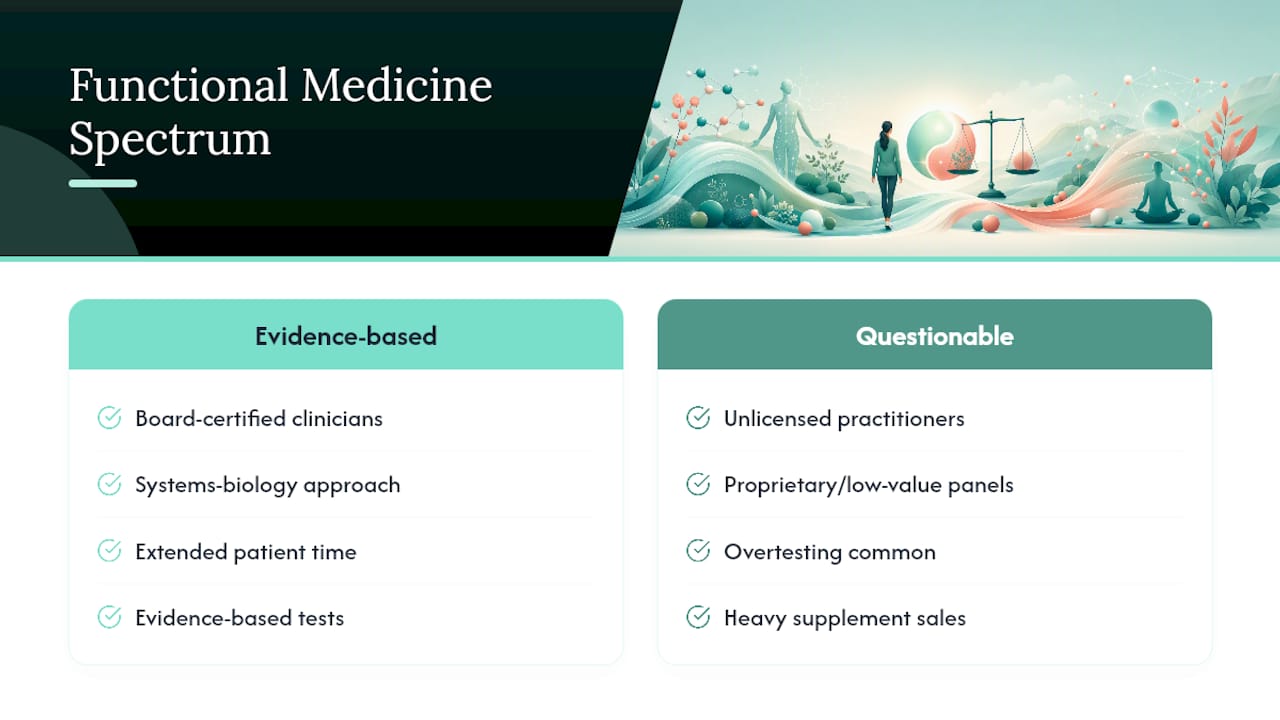
Most coverage of functional medicine wants you to pick a side: it’s either revolutionary root-cause medicine or it’s dressed-up quackery. Neither framing survives contact with the actual evidence. What critics get right is specific and important: certain FM practices do overtest, do treat vague labels like “adrenal fatigue” as if they were diagnoses, and do generate revenue through supplement sales that outpaces the evidence behind them. That’s a legitimate, documented pattern, not an exaggeration by skeptics.
What gets lost in the “is it pseudoscience” debate is that the parts of functional medicine actually worth keeping, extended time with patients, a genuine look at diet and sleep, attention to stress physiology, aren’t controversial anywhere in medicine. They’re just underused in a fifteen-minute conventional visit. The myth isn’t that functional medicine works. The myth is that it’s one thing. It’s a spectrum running from board-certified clinicians applying real systems biology, to unlicensed practitioners selling proprietary panels with dubious clinical value. Your job as a patient isn’t to trust or distrust “functional medicine” as a category. It’s to ask which end of that spectrum the person in front of you actually occupies.
— Lauren
Sources
- Functional medicine: what is it? (PMC article)
- Functional Medicine Is a Pipeline to Alt Med | Office for Science and Society - McGill University
- What is Functional Medicine? | Cleveland Clinic
FAQ
What is the controversy with functional medicine?
The core controversy is that functional medicine often relies on nonstandard testing and vaguely defined concepts, which critics say leads to overtesting and unnecessary treatment, while its stated goal of finding root causes has broad support even among skeptics.
What are some common medical myths in functional medicine?
The most repeated myths are that it’s entirely unscientific, that it’s mostly supplements, that it rejects conventional medicine, that it offers miracle cures, that it’s only for chronic illness, and that terms like “adrenal fatigue” and “leaky gut syndrome” are established diagnoses.
Can I trust a functional medicine doctor?
Trust depends on credentials and approach rather than the label alone. Look for an MD, DO, NP, or PA with accredited functional medicine training who orders tests with a clear rationale and coordinates with conventional specialists when needed.
Is Dr. Mark Hyman a real doctor?
Yes, Mark Hyman is a licensed physician who has built a public platform around functional medicine, though like the field broadly, some of his specific claims have drawn scrutiny from critics who argue the evidence behind certain protocols is thin.