
Clinicians' 12 Week Accreditation Aware Functional Medicine Exam Prep
Clinicians’ 12 Week Accreditation Aware Functional Medicine Exam Prep
The fastest reliable path through functional medicine exam prep combines an accredited, clinician-focused curriculum, timed full-length mock exams, and documented clinical case work mapped to the actual test blueprint. Start by confirming your certification pathway and eligibility hours against NCCA accreditation standards, then build a 12-week study calendar and book a mock exam through your program before you schedule the real thing on Prometric.
TL;DR:
- Certification pathways requiring documented training hours and patient encounters are stricter but may take longer, especially for board or diplomate exams.
- The exam heavily tests clinical reasoning through case scenarios across domains like cardiometabolic health, gastrointestinal function, and hormone regulation, rather than simple recall.
- A structured 12-week study plan balancing content review, mock exams, and remediation optimizes success, with booking your exam early helping maintain pacing.
- Full-length timed mock exams and question banks improve reasoning speed and accuracy, while documenting clinical cases during practice reinforces exam-relevant skills.
- Choosing an accredited program that aligns with your license type, offers practical module content, and supports clinical documentation can improve both exam readiness and professional marketability.
Table of Contents
- Which Certification Pathways Fit Your License and Role?
- What Domains Does the Exam Actually Test?
- How Should You Structure a 12-Week Study Plan?
- How Do You Use Mock Exams and Question Banks Effectively?
- What Are the Test-Day and Proctoring Rules You Need to Know?
- How Does an Accredited Program Cover Your Study Plan?
- What Clinicians Preparing While Working Full-Time Should Know
- Ready to Start? How Functionalacademy Maps to Your Study Plan
- Where to Verify Registration, Blueprints, and Proctoring Rules
- Sources
- FAQ
Which Certification Pathways Fit Your License and Role?
Not every functional medicine credential asks the same thing of you, and picking the wrong track wastes months. Board and diplomate exams, like the one administered through DABFM, typically demand documented training hours and a set number of patient encounters before you’re even eligible to sit for the test. Certificate-track programs, by contrast, usually verify education and license status but skip the encounter-count requirement, making them faster to reach if you’re newer to functional practice.
Your professional role changes which route makes sense. A physician or nurse practitioner often gravitates toward a board/diplomate credential because it carries more clinical authority in referral networks. A registered nurse building a wellness practice frequently finds a certificate pathway, paired with CEU documentation, gets them into practice faster without sacrificing rigor.
Before you commit, work through this checklist:
- Confirm your license type qualifies for the pathway you want.
- Total your training hours and patient encounters against the board’s published minimum.
- Decide whether you need CEUs bundled into the program or separately documented.
- Compare prerequisites using certificate-selection guidance built specifically for this decision.
What Domains Does the Exam Actually Test?
Functional medicine exams are not trivia tests. They reward clinical reasoning, meaning you’ll face case scenarios and lab interpretation questions far more than simple recall items. Certification bodies like ABPSus publish domain-weighted blueprints, and studying against that map, rather than a generic textbook, is what separates candidates who pass from those who don’t.
The domains you’ll typically see tested include:
- Cardiometabolic health — case-based items on insulin resistance, lipid patterns, and root-cause risk factors.
- Gastrointestinal function — lab interpretation involving stool panels, permeability markers, and dysbiosis patterns.
- Hormone regulation — treatment-plan questions covering thyroid, adrenal, and reproductive axis imbalances.
- Immune and inflammatory patterns — scenario items testing your ability to connect systemic inflammation to chronic symptoms.
- Bioenergetics and mitochondrial function — questions on fatigue presentations and metabolic root causes.
- Environmental and toxicology exposures — case items on detoxification pathways and exposure history.
As you move through clinical work, log each patient encounter under the domain it represents. That habit does double duty: it builds your eligibility documentation and rehearses the exact reasoning pattern the exam rewards.
How Should You Structure a 12-Week Study Plan?
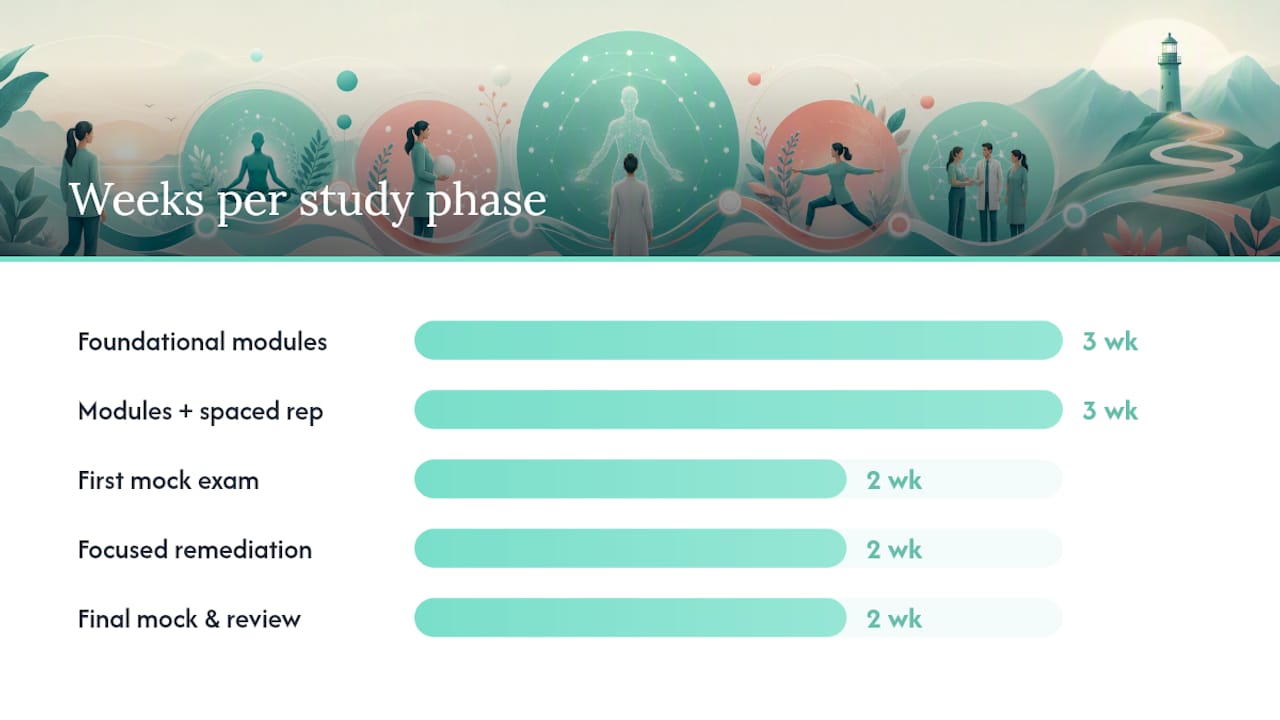
Twelve weeks is realistic for most working clinicians if you protect five to eight hours a week and treat the calendar as non-negotiable. Here’s a sequence that holds up under a full clinical schedule:
- Weeks 1 to 3: Work through foundational modules, one domain per week, spending roughly six hours weekly on content review and note-building.
- Weeks 4 to 6: Introduce spaced repetition flashcards for lab values and treatment protocols while continuing new module content.
- Weeks 7 to 8: Take your first full-length, timed mock exam. Treat the result as a diagnostic, not a verdict.
- Weeks 9 to 10: Run a focused remediation cycle on your two or three weakest domains, using case narratives from your own clinical documentation.
- Week 11: Take a second full mock exam under real test-day conditions, including proctoring rules.
- Week 12: Do light review only. Confirm your exam registration window and finalize test-day logistics.
If you’re studying part-time around night shifts or a full patient load, stretch this to 16 weeks by extending the module phase to five weeks and adding a second remediation cycle. The milestones stay the same; only the pacing changes.
Pro Tip: Book your exam date as soon as you finish week one. A fixed deadline on the calendar does more to keep you on pace than any study app reminder.
How Do You Use Mock Exams and Question Banks Effectively?

Timed, full-length mock exams that replicate real test conditions predict exam success far better than casual, untimed question review. The goal isn’t just answering correctly. It’s training your brain to reason through a case scenario at the pace the real exam demands.
Build your practice routine around these habits:
- Schedule one module quiz weekly and a full-length mock exam at week 8 and again at week 11.
- Review every missed item immediately, sorting mistakes by domain rather than by question number.
- Convert weak-domain patterns into a short remediation list of two or three focus areas per cycle.
- Turn actual clinic cases into two-paragraph exam-style narratives, matched to the domain they represent.
Mock exams built around module-aligned questions, full-length timed simulations, and diagnostic performance dashboards turn passive review into active clinical reasoning practice — the same reasoning style the real exam is built to test. Documenting your case narratives this way serves a second purpose: it builds the encounter record many boards require for eligibility.
What Are the Test-Day and Proctoring Rules You Need to Know?
Remote-proctored exams fail candidates for reasons that have nothing to do with clinical knowledge. Testing vendors enforce strict environment rules, and Prometric’s remote proctoring guidance warns that clutter, papers, or a second device in the room can trigger a paused or canceled session.
Run through this checklist the night before, not the morning of:
- Clear your desk completely. No notes, phones, or secondary monitors within reach.
- Test your camera and microphone at least 24 hours in advance, not minutes before your start time.
- Confirm your government ID matches your registration name exactly.
- Verify your internet connection can sustain a multi-hour video session without dropping.
- Know your board’s retake policy and waiting period before you sit down, so a rough first attempt doesn’t derail your timeline.
Register early. Popular exam windows fill weeks in advance, and scrambling for a last-minute slot adds stress you don’t need on top of the material itself.
How Does an Accredited Program Cover Your Study Plan?
An accredited program should map directly onto the milestones above instead of leaving you to assemble them piecemeal. When you’re evaluating any course, check it against NCCA accreditation standards, the most reliable benchmark for whether a credentialing body’s process holds up.
A program built for working clinicians typically covers:
- Module content organized by exam domain, not by arbitrary chapter order.
- CEU or contact hours that satisfy state licensing and board eligibility simultaneously.
- Structured support for converting clinical encounters into case documentation.
- Applied training you can use in practice immediately, not just theory for the test.
Nurses who complete an accredited pathway often see measurable gains in marketability once certified, particularly in wellness-focused practice settings.
What Clinicians Preparing While Working Full-Time Should Know
Two habits separate candidates who pass on the first try from those who don’t: they protect a fixed weekly study block instead of studying “when there’s time,” and they document clinical cases the same day they see the patient, not weeks later. Waiting to write up encounters costs you detail you need for both eligibility and exam-style reasoning practice. Start your plan this week. The domains won’t feel less dense next month.
— Lauren
Ready to Start? How Functionalacademy Maps to Your Study Plan
Functionalacademy offers a board certification path that includes module content organized for applied clinical use, CEU hours in the practitioner course, and support for documenting patient encounters as case work.
If you want to see the format before committing, the free 4-day functional medicine course walks you through the teaching style and module structure with no cost attached. For nurses ready to move past the course itself, weekly live business coaching helps you turn a new credential into a sustainable wellness practice once you’re certified, building on skills like attracting clients who stay. Functionalacademy doesn’t guarantee a passing score. It builds the applied clinical foundation and CEU documentation your study plan needs, and the rest comes down to the hours you put in. Start with the free four-day course this week and decide from there whether the full practitioner track fits your calendar.
Where to Verify Registration, Blueprints, and Proctoring Rules
Confirm every detail directly with the source before you register. Use NCCA’s accreditation criteria to vet any program’s standing, FMPhA’s certificate comparison to pick your pathway, DABFM’s exam page for diplomate eligibility hours, and Prometric’s exam portal for scheduling and proctoring rules. For broader context on how functional and traditional approaches differ in scope, this comparison is a useful primer.
Sources
- Institute For Functional Medicine (IFM) — Prometric exam information
- Which Functional Medicine Certificate Should I Do? — FMPhA
FAQ
What Are the 5 R’s of Functional Medicine?
The 5 R’s framework, commonly taught in functional medicine education, refers to Remove, Replace, Reinoculate, Repair, and Rebalance, a sequence used to address root causes of gastrointestinal and systemic dysfunction. You’ll see this framework tested in case-based GI and immune domain questions, so understanding the clinical logic behind each step matters more than memorizing the acronym.
What Are the Common Tests in Functional Medicine?
Functional medicine practitioners commonly order comprehensive stool panels, food sensitivity testing, hormone and adrenal panels, and micronutrient assessments to identify root-cause imbalances. Exam questions frequently ask you to interpret these lab patterns within a case scenario rather than just name the test.
What Is the Downside of Functional Medicine?
The most cited downside is inconsistent training standards across practitioners, which is exactly why accreditation frameworks like NCCA matter when choosing a certification program. Cost and time investment for extensive lab testing can also be a barrier for some patients, making documentation and clear treatment rationale part of responsible practice.
How Do I Study for Functional Medicine?
Build a study calendar around the exam’s domain blueprint, work through accredited module content first, then layer in timed full-length mock exams starting around week eight of a 12-week plan. Pairing that structure with documented clinical case work reinforces the exact clinical reasoning style the exam tests.
How Much Does Functional Medicine Exam Prep Cost?
Costs vary by certification board and program, covering application fees, study materials, and any CEU-bearing coursework you enroll in. Functionalacademy’s practitioner course and CEU pricing are listed directly on Functionalacademy, and the introductory four-day course is free to start.