
3 Outcomes Clinics Need: Functional Medicine Documentation Training
3 Outcomes Clinics Need: Functional Medicine Documentation Training
The best functional medicine documentation training builds three things at once: a structured case-format template library, real EHR integration with practitioner mapping, and role-specific workflows that tell every staff member exactly what belongs in a chart. Get those three right and clinics see the payoff fast — less after-hours charting, and notes that still capture the multi-system detail functional medicine actually requires.
TL;DR:
- Effective training must focus on structured case reports, reusable care plans, and billing-robust notes, all mapped to specific staff roles to prevent gaps.
- Role-specific curricula and short audits paired with simulated scenarios optimize staff learning, especially by prioritizing templates with high frequency and risk.
- Hands-on exercises, peer review, and live audits are most effective for building charting competence, rather than theoretical or policy-based training.
- Incorporating AI tools requires practitioner mapping and human review to avoid missed details or errors, with ongoing spot checks ensuring workflow discipline.
- Training success hinges on measurable improvements in chart quality, accuracy, and efficiency, validated through baseline assessments, peer review, and regular audits.
Table of Contents
- What Should Functional Medicine Documentation Training Actually Deliver?
- How Do You Assess Training Needs and Build Role-Based Learning Paths?
- What Training Formats Actually Build Documentation Competence?
- How Should EHR Templates and AI Tools Support Functional Medicine Charting?
- How Does Institute For Functional Nurses Training Map To These Skills?
- Getting New Staff Onboarded Without Slowing Down Care
- Why Documentation Quality Determines Whether Longitudinal Care Actually Works
- Protecting Patient Privacy in Functional Medicine Records
- Legal and Compliance Considerations Every Clinic Should Train For
- Techniques for Catching Documentation Errors Before They Become Problems
- Tools and Software Worth Training Staff On
- How to Assess Whether Documentation Training Actually Worked
- Where to Start If You’re Running This as a Pilot
- Get Structured Documentation Training Through an Accredited Program
- Sources
What Should Functional Medicine Documentation Training Actually Deliver?
Most clinics don’t have a documentation problem. They have a translation problem. Providers know functional medicine. They know how to think in systems, root causes, and timelines. What breaks down is turning that thinking into a chart entry that a biller can code, a colleague can pick up mid-treatment, and a board reviewer can approve for certification.
Training has to close that gap, and it starts with naming what “good documentation” is actually for.
Set your documentation goals before you touch a template. Every clinic training rollout should target three outcomes:
- Case reports formatted for certification and clinical continuity, built on the structured synthesis method taught in programs like Bastyr University’s functional medicine case writing course.
- Reusable care plans that survive the handoff between visits, providers, and even clinics.
- Notes that hold up under billing review without requiring a rewrite after the fact.
Once the goals are set, map ownership. A common failure point in functional medicine practices is assuming “documentation” is one job when it’s actually four:
- Providers own the assessment, differential thinking, and treatment rationale.
- Nurses own case summaries, intake synthesis, and care-plan updates between visits.
- Health coaches own progress notes and lifestyle-adherence tracking.
- Admin staff own intake capture and portal-facing documentation that patients see.
Skip the mapping step and you get overlap in some charts and gaps in others, usually discovered during an audit rather than before one.
Finally, pick metrics you can actually measure in the first 90 days. Three work well for most clinics: average after-hours charting time per provider per week, the timeliness of care plan updates at the point of visit closure, and chart completeness based on monthly audit samples. Clinical documentation education tied to concrete metrics like these consistently improves practitioner efficiency and reduces administrative burden, which shows up directly in clinician satisfaction and improvements in revenue capture.
How Do You Assess Training Needs and Build Role-Based Learning Paths?
You cannot train what you haven’t diagnosed. Start with a short chart audit, ten to fifteen recent encounters pulled at random, and score them against three questions: Is the assessment and plan section using structured fields or is it mostly free text? Are care plans referenced or rebuilt from scratch at each visit? Would a new provider understand this patient’s history without a verbal handoff?

Pair the audit with ten-minute interviews with each role. Ask what takes longest to document, what gets skipped when the schedule runs tight, and where staff feel unsure whether they’re charting “the functional medicine way” or just improvising.
From there, build role-specific curricula rather than one generic training deck:
- Admin staff train on intake templates: symptom timelines, prior treatment history, and structured demographic fields that feed downstream sections instead of sitting isolated.
- Nurses train on case summary templates that condense intake and visit history into the synthesis format used for functional medicine care plans in the EHR.
- Providers train on assessment and plan templates that map root-cause reasoning into structured, billable fields.
- Health coaches train on progress-note templates built around adherence tracking and lifestyle intervention markers.
Not every template deserves equal training time in week one. Build a simple prioritization matrix: rank templates by how often staff use them and how much clinical or billing risk they carry if done wrong. Intake and assessment templates almost always sit in the top-left quadrant, high frequency and high impact, and deserve the first training block.
Pro Tip: Run your needs assessment on the same week you pull your next chart audit sample. Comparing what staff say is hard against what the charts actually show is more revealing than either exercise alone.
What Training Formats Actually Build Documentation Competence?
Lecture-based training on documentation policy rarely changes behavior at the keyboard. What works is hands-on repetition inside the actual EHR, using cases that look like the ones staff will chart that afternoon.
Start with template walkthroughs using deidentified real cases. Walk a nurse or provider through the exact click path: where the intake data auto-populates, which fields require manual synthesis, and where the case narrative connects to the structured fields a biller will later scan. This is less about teaching functional medicine and more about teaching the mechanics of where information goes.
Follow that with simulation exercises for the scenarios that trip up even experienced staff: a patient with three overlapping chronic conditions, a handoff between a nurse and a provider mid-treatment, or a care plan that needs updating after new lab results arrive. Role-play these with sample lab data so the training mirrors the actual complexity of longitudinal functional medicine cases, not a simplified version of one.
Then verify the skill actually transferred, with three checks that work well together:
- A graded sample case report scored against a rubric, not just reviewed informally.
- Peer review, where staff swap charts and flag anything unclear to someone who wasn’t in the room for the visit.
- A live charting audit, spot-checking real notes within a week of training rather than waiting for the next scheduled review cycle.
Don’t skip communication scripts. Patient-facing documentation, particularly portal messages, needs its own short training block. A message that’s accurate but written in clinical shorthand confuses patients and generates callback volume that eats into the time savings training is supposed to create.
The return on this kind of structured investment is well documented. Targeted training programs that pair templates with regular audits reduce documentation errors and improve billing and coding accuracy, which matters as much to a clinic’s financial health as it does to clinical quality. Specialty charting courses built around dot-phrases and template libraries report similar wins: staff save meaningful charting time and produce more complete charts once the mechanics become second nature rather than something they have to think through each time.
How Should EHR Templates and AI Tools Support Functional Medicine Charting?
Templates only work if they live inside the EHR the way staff actually use it, not as a separate reference document nobody opens. That means translating the functional medicine case report format into structured fields the software can hold: history and timeline, systems review, root-cause hypothesis, intervention plan, and follow-up markers. Structured, template-based workflows are essential for tracking multi-visit treatment plans in functional medicine, and training has to cover both what to record and exactly where it goes in the chart.
Practitioner mapping deserves its own training block, not a footnote. When a note doesn’t sync to the correct provider profile or lands in the wrong chart, the error often isn’t caught until a billing rejection or an audit flags it weeks later. Before any new template or AI tool goes live clinicwide, run an encounter sync test on a handful of real appointments and confirm notes land where they should.
A few technical habits reduce the risk considerably:
- Import labs directly into structured fields rather than pasting values into free text, so trend data stays queryable across visits.
- Give patients portal visibility into care-plan summaries, which cuts down on repeat questions during follow-up calls.
- Standardize symptom trackers so a provider comparing visit three to visit one is comparing the same fields, not reinterpreting a different format each time.
AI-assisted SOAP notes are increasingly common in integrative and functional medicine settings, and the tools built specifically for this specialty can preserve multi-system detail while syncing with specialty EHRs, but only when practitioner mapping is configured correctly and every AI-generated note gets a human review pass before it’s finalized. The most common pitfalls are quiet ones: an omitted detail that changes a differential, a dosage transcribed incorrectly from a verbal note, or a care-plan update that doesn’t carry forward because the mapping broke. Train staff to treat AI drafts as a starting point, not a finished chart, and build a spot-check step into the first several weeks of any AI rollout. Interoperability standards from bodies like the World Health Organization’s digital health guidance reinforce the same principle at a system level: the tools matter less than the workflow discipline around them.
How Does Institute For Functional Nurses Training Map To These Skills?
The gap between knowing functional medicine and documenting it well is exactly what accredited programs are built to close. Functionalacademy’s coursework through the Institute for Functional Nurses ties case-writing practice, template use, and workflow integration directly to the skills covered above, rather than teaching documentation as an abstract policy topic.
Course modules that map most directly to clinic-floor documentation include:
- Structured case-writing practice aligned with certification-style formats.
- Template-based charting exercises built for real clinical application, not hypothetical scenarios.
- Workflow integration guidance for fitting functional medicine documentation into an existing EHR without adding hours to a provider’s day.
Graduates typically leave able to produce structured, billing-ready case reports and apply templates without the trial-and-error most self-taught staff go through, which is worth reviewing alongside how board certification tends to affect nurse income over time.
Getting New Staff Onboarded Without Slowing Down Care
New hires are where documentation habits either form correctly or calcify into workarounds nobody wants to unwind later. The fix isn’t a longer orientation packet. It’s scenario-based onboarding that puts new staff inside real workflows within the first week, not the first month.
Start every new hire with the same three simulated scenarios regardless of role: a straightforward new-patient intake, a follow-up visit requiring a care-plan update, and a multi-provider handoff where the new hire has to read someone else’s chart and continue the plan without a verbal briefing. These three cover the situations that expose weak documentation habits fastest.
Simulation training works better than shadowing alone because shadowing shows staff what an experienced colleague does, not why they do it that way. A new nurse watching a case summary get written doesn’t necessarily learn the decision logic behind which details made the cut. Walking through a simulated case and then comparing notes against a model answer does.
Build in a short competency check at the end of week one: a single graded case report, reviewed against the same rubric used in ongoing staff audits. This catches formatting habits and gaps in synthesis before they turn into a pattern across dozens of real patient charts. Clinics that treat the first two weeks as a documentation sandbox, rather than throwing new staff straight into a full patient load, consistently report fewer chart corrections in the following quarter.
Why Documentation Quality Determines Whether Longitudinal Care Actually Works
Functional medicine is longitudinal by design. A single visit rarely tells the full story. What matters is the pattern across visits three, six, and twelve, and that pattern only exists if each visit’s documentation connects cleanly to the ones before it.
This is where fragmented charting causes real damage. When care plans get rebuilt from scratch at each visit instead of updated and referenced, trend data disappears. A provider reviewing a patient’s sixth visit has no easy way to see that a symptom cluster first flagged in visit two has been improving steadily, because that thread was never carried forward in a structured way. Functional medicine’s longitudinal nature demands a deliberate documentation strategy; training programs that skip this produce exactly the fragmented plans that undercut root-cause treatment.
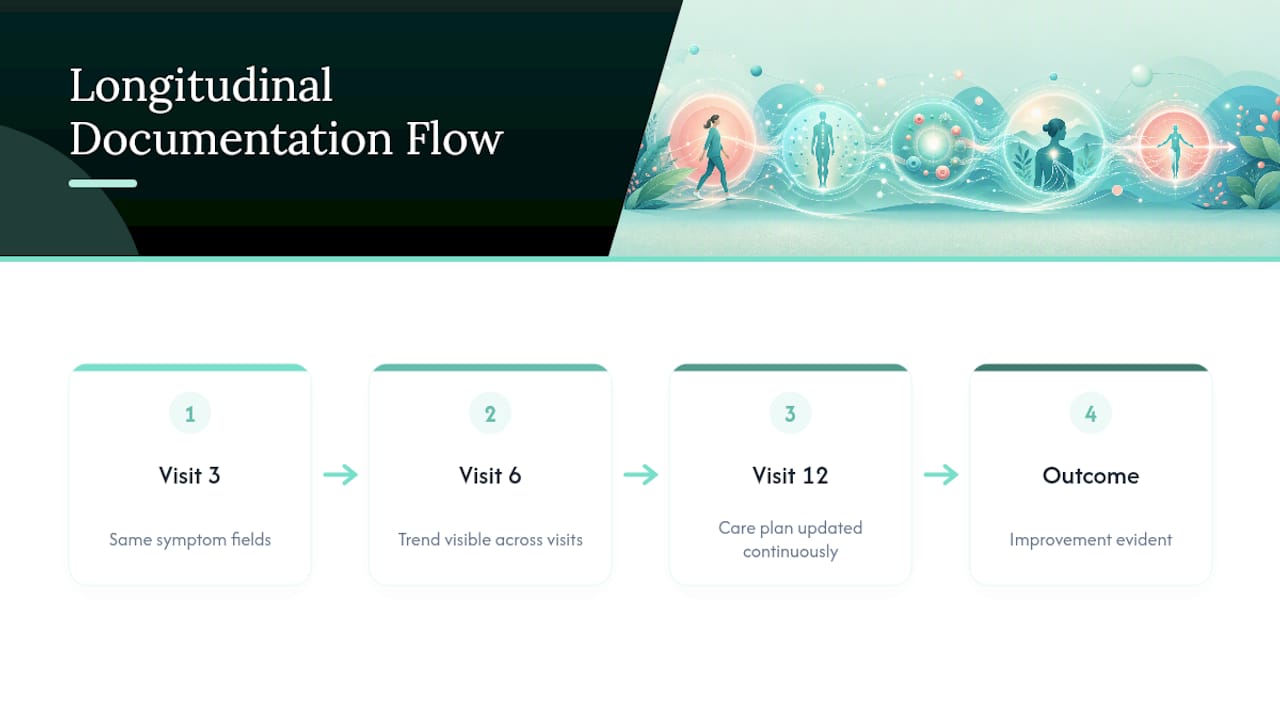
Structured templates solve this by design, not by accident. When a symptom tracker uses the same fields visit over visit, a provider can scan four appointments in under a minute and see the trend line. When a care plan lives in one continuously updated location rather than being rewritten each time, the history of what’s been tried and what worked stays intact. Research on digital health workflows backs this up directly: structured templates and digital workflows measurably improve continuity of care and data quality in longitudinal care models, which is precisely the model functional medicine runs on.
Training staff to think in terms of the functional medicine matrix, the multi-system framework behind root-cause reasoning, helps here too. When documentation templates mirror that matrix, tracking becomes structural instead of relying on any one clinician’s memory of a patient’s history.
Protecting Patient Privacy in Functional Medicine Records
Functional medicine charts tend to hold more sensitive detail than a typical primary care note: extended family history, lifestyle and dietary specifics, mental health context, and sometimes genetic or lab data that goes well beyond a standard panel. That density raises the stakes on privacy training considerably.
Start with access controls that match role, not convenience. A health coach documenting adherence notes doesn’t need visibility into a provider’s full differential reasoning, and an admin staffer capturing intake doesn’t need access to lab results still pending provider review. Role-based access limits exposure if credentials are ever compromised, and it also reduces the odds of a well-meaning staff member accidentally editing a field outside their scope.
Train staff explicitly on what belongs in structured fields versus free text, because free text is where sensitive detail tends to sprawl unnecessarily. A note that says “discussed family history of depression, patient declined to elaborate further” belongs in a structured psychosocial field with defined access rules, not buried in an open narrative box visible to every role that opens the chart.
Portal messaging deserves its own privacy pass during training. Care-plan summaries shared with patients should never carry information one household member shouldn’t see if a shared device or account is involved, and staff should be trained to confirm portal identity verification before sending anything with lab results or diagnosis language.
Finally, build a habit of quarterly access audits: who has viewed which charts, and does that access still make sense given their current role. Clinics that treat this as routine, rather than reactive after an incident, catch access creep before it becomes a real exposure.
Legal and Compliance Considerations Every Clinic Should Train For
Functional medicine documentation carries the same baseline compliance requirements as any clinical charting, HIPAA privacy rules, state licensing board documentation standards, and payer audit requirements, but a few areas need extra attention because of how functional medicine practice actually runs.
Scope-of-practice documentation matters more here than in many specialties. When a health coach documents adherence notes or a nurse drafts a case summary, the chart needs to reflect clearly who performed which clinical action and under what authority. Ambiguous authorship in a chart is one of the fastest ways to trigger a compliance flag during an insurance audit or a licensing board review.
Supplement and off-label treatment documentation needs particular care. Functional medicine plans often include recommendations that fall outside standard formulary guidance, and training should cover exactly how to document the clinical rationale, patient consent, and monitoring plan for these recommendations so the chart supports the treatment decision rather than leaving it looking unexplained.
Informed consent documentation for extended visits and non-standard testing also deserves a dedicated training block. A sixty-minute intake visit or a specialty lab panel outside typical coverage should have consent language and cost disclosure documented at the time of the visit, not reconstructed later if a billing dispute arises.
None of this replaces legal counsel review of your specific compliance obligations, which vary by state licensing board and payer contract. Training should teach staff the documentation habits that keep charts defensible, while pointing genuinely ambiguous scope or consent questions to a compliance officer or legal advisor rather than leaving staff to guess.
Techniques for Catching Documentation Errors Before They Become Problems
Accuracy in functional medicine charting is mostly a mechanics problem, not a knowledge problem. Staff usually know what should go in a chart. What fails is the process for catching what got left out or entered wrong before that gap turns into a clinical or billing issue.
Cross-referencing is the simplest fix and the most skipped one. Before closing a visit note, staff should compare the intake data, the lab import, and the assessment section for consistency, catching things like a medication listed in intake but never referenced in the plan, or a lab value imported but never addressed in the narrative.
Structured fields do more of this work automatically than free text ever will, because a required field can’t be silently skipped the way a sentence in a paragraph can. Training should reinforce this directly: whenever a template offers a structured field instead of an open text box, use it, even if it takes a few extra seconds to fill in properly.
A second-set-of-eyes review works well for anything involving dosages, supplement interactions, or care-plan changes carried forward from a prior visit. This doesn’t need to be a formal sign-off process for every chart, just a habit of a quick peer glance on the entries most likely to carry a costly transcription error.
Weekly spot audits, five or six charts pulled at random and reviewed against a short accuracy checklist, catch drift before it becomes a pattern across an entire care team. Clinics that run this consistently for the first ninety days after training tend to see error rates drop noticeably faster than clinics that wait for an annual compliance review to surface the same issues.
Tools and Software Worth Training Staff On
The right software choice matters less than most clinics assume. What matters more is whether staff are trained thoroughly on whatever system the clinic already runs, because switching platforms rarely fixes a documentation problem rooted in weak training.
That said, a few categories are worth evaluating specifically for functional medicine work. Specialty EHR platforms built with integrative and functional medicine templates in mind tend to require less custom configuration than general-purpose systems, since fields for multi-system review and root-cause synthesis often come built in rather than needing to be built from scratch. General training resources on configuring these systems, including guidance on EHR setup for integrative and functional medicine practices, are worth reviewing before committing to a heavy customization project.
AI-assisted documentation tools are the fastest-growing category, and they’re genuinely useful when scoped correctly: drafting SOAP notes from visit audio, flagging incomplete fields, or auto-populating lab trend summaries. They’re a liability when treated as a replacement for clinical judgment rather than a first draft awaiting review.
Dedicated charting resource libraries, dot-phrase sets, and template packs built specifically for functional and integrative practice, give staff a faster starting point than building templates from scratch. Whatever combination a clinic settles on, the training investment matters more than the tool choice, and a modest software budget paired with thorough training consistently outperforms an expensive platform paired with a rushed rollout.
How to Assess Whether Documentation Training Actually Worked
Training that ends with a certificate of completion and no follow-up measurement is training that clinics can’t actually prove worked. Build assessment into the process from the start, not as an afterthought once staff are back on the schedule full time.
Graded case reports remain the single best individual assessment tool, scored against a consistent rubric that covers structure, completeness, clinical reasoning clarity, and billing-relevant detail. Score the same staff member’s report at the start and end of training to show measurable improvement, which also gives you a defensible record if a licensing board or payer ever asks how documentation competence is verified.
Peer review adds a second layer that catches different problems than a formal rubric does. A colleague reading a chart cold, without the context of having been in the room, will flag confusing phrasing or missing context faster than a self-review ever will.
Live chart audits, conducted weekly during the first month post-training and monthly afterward, are where the real feedback loop lives. Track completeness percentage, average time to chart closure, and error rate by category, and share those numbers back with staff rather than keeping them purely administrative. A small pilot covering one role and one template, followed by a thirty-day metric review, remains the fastest way to prove ROI on a documentation training investment, and that same review structure works just as well as an ongoing feedback mechanism once the pilot phase ends.
Where to Start If You’re Running This as a Pilot
Pilot one role and one template first. Measure your baseline before training, then check the delta at thirty days. Expect some resistance, and use weekly huddles to work through the tech friction as it comes up. For quick wins, lean on template dot-phrases, shared care-plan summaries, and nightly charting audits before scaling anything clinicwide.
— Lauren
Get Structured Documentation Training Through an Accredited Program
An accredited program builds documentation skills similar to those covered here directly into its coursework: structured case-writing practice, template application, and workflow integration guidance for translating functional medicine reasoning into billing-ready, longitudinal charts.
The program runs self-paced, allowing clinic staff to train around existing shift schedules rather than pulling coverage for a multi-day workshop. It includes continuing education units (CEUs) and leads toward various board certification pathways, depending on your role and career goals. Nurses considering the jump often want to know how integrative nursing practice actually changes day-to-day workflow before enrolling, and that context pairs well with the documentation focus covered in this training.
If your clinic is planning a documentation training rollout this year, visit the Institute for Functional Nurses program page to review course modules, certification pathways, and enrollment dates.
Sources
- How to Document Functional Medicine Care Plans in Your EHR — OptiMantra
- PMC article on digital health and documentation