
Functional Medicine Diagnostic Approach Explained
Functional Medicine Diagnostic Approach Explained
The functional medicine diagnostic approach is a science-based, patient-centered method that identifies the root causes of illness by evaluating each person’s unique biology through detailed history, symptom mapping, and targeted testing. Unlike conventional diagnosis, which labels disease, this approach asks why dysfunction is occurring in the first place. The Institute for Functional Medicine popularized this framework, and practitioners trained in systems biology use it to build personalized care plans that go far beyond symptom management. If you are a healthcare practitioner or someone pursuing holistic health, understanding this process changes how you see every patient encounter.
What is the functional medicine diagnostic approach?
The functional medicine diagnostic approach is an iterative, 10-step process that moves from comprehensive history intake through hypothesis-driven testing to care plan refinement. Each step builds on the last. The process does not require a fixed diagnosis at the start. Instead, it organizes a patient’s timeline and symptoms to sequence tests and interventions logically.
This is systems biology applied to clinical practice. The body is treated as an interconnected network, not a collection of isolated organs. A symptom in one system almost always reflects dysfunction in another. Functional medicine practitioners are trained to see those connections and trace them back to their source.

The result is a diagnostic picture that is specific to one individual, not averaged across a population. That specificity is what makes this approach so powerful for patients who have been told their labs are “normal” while still feeling unwell.
How does functional medicine work during patient evaluation?
The first clinical step is a thorough intake visit. Functional medicine visits typically run 60–90 minutes, compared to the standard 15-minute appointment in conventional care. That time difference is not a luxury. It is a clinical necessity.
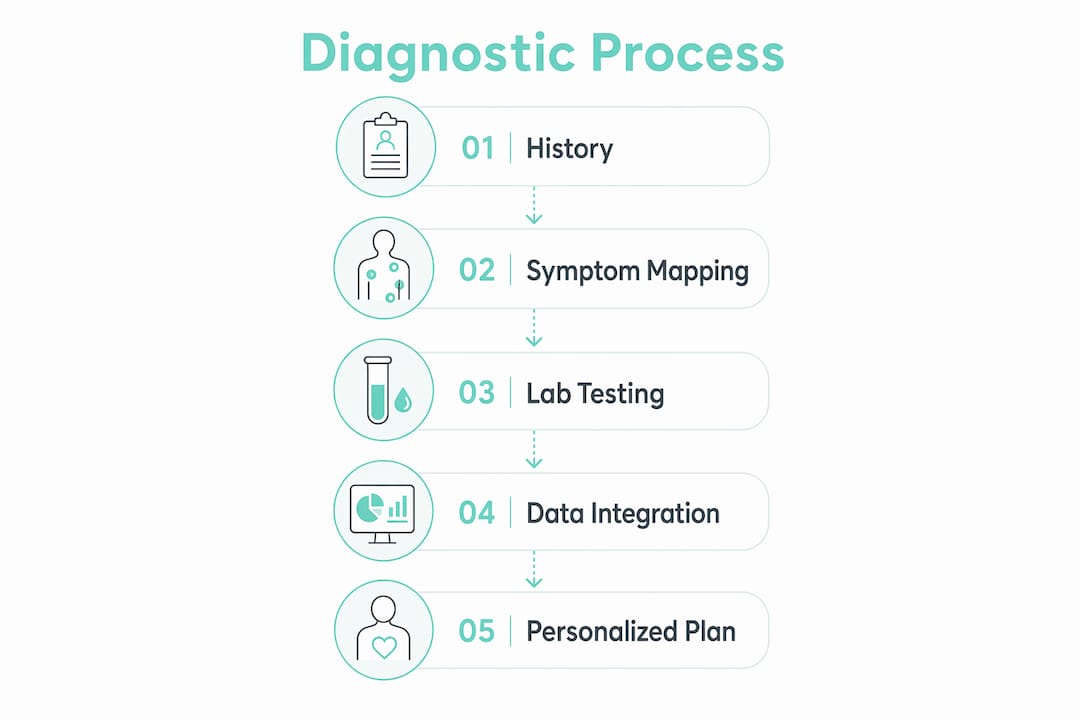
During intake, practitioners collect a full health history that includes lifestyle habits, environmental exposures, past diagnoses, medications, stress patterns, and family history. Symptoms are then mapped to physiological systems to identify patterns rather than isolated complaints. A patient reporting fatigue, brain fog, and weight gain is not presenting three separate problems. Those symptoms may all point to a single upstream driver, such as thyroid dysfunction or chronic inflammation.
The stepwise evaluation process looks like this:
- Comprehensive history intake covering all body systems and life events
- Symptom mapping to identify which physiological systems are involved
- Pattern recognition to form initial clinical hypotheses
- Hypothesis-driven test selection to clarify specific questions
- Contextual lab interpretation using functional reference ranges
- Prioritization of root drivers versus downstream effects
- Care plan development tailored to the individual
- Monitoring of outcomes over time
- Iterative refinement as new data emerges
- Long-term relationship to sustain and build on improvements
Pro Tip: Document the patient’s full timeline from birth to present, including major life stressors, infections, and environmental changes. Patterns that span years often reveal the true origin of chronic illness.
What do functional medicine lab tests actually measure?
Functional medicine testing is hypothesis-driven, not broad or indiscriminate. Tests are selected to answer specific clinical questions formed during history intake, not to run every panel available. Overtesting creates noise and delays clarity.
The most important distinction in functional medicine lab interpretation is the use of optimized reference ranges. Standard labs identify disease; functional labs identify early dysfunction by applying tighter, functionally optimal ranges rather than broad population-based norms. A TSH of 3.5 mIU/L may fall within the standard lab’s reference range but still indicate suboptimal thyroid function when evaluated through a functional lens.
Normal results on standard labs may still indicate dysfunction when interpreted with symptom context and functional ranges. This is why patients with clear symptoms are sometimes dismissed after a “normal” blood panel. Functional medicine closes that gap.
Here is how standard and functional lab approaches compare across key testing categories:
| Testing Category | Standard Medicine Approach | Functional Medicine Approach |
|---|---|---|
| Thyroid | TSH only | TSH, free T3, free T4, reverse T3, thyroid antibodies |
| Cortisol | Single morning draw | Four-point salivary cortisol rhythm |
| Inflammation | CRP (standard) | High-sensitivity CRP (hs-CRP), homocysteine, ferritin |
| Gut Health | Stool culture for pathogens | Comprehensive microbiome analysis including diversity markers |
| Nutrients | Rarely tested | Full vitamin, mineral, and amino acid panels |
Advanced functional testing includes detailed hormone panels, inflammatory markers, stool microbiome analysis, and nutrient assessments. Each test is selected because it answers a specific question raised by the patient’s history and symptoms. Labs are never interpreted in isolation. They are always read alongside the full clinical picture.
Pro Tip: When ordering a thyroid panel, always include reverse T3 alongside free T3. The ratio between these two markers reveals conversion problems that a standard TSH test will completely miss.
How does the functional medicine matrix organize diagnosis?
The Functional Medicine Matrix is a visual framework that organizes complex patient data across seven body system nodes and a timeline of triggers and mediators. The matrix integrates assimilation, defense and repair, energy, biotransformation and elimination, transport, communication, and structural integrity into a single diagnostic map. Practitioners use it to see where multiple symptoms converge and which upstream imbalances are driving downstream effects.
The matrix is not just an organizational tool. It is a prioritization engine. When a practitioner maps a patient’s symptoms across all seven nodes, patterns emerge that would be invisible in a standard problem-focused visit. A patient with digestive complaints, mood instability, and joint pain may show dysfunction clustering around the assimilation and defense nodes. That clustering points toward gut-immune axis dysregulation as the root driver.
| Matrix Node | Body Systems Involved | Common Dysfunction Signals |
|---|---|---|
| Assimilation | Digestion, absorption, microbiome | Bloating, nutrient deficiency, food sensitivity |
| Defense and Repair | Immune, inflammatory response | Chronic infections, autoimmunity, allergies |
| Energy | Mitochondrial function, metabolism | Fatigue, brain fog, weight dysregulation |
| Biotransformation | Liver detox, elimination pathways | Chemical sensitivity, hormonal imbalance |
| Transport | Cardiovascular, lymphatic | Edema, circulation issues, cardiovascular risk |
| Communication | Hormones, neurotransmitters | Mood disorders, sleep disruption, hormonal symptoms |
| Structural Integrity | Musculoskeletal, cellular membranes | Pain, inflammation, tissue breakdown |
The matrix framework prioritizes interventions that address upstream imbalances first, unlocking improvements in multiple downstream systems simultaneously. Treating the gut, for example, often resolves symptoms in the communication and defense nodes without directly targeting those systems. That is the power of root-cause thinking.
Functionalacademy trains practitioners to use the matrix as a living document, updated at each visit as new lab data and patient feedback refine the clinical picture. You can explore this further in Functionalacademy’s guide on the Functional Medicine Matrix for practitioners.
Functional medicine vs. conventional diagnostic methods
Functional medicine expands conventional care by asking why illness occurs rather than only what illness is present. This is a fundamental shift in diagnostic philosophy, not just a difference in test selection.
Here is where the two approaches diverge most clearly:
- Visit length: Functional medicine intake runs 60–90 minutes. Conventional visits average 15 minutes. That time gap determines how much history a practitioner can realistically collect.
- Diagnostic goal: Conventional medicine categorizes disease. Functional medicine identifies the specific biological drivers behind that disease in one individual.
- Lab interpretation: Conventional labs use population-based reference ranges. Functional labs use optimized ranges that detect suboptimal physiology before disease is established.
- Testing philosophy: Conventional panels are broad and protocol-driven. Functional testing is targeted and hypothesis-driven, selected to answer specific clinical questions.
- Treatment direction: Conventional care often manages symptoms with medication. Functional care targets root causes through nutrition, lifestyle, supplementation, and targeted therapies.
- Patient engagement: Functional medicine requires active patient participation in history collection and lifestyle change. Conventional care is often more passive for the patient.
Neither approach is wrong. Functional medicine is best seen as an expansion of conventional care using systems biology and personalized diagnostics to identify deeper causes. The two models work best together, with functional diagnostics filling the gaps that conventional testing leaves open.
Practical applications for practitioners and holistic health seekers
Effective functional medicine evaluation depends on clinical reasoning, not just test ordering. Testing is purposeful; it clarifies questions raised by history, not replaces the thinking required to form those questions. Practitioners who skip thorough history-taking and jump straight to broad lab panels often end up with data they cannot interpret meaningfully.
The diagnostic process is iterative by design. Do not expect a complete picture after the first visit. Each round of testing refines the hypothesis and narrows the focus. A patient presenting with fatigue may initially point toward thyroid dysfunction. First-round labs may confirm suboptimal thyroid conversion, which then raises questions about cortisol rhythm and gut absorption. Second-round testing addresses those specific questions. The picture builds over time.
Integrating patient history, lab data, and lifestyle factors produces a care plan that is genuinely personalized. Micronutrient testing, for example, reveals deficiencies that standard panels miss entirely. Resources like this micronutrient monitoring guide show how tracking specific nutrients informs both diagnosis and therapeutic direction. Understanding how functional medicine improves patient outcomes gives practitioners a clear picture of what this process delivers in real clinical settings.
Pro Tip: Sequence your tests in clinical priority order. Start with the systems most likely driving the patient’s chief complaint, then expand based on what the first round reveals. This approach saves time, reduces cost, and keeps the diagnostic process focused.
Key takeaways
The functional medicine diagnostic approach identifies root causes of illness through a structured, iterative process that integrates patient history, symptom mapping, targeted lab testing, and the Functional Medicine Matrix to build a personalized clinical picture.
| Point | Details |
|---|---|
| Root-cause focus | Functional medicine asks why dysfunction occurs, not just what disease is present. |
| Longer intake visits | Visits run 60–90 minutes to collect the full history needed for accurate hypothesis formation. |
| Optimized lab ranges | Functional labs use tighter reference ranges to detect suboptimal physiology before disease is established. |
| Matrix framework | The seven-node Functional Medicine Matrix maps symptoms to upstream drivers and prioritizes interventions. |
| Iterative refinement | Diagnosis is a process, not a single event; each round of testing sharpens the clinical picture over time. |
Why this approach changed how i see every patient chart
I have reviewed hundreds of patient cases where the conventional workup came back clean and the patient was still suffering. That pattern is not rare. It is the norm for a significant portion of people with chronic, complex conditions. What functional diagnostics revealed in those cases was not exotic or mysterious. It was suboptimal thyroid conversion, gut dysbiosis driving systemic inflammation, or cortisol patterns that disrupted sleep and metabolism. The answers were in the data all along. The standard tools just were not looking in the right places.
What I find most valuable about this diagnostic framework is the discipline it requires. You cannot shortcut the history. You cannot skip the matrix. The process forces you to think before you test, and that discipline produces better clinical decisions. Practitioners who embrace the complexity of this approach, rather than resisting it, consistently report better patient engagement and more meaningful outcomes.
My advice to anyone new to functional diagnostics: be patient with the process. The first few cases feel slow. By the tenth, the pattern recognition becomes second nature. The matrix stops feeling like a worksheet and starts feeling like a clinical superpower. Stick with it. The patients who have been failed by conventional care are counting on practitioners who think this way.
— Lauren
Build your functional medicine diagnostic skills with Functionalacademy
Ready to put this into practice? Functionalacademy’s fully accredited Board Certification program gives healthcare practitioners the clinical tools to apply functional medicine diagnostic methods from day one.
The Institute for Functional Nurses at Functionalacademy delivers online training that covers the full diagnostic process, from intake and matrix mapping to advanced lab interpretation and personalized care planning. This is not theory. It is practical, evidence-based training designed to fit into your existing practice without requiring you to start over. Practitioners who complete this program report stronger clinical confidence, better patient outcomes, and a clear competitive edge in a healthcare market that is demanding this expertise right now. Take the next step and build the skills that actually change lives.
FAQ
What is the functional medicine diagnostic approach?
The functional medicine diagnostic approach is a patient-centered, systems biology-based method that identifies root causes of illness through detailed history intake, symptom mapping, and hypothesis-driven lab testing. It differs from conventional diagnosis by focusing on why dysfunction occurs rather than simply labeling a disease.
How does functional medicine testing differ from standard lab work?
Functional medicine testing uses optimized reference ranges to detect suboptimal physiology that standard population-based norms would classify as normal. Tests are selected to answer specific clinical questions formed from patient history, not ordered as broad, indiscriminate panels.
What is the functional medicine matrix?
The Functional Medicine Matrix is a diagnostic framework that organizes patient symptoms and history across seven body system nodes, including assimilation, energy, and communication, to identify upstream root drivers and prioritize interventions.
How long does a functional medicine evaluation take?
Initial functional medicine intake visits typically run 60–90 minutes, compared to the standard 15-minute conventional appointment. That extended time is necessary to collect the full history required for accurate hypothesis formation and test sequencing.
Can functional medicine diagnostics work alongside conventional care?
Yes. Functional medicine is best understood as an expansion of conventional care, not a replacement. It uses systems biology and personalized diagnostics to fill the gaps that standard testing leaves open, and works most effectively when integrated with conventional clinical findings.