Clinicians 5 Checkpoints for Accredited Functional Medicine Certification
Clinicians 5 Checkpoints for Accredited Functional Medicine Certification
The pathway runs through five checkpoints: confirm your license and clinical hours, complete an accredited training program, submit your application with documentation, pass the exam or portfolio review, then maintain your credential through continuing education. Most licensed clinicians (RNs, NPs, MDs, DOs, PAs) complete their certification pathway in a timeframe ranging from a few months up to about a year and a half, with costs varying widely depending on whether they choose a graduate certificate, a board-style credential through a body like the American Board of Physician Specialties, or a practice-focused program such as certain board certification tracks.
TL;DR:
- Most certification pathways take between three months and a year and a half, with costs and rigor increasing from certificates to board credentials.
- Board-style certifications require an active license, clinical hours, and a passing exam, providing the strongest recognition for specialists.
- Certificate programs are faster and more flexible but generally offer less formal recognition, suitable for clinicians seeking quick practical skills.
- Confirm that Continuing Education hours from the chosen program are accepted by your licensing board before enrolling.
- Practical clinical application and accreditation are crucial, with clinical case work directly translating into patient care and professional credibility.
Table of Contents
- What the Functional Medicine Certification Pathway Actually Requires
- Recognized Credentials and What They Signify
- Choosing a Program Type: Certificates, Board Pathways, or Fellowships
- Costs, Time Commitment, and Realistic Timelines
- Eligibility and Prerequisites You Need Before You Apply
- How to Apply, Prepare, and Sit for the Exam
- Maintaining Certification: CE, Renewal, and Recordkeeping
- Why Accreditation and Clinical Application Matter More Than the Diploma
- Choosing a Pathway When Time and Budget Are Both Tight
- Your Next Step Toward Board Certification in Functional Medicine
- Verify the Details Before You Enroll
- Sources
- FAQ
What the Functional Medicine Certification Pathway Actually Requires
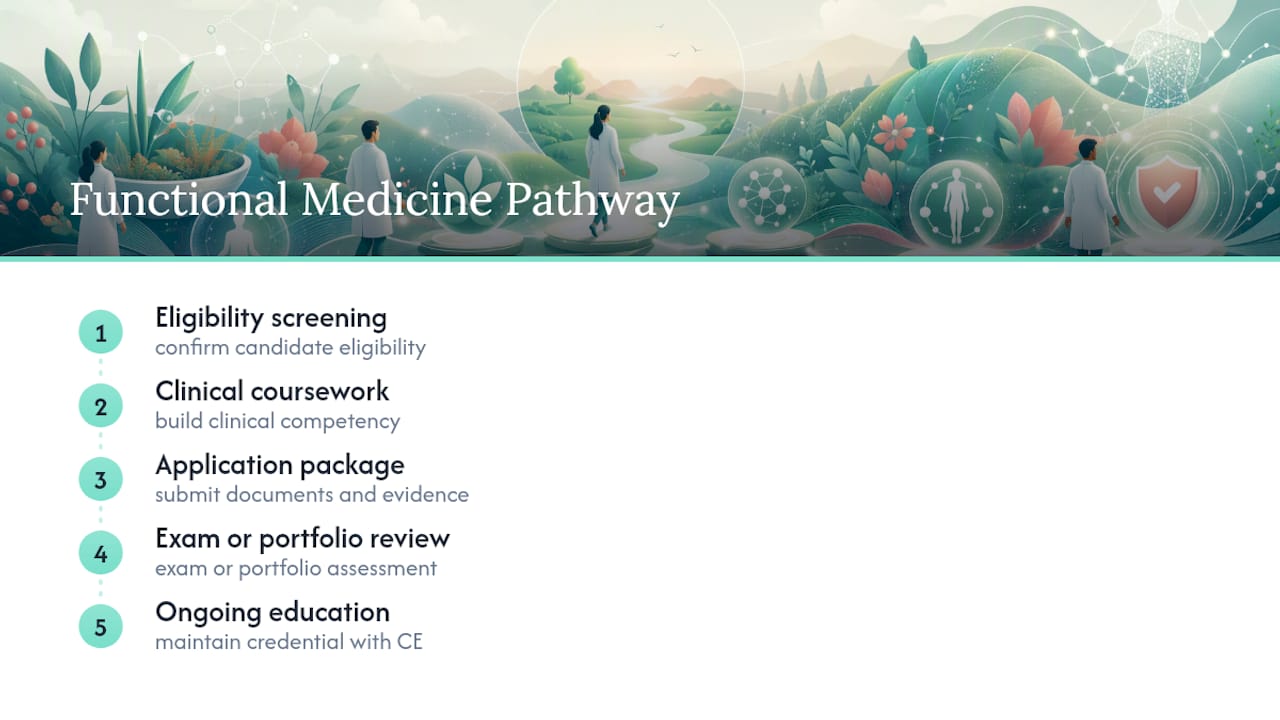
Every credible functional medicine certification pathway is built on the same scaffolding, even when the names on the diplomas differ. You start with eligibility screening, move through coursework that builds clinical competency, submit an application package, sit for an exam or portfolio review, and then commit to ongoing education to keep the credential active. What varies between programs is the depth of clinical hours required, the rigor of the exam, and whether the sponsoring body issues board certification, professional certification, or an academic certificate.
Healthcare professionals often assume “certified in functional medicine” means one standardized thing. It doesn’t. A nurse who completes a 15 credit graduate certificate at a university and a physician who earns board certification through an organization structured like the American Board of Integrative Medicine have taken different roads to related, but not identical, destinations. Both are legitimate. Neither is interchangeable with the other when it comes to how employers, insurers, or state boards interpret the title.
Recognizing which credential you’re actually working toward saves you from the single most common mistake in this space: enrolling in a program that doesn’t match your career goal.
Recognized Credentials and What They Signify
Three broad credential categories dominate this space, and each communicates something different to patients, employers, and licensing bodies.
- Board-style certification typically requires an active license, documented clinical hours, and a passing score on a written exam. Bodies like the American Board of Physician Specialties issue credentials that let successful candidates represent themselves as specialists, a designation that carries real weight in credentialing files and malpractice conversations.
- Professional certification (the category most nurse-focused and practitioner-focused programs fall into) usually requires completing graded coursework, submitting case documentation, and often passing a competency exam, but doesn’t carry the same formal “board specialist” designation.
- Graduate certificates, offered through university health science divisions, function as academic credentials. They’re frequently structured as 15-credit programs delivered online, and many transfers directly into master’s degree programs if you decide to go further later.
Each type has its own gravity. Board-style certifications tend to demand stricter eligibility (licenses, sometimes residencies, letters of recommendation) but deliver the strongest specialist recognition. Professional certifications reward clinical application and case-based competency. Academic certificates carry weight in university and research settings but may say less to a private practice patient than “board certified” does.
Choosing a Program Type: Certificates, Board Pathways, or Fellowships
Once you understand the credential categories, the next decision is which program structure actually fits your practice and your calendar.
- Standalone certificate programs. These are the fastest route into functional medicine competency, usually built around self-paced modules and clinical case application, without demanding a multi-year academic commitment. They fit clinicians who want to start using root cause frameworks with patients within months, not years.
- Board certification pathways. These combine structured coursework with a formal exam or portfolio review and issue a board-recognized title, such as the FIM-P, BC-FMP, or BC-FMC pathways offered through Functionalacademy. They fit clinicians who want the strongest professional signal on a resume or a practice website.
- University fellowships and graduate certificates. These take longer, cost more, and often require in-person residencies or synchronous coursework. They fit clinicians pursuing academic advancement or eventual master’s level credentials.
Your decision should hinge on four factors: how fast you need to apply functional medicine skills in practice, whether your state board or employer specifically recognizes board certification, whether the CE hours will count toward your existing license renewal, and how much time you can realistically protect each week for coursework.
Pro Tip: Before enrolling anywhere, ask the program directly whether its CE hours are accepted by your state licensing board for your specific credential. A program can be excellent and still not count toward your renewal requirements if the accreditation doesn’t match your license type.
Fellowships win on prestige and depth. Board pathways win on speed to practical, patient-facing competency. Certificates win on cost and flexibility. None of them is wrong. They’re just built for different clinicians at different career stages.
Costs, Time Commitment, and Realistic Timelines
Budget planning for a functional medicine certification pathway needs to account for tuition, fees most programs don’t advertise upfront, and the actual hours you’ll spend studying around a clinical schedule.
- Short certificate programs: tuition costs vary and are usually moderate, completed in a few months of part-time, self-paced study.
- Board certification pathways: cost and duration depend on coursework and possible extra modules, typically completed within up to a year.
- University graduate certificates and fellowships: usually the most expensive and longest, taking from several months to a couple of years, sometimes with in-person residency requirements.
- Hidden extras: exam fees, professional membership dues, required textbooks, and travel for any in-person components.
Demand for this training keeps climbing for a reason worth sitting with, as top doctors are embracing integrative health in increasing numbers. The NIH has documented a significant rise in patient use of complementary health approaches, particularly for pain management, which means patients are already asking their clinicians questions that traditional training didn’t prepare them to answer. That demand curve is exactly why certification timelines matter. The clinicians moving fastest into board-recognized credentials are positioning themselves ahead of a patient population that’s already looking for this kind of care.
Eligibility and Prerequisites You Need Before You Apply
Most functional medicine training programs share a baseline set of prerequisites, even though the specifics shift by credentialing body.
- An active, unrestricted healthcare license (RN, NP, MD, DO, PA, or equivalent, depending on the program).
- A minimum number of supervised or documented clinical hours, which varies by pathway but often ranges from several hundred to over a thousand for board-level credentials.
- Prior coursework or a degree in a relevant clinical field, confirmed through transcripts.
- Application documentation, usually a current CV, a copy of your license, one or two professional letters of recommendation, and sometimes a case log demonstrating patient-facing experience.
Allied health professionals (health coaches, dietitians without a clinical license, or nutritionists) occupy a gray zone. Some programs, including several professional certification tracks, welcome them into non-board pathways or coaching-focused certificates, while board-style credentials generally reserve eligibility for licensed clinicians. If you’re unsure where you land, contact the program’s admissions team before you pay a deposit. It’s a five-minute question that prevents a very expensive mistake.
How to Apply, Prepare, and Sit for the Exam
The application and exam sequence follows a fairly predictable rhythm across most accredited pathways, though the depth of the exam varies by credential level.
- Submit your application package (CV, license copy, transcripts, letters of recommendation) through the program’s candidate portal, typically several weeks before your target coursework start date.
- Complete required coursework, which usually blends self-paced modules with clinical case application assignments graded for competency, not just completion.
- Log clinical hours or case documentation as you go, rather than scrambling to compile them right before your exam window opens.
- Schedule your exam or portfolio review, which most programs open only after coursework and hour requirements are verified as complete.
- Sit for the assessment. Exam formats vary; some rely on multiple choice competency testing, others use case-based portfolio review, and some, following frameworks similar to those used by IBHIM’s board certification categories, incorporate a structured practical component.
Exams typically test systems thinking, nutrition science, clinical reasoning applied to chronic disease, and your ability to build a root cause treatment plan from a patient case. The most effective preparation sequence is coursework first, case logs second, and timed practice questions third, in that order. Skipping straight to practice questions without the clinical case work behind you tends to produce candidates who can answer questions but struggle when the exam presents an unfamiliar patient scenario.
Maintaining Certification: CE, Renewal, and Recordkeeping
Earning the credential is the beginning of an ongoing obligation, not the finish line. Most functional medicine certifications require renewal every one to two years, with continuing education requirements typically ranging from 15 to 40 hours per cycle depending on the credentialing body.
- Confirm which CE activities count. Programs aligned with ACCME standards or an equivalent recognized accreditor are far more likely to have their CE hours accepted by other boards or by your employer’s credentialing office.
- Keep digital records of every CE certificate the moment you earn it, rather than trying to reconstruct two years of documentation the week before renewal.
- Set a calendar reminder 90 days before your renewal deadline. Missed reporting windows are the single most common (and most avoidable) reason clinicians lose an active credential.
Why Accreditation and Clinical Application Matter More Than the Diploma
An accredited, practice-focused certification does more than decorate a wall. It tells patients, employers, and licensing boards that your training met a defined competency standard, not just a marketing claim.
Systematic reviews published through PMC consistently point to the importance of evidence-informed training when clinicians apply integrative and complementary approaches, particularly around safety considerations that untrained practitioners routinely miss.
That’s the real argument for choosing an accredited program over a loosely structured workshop. Some board certification pathways build in clinical case application specifically so the coursework translates into patient encounters, not just theory retained for an exam. PMC reviews of lifestyle and integrative interventions reinforce why that clinical grounding matters for chronic disease management, where root cause thinking tends to outperform symptom management alone.
Pro Tip: Before enrolling in any program, request the syllabus, confirm the CE hours are approved by an accreditor your board recognizes, and ask exactly how many clinical case hours the coursework requires. A program that won’t share this upfront is telling you something.
Choosing a Pathway When Time and Budget Are Both Tight
Every clinician I’ve watched go through this decision eventually confronts the same tension: accreditation, speed, and cost rarely all point the same direction. The credential with the strongest name recognition often takes the longest and costs the most, while the fastest certificate might not carry the specialist weight you want on a practice website.
The clinicians who navigate this well do three things immediately after researching their options: they confirm their state board’s CE acceptance rules in writing, they request a syllabus from no more than two programs before committing, and they block recurring calendar time for coursework instead of hoping it fits in around shifts. Protecting even five hours a week turns an 18-month timeline into something closer to ten.
— Lauren
Your Next Step Toward Board Certification in Functional Medicine
If you’ve made it this far, you already know the difference between a weekend workshop and a credential that actually moves your career. The Institute for Functional Nurses at Functionalacademy exists for exactly that gap: an accredited board certification pathway built specifically for licensed clinicians who want to apply functional medicine in practice without pausing their career for two years to do it.
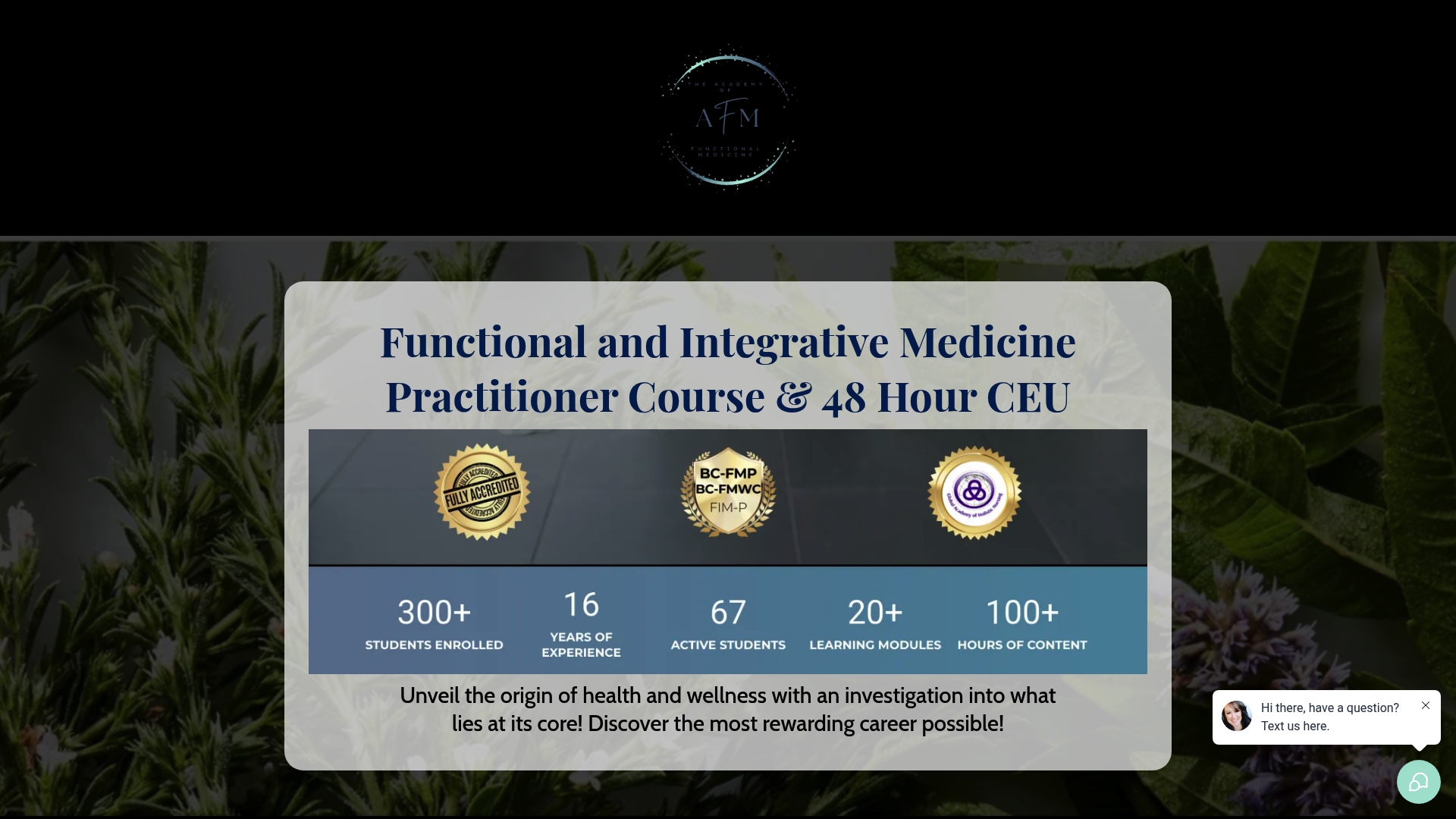
Here’s the snapshot. Some programs offer fully accredited board certification tracks, self-paced modules built around clinical case application rather than theory alone, and CEUs designed to slot into existing license renewal requirements. Nurses, nurse practitioners, and licensed healthcare practitioners are the clinicians who benefit most, walking away with the competency to identify root causes in chronic disease patients and the board credential to back it up professionally. Many graduates also tap into the program’s business and marketing coaching, useful if you’re building a functional medicine practice rather than just adding a skill inside an existing role, a path explored further in how nurses attract wellness clients that stay.
Ready to see where you’d start? Explore the certification pathways at Functionalacademy and request the program syllabus for the track that matches your license and career goal.
Verify the Details Before You Enroll
Confirm program specifics directly with primary sources before committing tuition:
- American Board of Integrative Medicine eligibility criteria
- ACCME continuing education accreditation standards
- IBHIM board certification competency categories
- Credentialing Excellence professional standards
Request each program’s candidate handbook, CE policy document, and exam blueprint before you enroll.
This article is general information, not a substitute for advice from a qualified doctor. Consult a qualified healthcare professional about your own circumstances before acting on anything here.
Sources
- American Board of Integrative Medicine (ABOIM) / career.uconn.org
- NIH news release on rise in complementary health approaches
- PMC article (relevant review)
- ACCME — Accreditation Council for Continuing Medical Education
FAQ
How long does it take to become certified in functional medicine?
Most licensed clinicians complete a certification pathway in a timeframe ranging from a few months up to about a year and a half, depending on whether they choose a short certificate, a board certification track, or a university graduate certificate.
How do you become certified in functional medicine?
You confirm eligibility (active license and clinical hours), complete accredited coursework with clinical case application, submit your application documentation, pass the exam or portfolio review, then maintain the credential through continuing education.
Is a functional medicine certificate worth it?
For licensed clinicians, a board-recognized certificate signals specialist competency to patients and employers, and it’s arriving at a moment when patient demand for complementary and integrative approaches is rising sharply, making the investment increasingly relevant to career growth.
Which functional medicine certification is best?
The best pathway depends on your license type and career goal: board certification pathways like those offered through Functionalacademy suit clinicians who want fast, clinically applicable training with formal board recognition, while university graduate certificates suit those pursuing academic or research-track credentials.