
Functional Medicine Board Certification: A Clinician's Guide
Functional Medicine Board Certification: A Clinician’s Guide
A recognized functional medicine board certification is a diplomate-style credential issued by an independent credentialing body after you pass a competency exam. Verify the governing body before you enroll in anything. Eligibility depends entirely on your existing license and scope of practice: a registered nurse, nurse practitioner, and physician often qualify for different tiers of the same credential, not identical ones.
Your immediate next step, before comparing curricula or price tags, is simple:
- Confirm the credentialing body has independent governance, separate from the school selling the course
- Check that competencies are published publicly, not just described in marketing copy
- Verify there’s an actual exam or assessed clinical work, not just a certificate of attendance
- Look for stated renewal and continuing education requirements
If a program can’t show you those four things in writing, it’s a certificate, not a board certification, no matter what the sales page calls it.
Key Takeaways
Board-style functional medicine certification requires independent governance, a published competency framework, an assessed exam, and renewal requirements, not just completed coursework.
| Point | Details |
|---|---|
| Governance comes first | Confirm the certifying body operates independently of the teaching program before comparing anything else. |
| Certificates aren’t certification | Completion certificates and CE credits document learning; board certification independently verifies competency. |
| Eligibility tracks your license | Nurses, NPs, and physicians can all qualify, but scope of practice determines what you can do with the credential. |
| Budget for three cost categories | Course fees, exam or application fees, and renewal fees typically apply separately. |
| Functionalacademy offers a clinically focused pathway | The Institute for Functional Nurses provides an accredited board certification with case-based application, CEUs, and pathways like FIM-P, BC-FMP, and BC-FMWC. |
Table of Contents
- What Is Functional Medicine Board Certification, Really?
- Who Can Get Certified, and What Are the Common Paths?
- How Long Does Certification Take, and What Does It Cost?
- Does Board Certification Actually Help Your Career?
- How Do You Vet a Program Before You Enroll?
- Where the Institute for Functional Nurses Fits This Checklist
- What Nurses Get Wrong About Board Certification
- Ready to Pursue an Accredited Credential?
- Sources
What Is Functional Medicine Board Certification, Really?
Board-style certification means an independent body, separate from whoever taught you the material, tests your competency against a published standard and issues a credential you renew on a schedule. That independence matters more than most clinicians realize when they start shopping for programs. A school grading its own final exam and calling the result a “board certification” isn’t the same thing as a credentialing body with its own governance structure evaluating candidates from multiple training backgrounds.
Certificates and continuing education programs serve a real purpose. They document that you completed coursework and absorbed material. But completion isn’t competency verification, and a CE certificate doesn’t carry the same weight when a hospital credentialing committee, an insurance panel, or a referring physician looks at your file. Credentialing organizations treat governance and published competency frameworks as the foundation of legitimate certification, not an optional extra.
Here’s what separates a real board-style credential from a repackaged course:
- Independent governance. The certifying body operates separately from any single training program, even if it accepts coursework from that program as a prerequisite.
- A public competency framework. You can find, before you pay, the exact clinical skills and knowledge areas the exam covers.
- An actual exam or graded assessment. Not a quiz you can retake until you pass; a real competency check.
- Renewal and continuing education requirements. Credentials that never expire and never require updated learning aren’t tracking your ongoing competence.
- A verifiable credential. You should be able to look up your certification status, or have a third party verify it, after you’re certified.
Organizations building national examination boards in functional medicine describe their mission in almost identical terms: standardizing educational requirements and diagnostic skills so a credential means the same thing regardless of which school prepared the candidate.
Pro Tip: Ask any program directly, “Who governs your certification, and is that body separate from your teaching faculty?” A program that hesitates on that question is telling you something.
Who Can Get Certified, and What Are the Common Paths?
Eligibility hinges on your license, not your job title. Registered nurses, nurse practitioners, physicians, physician assistants, and in some programs health coaches working under supervision can all pursue functional medicine credentials, but the scope of what you’re certified to do with that credential tracks your existing license. A physician certified in functional medicine can diagnose and treat within their specialty. A registered nurse certified in the same framework applies that knowledge within RN scope of practice, which varies by state.
Prerequisites typically include:
- An active, unrestricted clinical license (RN, NP, MD, DO, PA, or equivalent)
- A minimum number of clinical practice hours, sometimes pre- or post-certification
- Completion of core coursework covering systems biology, clinical nutrition, and root-cause assessment
- Documented case logs or a clinical portfolio for programs using experiential pathways
Not every pathway looks the same. Some programs are education-first: you complete structured coursework, then sit for the exam. Others use portfolio or mentorship routes, where you submit case summaries, supervisor attestations, and reflective clinical write-ups instead of, or alongside, a written exam. This matters especially for nurses moving from a purely conventional care model into integrative nursing practice, where a bridge pathway acknowledges existing clinical hours rather than requiring you to start from zero.
How Long Does Certification Take, and What Does It Cost?
Certification typically runs anywhere from a few months to roughly a year, depending on whether you’re studying part time around a full clinical schedule or moving through an accelerated track. The sequence looks fairly consistent across reputable programs:
- Confirm your license and scope meet the program’s eligibility rules.
- Complete core coursework in systems biology, clinical nutrition, and root-cause clinical formulation.
- Assemble case logs or a portfolio if the pathway requires experiential documentation.
- Sit for the competency exam, or submit your portfolio for board review.
- Receive your credential and register for renewal tracking.
- Complete continuing education hours on the schedule the board sets, typically every one to two years.
Exams generally assess clinical formulation (can you build a root-cause treatment plan from a case presentation?), a systems-based approach to chronic disease, and therapeutic nutrition and supplementation knowledge. Costs break into three categories: the education or course fee, a separate application or exam fee, and a renewal fee due on your recertification cycle. Budget for all three; programs that quote only the course price often surprise candidates later with exam and renewal costs.
Case-log practice and mentorship documentation aren’t just eligibility paperwork. Structured case summaries and supervisor attestations sharpen the exact clinical reasoning skills the exam tests. Practicing formulation on real or simulated cases, including how you’d sequence a clinical supplement workflow, is one of the higher-yield ways to prepare, because it forces you to justify a plan rather than just recall facts.

Does Board Certification Actually Help Your Career?
A board-style credential changes how referring providers, patients, and sometimes employers read your qualifications. It signals that an outside body, not just your employer or your own website, verified your competency in root-cause, systems-based clinical care. That distinction shows up concretely in referral patterns: physicians and other nurses are more willing to send patients to a colleague whose credential they can independently verify.
For nurses specifically, certification tends to open doors that a certificate alone doesn’t:
- Expanded service offerings within your existing scope of practice
- Stronger client retention, since patients often seek out the credential specifically
- Higher income potential tied to specialized services, particularly for nurses building independent or hybrid practices
But certification has real limits you should know before you count on it for anything beyond credibility. It is not equivalent to an ABMS-recognized medical specialty board, and it doesn’t expand your legal scope of practice or automatically grant hospital privileges or insurance panel status.
A functional medicine credential tells patients and colleagues you’ve been independently assessed on root-cause clinical reasoning. It does not, by itself, change what your license legally permits you to do. Every nurse should check that distinction against her own state board rules and employer credentialing policy before assuming certification changes her scope.
The American Nurses Association publishes guidance specifically because scope-of-practice confusion after certification is common enough to warrant it.
How Do You Vet a Program Before You Enroll?
Run every program through the same short list of questions. A legitimate board-style certification should answer all of them without evasion, and the answers should be published somewhere you can check independently, not just delivered verbally by an admissions rep.
| Checklist Item | What You’re Looking For |
|---|---|
| Governance | Certifying body is independent of the teaching program |
| Competencies | Published, specific list of clinical skills the exam covers |
| Assessment | An actual exam or graded portfolio review, not attendance credit |
| Renewal policy | Stated CE hours and recertification interval |
| Clinical emphasis | Curriculum built around clinical application, not theory alone |
Ask admissions staff directly: “Who governs the certifying exam, and is that separate from your teaching faculty? What happens if I don’t recertify on schedule? Can a third party verify my credential once I earn it?”
Red flags are usually easy to spot once you’re looking for them. No exam or assessment of any kind. Competencies described only in vague marketing language (“holistic,” “cutting-edge”) rather than a specific skills list. No renewal or CE requirement at all, which usually means the credential never gets checked again after you pay. Alumni success claims you can’t verify independently.
Pro Tip: Search for the credentialing body’s name plus “verify credential” before you enroll. If nothing comes up, and you can’t find a third-party way to confirm someone’s certification status, that’s worth a direct question to the program before you pay anything.
Where the Institute for Functional Nurses Fits This Checklist
The Institute for Functional Nurses built its board certification program around the exact criteria above, not around a marketing checklist reverse-engineered after the fact. The program is accredited, emphasizes clinical application over abstract theory, and issues continuing education units alongside a verifiable credential once you complete it.
Here’s how it maps to what you should be checking:
- Accreditation and governance: the certification sits outside a single-instructor course model, with published standards behind it.
- Clinical focus: coursework is built for nurses and healthcare practitioners to apply functional medicine techniques inside their existing scope of practice, not to relearn medicine from scratch.
- Assessment and renewal: candidates complete an assessed pathway toward credentials like the BC-FMP and BC-FMWC tracks, with CEUs supporting recertification over time.
If you’re evaluating enrollment, the practical next step is checking the specific pathway, FIM-P, BC-FMP, or BC-FMWC, that matches your license and career goals, and confirming eligibility before you commit to a start date.
What Nurses Get Wrong About Board Certification
Most of the noise around functional medicine certification focuses on curriculum length or module count, and almost none of it focuses on governance. That’s backward. A 40-hour course with independent oversight and a real exam is worth more to your career than a 200-hour program that grades its own students and calls the certificate of completion a “board certification.”
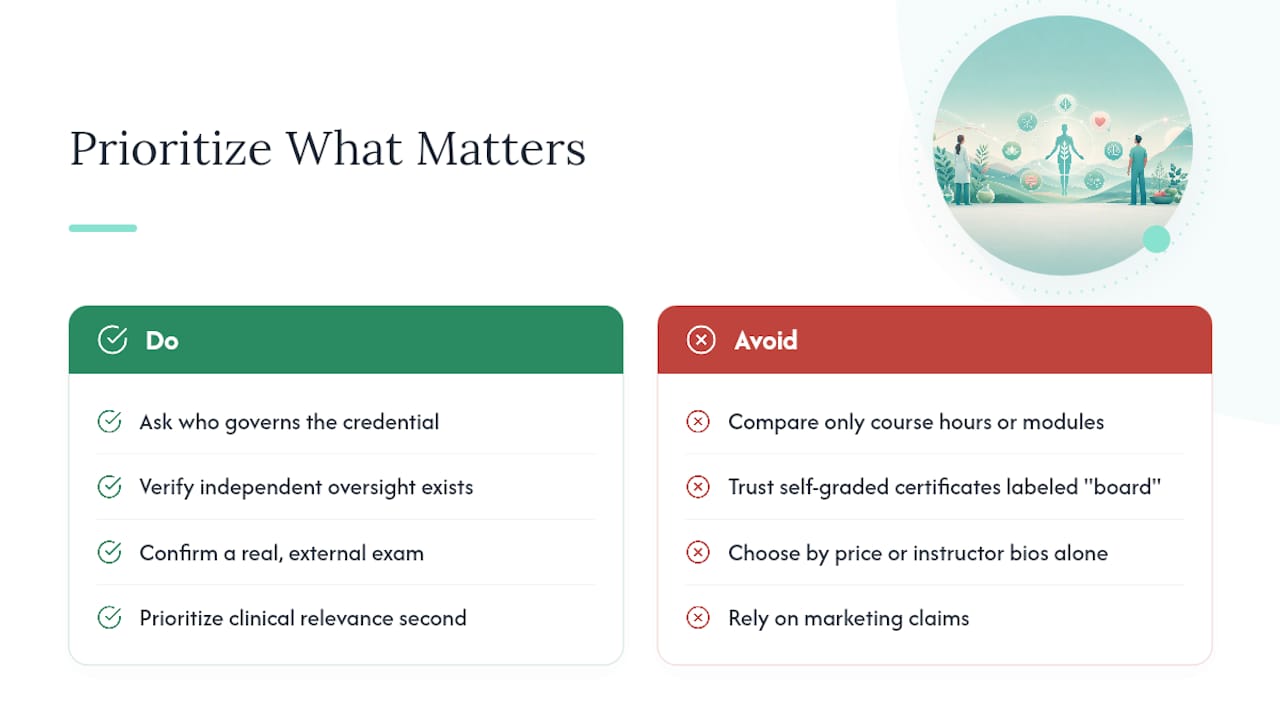
The conventional advice, compare program hours, compare price, compare instructor bios, skips the question that actually determines whether a credential holds up when a hospital credentialing committee or an insurance panel looks at it five years from now: who verified this, and can anyone else check?
If you take one thing from this primer, prioritize governance first, clinical relevance second, and marketing claims dead last. A credential that can’t answer “who governs you” isn’t a weaker version of board certification. It’s a different product wearing the same name. Nurses and physicians who ask that question before enrolling save themselves from discovering the gap after they’ve already paid tuition and put the credential on a resume.
— Lauren
Ready to Pursue an Accredited Credential?
If governance and clinical relevance are what separate a real board certification from a certificate with a nicer name, the next question is practical: which program actually delivers both without demanding you pause your clinical work for a year to get there? Functionalacademy’s Institute for Functional Nurses built its pathway specifically for working nurses and healthcare practitioners, so the coursework fits around existing patient loads rather than competing with them.
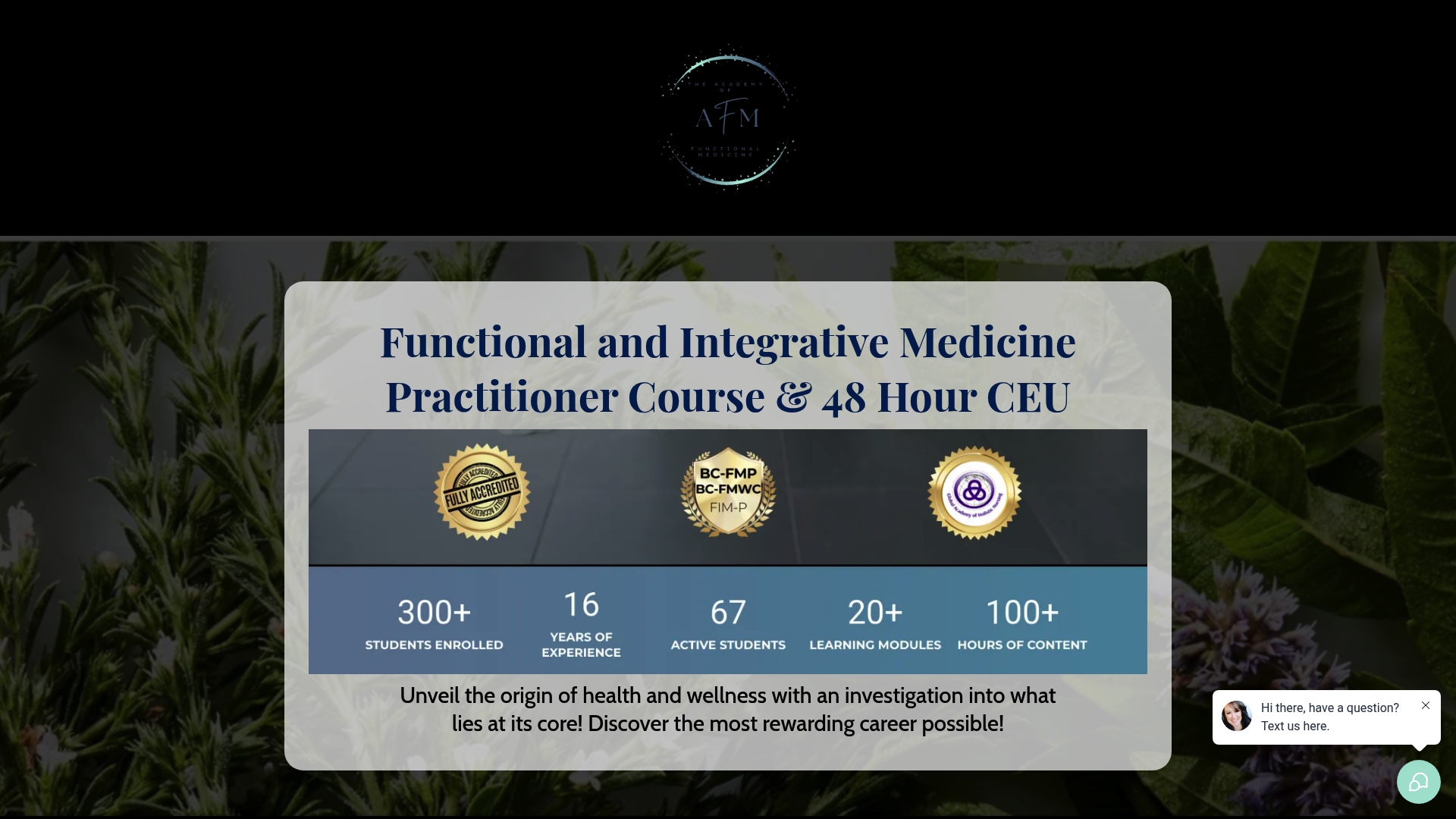
The program combines self-paced, clinically focused modules with case-based application, CEUs, and pathways like FIM-P, BC-FMP, and BC-FMWC, mapped to different licenses and career goals. Graduates come out with a credential they can verify and a set of skills they can use with patients the next day, not just a certificate to file away. If you’ve been comparing programs against the governance checklist above, check your eligibility and pathway options directly with the Institute for Functional Nurses before your next enrollment window closes.
Sources
- About | National Association for Health Care Credentialing (Credentialing Excellence)
- American Nurses Association (ANA)