
5 Point PROMIS Gains Clinicians Use as Evidence for Functional Medicine
5 Point PROMIS Gains Clinicians Use as Evidence for Functional Medicine
Clinical evidence for functional medicine is promising but still developing. Retrospective cohort studies, one randomized controlled trial, and shared medical appointment data show measurable, sometimes clinically meaningful improvements in patient-reported outcomes. The strongest signals come from PROMIS-based cohort work; the biggest gap is a shortage of large pragmatic trials and standardized protocols. If you’re deciding how much weight to give this model in your own practice, that’s the honest starting point.
TL;DR:
- Large observational studies show that at least 50% of functional medicine patients achieve a clinically meaningful PROMIS score improvement of 5 points or more.
- Group medical appointments deliver better outcomes, including higher PROMIS score improvements and lower costs, compared to individual visits.
- Evidence suggests that coaching support significantly benefits high-symptom patients, especially in mental health and symptom reduction.
- The current research base is mostly retrospective and cohort studies, with a lack of large, long-term randomized trials for definitive conclusions.
- Clinicians should focus on tracking PROMIS scores and patient-reported outcomes within their practices to build real-world evidence over time.
Table of Contents
- The Strongest Evidence for Functional Medicine, Study by Study
- How to Read Functional Medicine Research Without Getting Fooled
- Where the Evidence Is Strongest by Condition
- The Real Limitations in Functional Medicine Research
- Applying the Evidence in Your Own Practice
- Building the Skills to Practice Evidence-Informed Functional Medicine
- Primary Sources Worth Reading in Full
- An Editorial Take on What This Evidence Actually Supports
- Sources
The Strongest Evidence for Functional Medicine, Study by Study
You don’t need to take functional medicine on faith anymore. Four studies now form the backbone of the evidence base, and each one measures something a little different, which is exactly why they’re worth reading together rather than in isolation.
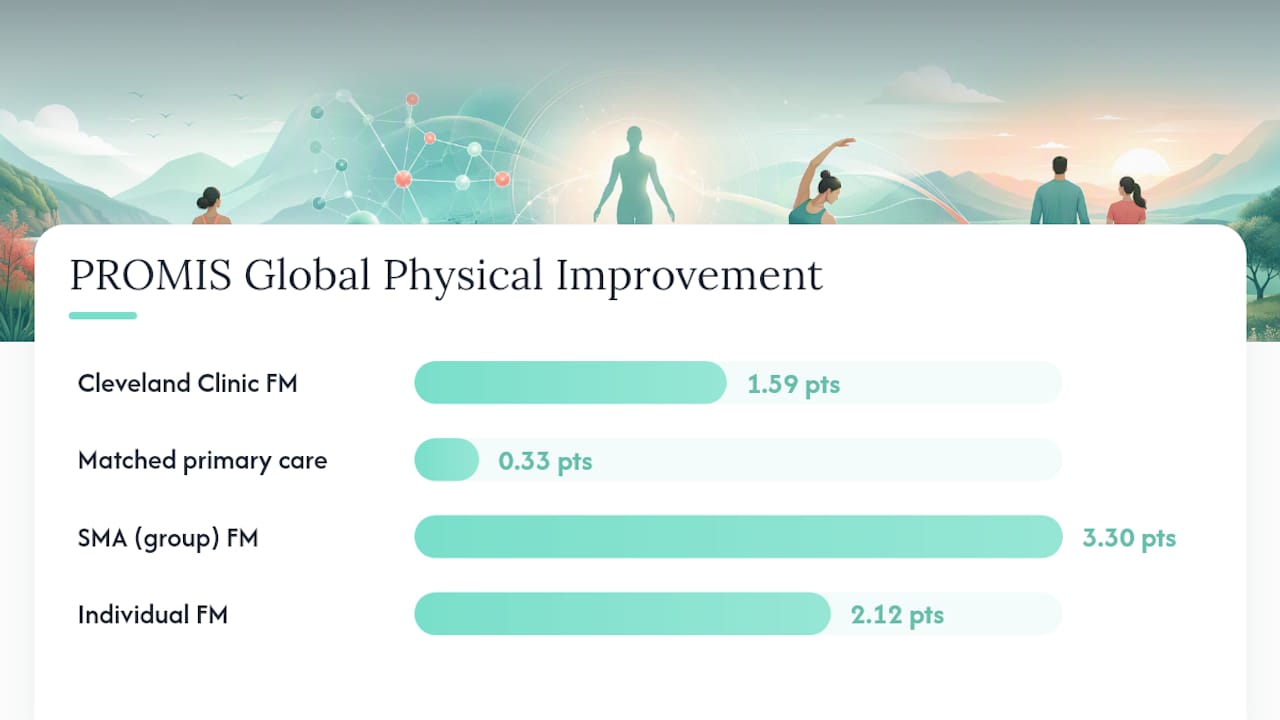
The most cited work comes out of the Cleveland Clinic Center for Functional Medicine, published as an analysis of the functional medicine model of care and patient-reported quality-of-life outcomes in JAMA Network Open. Researchers ran a retrospective cohort study using propensity-score matching to compare functional medicine patients against a similar group receiving standard primary care at the same institution. At six months, the functional medicine cohort’s mean PROMIS Global Physical Health score improved by 1.59 points, versus 0.33 for the matched primary care group, a statistically significant difference (P = .004). More important for clinicians than the mean shift: a meaningfully higher proportion of functional medicine patients hit the ≥5-point PROMIS change that researchers treat as the threshold for a clinically noticeable improvement, not just a statistical blip.
That last detail matters more than the topline number. A lot of quality-of-life research reports averages that look nice on a slide but tell you nothing about how many actual patients felt better. This study reported both, which is part of why it’s held up as the field’s flagship dataset.
The BMJ Open retrospective study on shared medical appointments adds a second layer: delivery format. Researchers compared functional medicine care delivered in group SMAs against the same care delivered one-on-one, again using propensity-score matched pairs. At three months, the SMA group’s average PROMIS Global Physical Health improvement was 3.30 points, compared to 2.12 in the individually treated group. Average weight loss ran higher in the SMA arm too, showing a statistically significant difference favoring the group visits. Per-patient delivery costs were lower for the group format. That combination, better outcomes and lower cost, is unusual enough in health services research that it deserves attention beyond the functional medicine niche.
The randomized controlled trial on functional medicine health coaching paired with an elimination diet is the one true RCT in this evidence set, and it’s worth treating differently from the observational studies above. Researchers randomized 125 participants, all healthcare professionals, to either a self-guided elimination diet or the same diet supported by functional medicine health coaching. The topline result: coaching improved dietary compliance. But the more clinically interesting finding lived in the subgroup analysis. Among participants who started with higher baseline symptom burden, the coached group showed a statistically significant 3.90-point advantage in PROMIS mental health scores (P = .0038) and a 12.3-point advantage on the Medical Symptom Questionnaire (P = .047) compared to the self-guided group.
That subgroup effect tells you something an average-patient result never could: coaching support seems to matter most for the patients who are struggling hardest, not the ones who were likely to improve on any reasonable diet anyway.
Key study findings at a glance:
- Cleveland Clinic cohort: +1.59 PROMIS GPH points at 6 months vs. +0.33 for matched primary care patients
- BMJ Open SMA study: +3.30 PROMIS GPH points at 3 months for group visits vs. +2.12 for individual visits, plus greater weight loss and lower per-patient cost
- RCT (PMC11309605): 3.90-point PROMIS mental health advantage for coached, higher-symptom participants (P = .0038)
- All three studies use the ≥5-point PROMIS change as the rough marker of a clinically meaningful shift
The consistent thread across these datasets: functional medicine patients cross the clinically meaningful PROMIS threshold more often than matched comparison groups, and group-based delivery appears to amplify rather than dilute that effect.
The Cleveland Clinic Center for Functional Medicine’s own research page lists multiple IRB-tracked studies and an active registry, which signals this isn’t a one-off publication chasing headlines. It’s an institution building a longitudinal dataset on purpose. That infrastructure, more than any single P-value, is what separates functional medicine research today from where it stood a decade ago, when rising chronic disease burden first pushed clinicians to look for systems-based alternatives to symptom management.
How to Read Functional Medicine Research Without Getting Fooled
PROMIS scores drive most of the outcome data in this field, so understanding what they actually measure is the first skill worth building. PROMIS, the NIH-supported Patient-Reported Outcomes Measurement Information System, converts patient responses into T-scores centered on a mean of 50. A JAMA Network Open study using PROMIS as its primary outcome treats a 5-point change as the minimum clinically important difference, meaning that’s roughly the threshold at which a patient would notice and report feeling different, not just where a statistician would notice a trend line move.
That 5-point figure is the number to memorize. When you read a functional medicine study, the first question isn’t “was this significant?” It’s “did the average patient cross the MCID, and what share of the whole group did?”
Randomized controlled trials remain the gold standard for isolating a single intervention’s effect, but they run into a structural problem with functional medicine specifically. Functional medicine care typically bundles diet changes, coaching, supplementation, and sometimes medication adjustment into one individualized plan. An analysis of what evidence-based functional medicine should look like in the 21st century argues that forcing a multi-component, personalized intervention into a traditional single-variable RCT design strips out the very individualization that makes the model work. You can randomize people to “get functional medicine” or “don’t,” but you can’t easily randomize which specific combination of interventions each patient receives, because that combination is the whole point.
That’s why the field increasingly leans on three complementary designs:
- Pragmatic trials that test the whole care model as delivered in real clinics, rather than a single isolated variable.
- N-of-1 and registry-based designs that track individual patients over time and aggregate patterns across many single-subject cases.
- Propensity-score matched cohort studies, like the Cleveland Clinic and BMJ Open work above, which approximate randomization statistically when true randomization isn’t feasible.
Pro Tip: When you’re handed a functional medicine study, check three things before you read the abstract’s conclusion: the sample size, whether PROMIS or another validated PROM was the primary outcome, and whether the paper reports the percentage of patients hitting the MCID rather than just the group mean. Those three checks take under a minute and will tell you more than the discussion section.
Registries deserve more attention from clinicians than they currently get. A well-built registry that standardizes PROMIS collection at baseline, three months, six months, and twelve months turns your own patient population into an evidence source, even without formal grant funding or IRB overhead for a full trial.
Where the Evidence Is Strongest by Condition
Not every condition has the same weight of evidence behind it. Some have retrospective cohort data with real numbers attached. Others have small pilot signals that deserve interest but not confidence yet.
Type 2 diabetes shows some of the more consistent directional signals in the literature, with reviews describing improved outcomes and medication responsiveness when functional medicine principles, particularly dietary pattern change and systematic root-cause workups, are layered onto standard management. The evidence here is still largely review-level and observational rather than trial-based, but the direction is consistent across multiple reports.
Inflammatory arthritis has a specific 12-week retrospective analysis showing PROMIS and pain-score improvements in patients managed under a functional medicine protocol. Twelve weeks is a short window for a chronic autoimmune condition, and the sample sizes in this literature tend to be modest, so treat this as an encouraging early signal rather than a settled finding.
Hashimoto’s thyroiditis has some of the more interesting preliminary data, largely tied to Autoimmune Protocol interventions. Small studies report directional improvement in both PROMIS scores and inflammatory markers, though “directional” is the operative word. These studies aren’t powered to prove causation, and marker changes in small samples can reflect regression to the mean as easily as a true treatment effect.
Multiple sclerosis and traumatic brain injury sit at the more preliminary end of the spectrum. Small dietary and multimodal intervention trials report symptomatic and quality-of-life improvements, but sample sizes are limited, and the mechanistic overlap between diet, neuroinflammation, and functional status in these conditions is still being worked out. Replication in larger cohorts is the clear next step before anyone should treat this as established practice.
What this means for your patient selection:
- Type 2 diabetes and general metabolic conditions currently have the deepest observational evidence base
- Inflammatory arthritis has short-term retrospective support worth discussing as an adjunctive option
- Autoimmune thyroid conditions have preliminary but genuinely interesting signals
- MS and TBI applications remain exploratory and should be framed to patients as such
The practical takeaway: patients with metabolic and inflammatory conditions, where the mechanism of diet and lifestyle intervention is well understood physiologically, are currently the most defensible candidates for functional medicine as an adjunct. Patients with complex neurological conditions can reasonably be offered these approaches too, but the conversation about evidence strength needs to be more candid.
The Real Limitations in Functional Medicine Research
None of the studies above are perfect, and pretending otherwise does the field a disservice. If you’re going to defend functional medicine’s evidence base to a skeptical colleague, you need to know exactly where it’s thin.
The most persistent problem is definitional. Functional medicine isn’t a single standardized protocol the way a specific drug at a specific dose is. Two clinics both calling themselves “functional medicine” might deliver meaningfully different combinations of coaching, testing, and intervention, which makes cross-study comparison genuinely difficult. A study’s positive result tells you what worked at that clinic, with that patient population, using that specific bundle of interventions, not necessarily what will work everywhere the label gets applied.
Selection bias runs through most of the observational data. Patients who seek out functional medicine care, often paying out of pocket and investing significant time, tend to be more motivated and more health-engaged than a typical primary care comparison group, even after propensity-score matching accounts for measurable variables. Matching can’t fully correct for the unmeasured motivation gap between someone who sought out a specialty clinic and someone who didn’t.
A few other issues worth flagging directly:
- Sample sizes in condition-specific studies (arthritis, thyroid, MS) are frequently in the dozens rather than the hundreds, limiting how confidently results generalize.
- Regression to the mean is a real risk in any study enrolling symptomatic patients at their worst moment, since some natural improvement would happen regardless of intervention.
- PROM-driven outcomes are vulnerable to expectation and placebo effects, especially in studies where patients know they’re receiving an intensive, personalized intervention.
- Follow-up windows in several studies stop at three or six months, leaving open questions about whether gains persist at 12 months and beyond.
None of this means the positive findings are wrong. It means they’re preliminary in the way most emerging clinical fields are preliminary, and your job when discussing this with patients is to represent that honestly. Tell patients the evidence is encouraging and growing, particularly for metabolic and inflammatory conditions, while being clear that functional medicine research hasn’t yet produced the large, multi-site, long-follow-up trials that would settle the debate definitively. Patients generally respond better to that kind of calibrated honesty than to either blanket dismissal or overpromising.
Applying the Evidence in Your Own Practice
Reading the studies is one thing. Building them into how you actually practice is another, and it starts with a simple appraisal habit you can run in under two minutes for any new paper that crosses your desk.
- Check the design first. Is this an RCT, a propensity-matched retrospective cohort, or a small pilot? Weight your confidence accordingly, and don’t let a compelling abstract override a weak design.
- Confirm the outcome measure is validated. PROMIS domains, standardized symptom inventories, or specific biomarkers carry more weight than an in-house satisfaction survey.
- Look for the MCID, not just the P-value. A statistically significant 1-point PROMIS shift is a very different clinical story than 60% of patients crossing the 5-point threshold.
- Note the follow-up window. Three-month data tells you about short-term response; six and twelve-month data tells you about durability.
- Ask what’s replicable in your setting. A single-site academic study with a dedicated research team may not translate cleanly to a two-provider community practice.
Once you’re comfortable appraising the literature, the next step is deciding what to actually measure in your own patients. PROMIS Global Physical Health and Global Mental Health are the most literature-backed choices, giving you direct comparability to the Cleveland Clinic and BMJ Open datasets. Layer in a condition-specific symptom inventory where relevant, and track a small set of objective biomarkers tied to the conditions you’re treating most often.
Delivery model matters too. The BMJ Open shared medical appointment data suggests group-based visits aren’t a compromise for patients unable to afford one-on-one time. They may genuinely outperform individual visits on both outcomes and cost, which makes SMAs worth piloting even in resource-constrained settings. Pairing that model with the functional medicine matrix framework gives your team a structured way to organize the intake, testing, and intervention data that a registry needs to be useful later.
Pro Tip: Start your registry before you think you need one. Even a simple spreadsheet tracking PROMIS scores at baseline, three months, and six months for your first 20 functional medicine patients gives you internal evidence you can use in program reviews, insurance conversations, and your own clinical decision-making, long before you’d ever consider a formal IRB-approved trial.
Formal program evaluation, the kind that might warrant IRB oversight and patient consent, becomes worth considering once your internal registry shows a pattern worth publishing or once you’re combining data across multiple providers. Until then, structured internal QI tracking is enough to keep you honest about what’s actually working. And regardless of how rigorous your internal data collection gets, functional medicine should be positioned as an adjunct that coordinates with specialty care, particularly for autoimmune and neurological conditions, rather than a replacement for it. The outcomes literature on functional medicine consistently frames it as complementary to, not competitive with, standard medical management. For chronic pain populations specifically, cross-referencing personalized, evidence-informed rehabilitation approaches alongside functional medicine protocols can round out a more complete care plan.
Building the Skills to Practice Evidence-Informed Functional Medicine
Reading the studies is necessary but not sufficient. Translating PROMIS thresholds, coaching protocols, and SMA delivery models into your actual practice takes structured training, not just literature review on your lunch break.
The Institute for Functional Nurses offers board certification pathways that help registered nurses, nurse practitioners, and other licensed healthcare professionals learn the clinical application side of this evidence, not just the theory. That means learning how to structure PROM tracking, how to run a coaching-supported intervention the way the PMC11309605 trial did, and how to think through SMA delivery models with real patient volume in mind.
The self-paced, online format matters for practicing clinicians who don’t have room in their schedule for a traditional fellowship. You’re applying what you learn to your existing patient panel as you go, rather than shelving a certificate until you find time to use it.
If the evidence outlined above has you thinking about where functional medicine fits in your own scope of practice, Functionalacademy’s certification programs are the direct next step from research literacy to clinical competency and marketability in a field that’s only getting more scrutiny, and more legitimacy, every year.
Primary Sources Worth Reading in Full
The JAMA Network Open study on the functional medicine model of care is the field’s most cited cohort dataset and the best starting point for understanding PROMIS-based outcome measurement. The BMJ Open study on shared medical appointments pairs outcome data with cost analysis, useful if you’re building a business case for group visits. The randomized controlled trial on coaching and elimination diets is the strongest trial-level evidence currently available. For the theoretical case behind alternative study designs, read Bland’s review on evidence-based functional medicine in the 21st century, and for condition-specific context, Functional Medicine Past, Present, and Future. The Cleveland Clinic’s ongoing research and registry page is worth bookmarking for new publications as they come out.
An Editorial Take on What This Evidence Actually Supports
Here’s what the data doesn’t support: treating functional medicine as either fully proven or fully unproven. Both extremes let people off the hook from doing the actual appraisal work.
What the evidence does support is narrower and more useful. Functional medicine, delivered through structured, PROM-tracked programs, produces clinically meaningful improvement in a meaningful share of patients, particularly for metabolic and inflammatory conditions. The conventional advice, wait for more RCTs before taking any of this seriously, undersells how much propensity-matched cohort work and validated PROM tracking can already tell a careful reader.
What’s overrated is the instinct to treat any single study as a verdict. What’s underrated is the registry work happening inside individual clinics right now, quietly generating exactly the real-world evidence this field needs most. If you’re a clinician deciding what to prioritize first, it’s this: start tracking PROMIS scores on your own patients before you decide what you believe about the literature. The data you generate will teach you more than any review article, this one included.
— Lauren
This article is general information, not a substitute for advice from a qualified doctor. Consult a qualified healthcare professional about your own circumstances before acting on anything here.