
Budgeting and Reimbursement for U.S. Cash Pay Functional Medicine
Budgeting and Reimbursement for U.S. Cash Pay Functional Medicine
Cash pay functional medicine is worth it if you need longer visits, deeper testing, and a practitioner who has time to chase root causes instead of managing symptoms. Expect to pay somewhere between $3,000 and $8,500 in year one for visits, labs, and supplements combined. Track everything with superbills and an HSA or FSA, and this model tends to fit patients with chronic, multi-system complaints far better than a quick fix.
TL;DR:
- Cash-pay functional medicine costs between $3,000 and $8,500 in the first year, covering extended visits, advanced labs, and supplements, often with the option to recover costs via superbills and HSAs.
- It offers longer, more personalized appointments lasting 60 to 90 minutes, allowing comprehensive history-taking, education, and root-cause analysis impossible in standard insurance visits.
- Specialty lab panels can cost hundreds of dollars each, with initial testing and baseline labs being the largest upfront expenses, which decrease in subsequent years.
- Hybrid billing models are common, combining insurance for standard diagnostics and cash-pay for advanced tests and extended consultations, depending on your health complexity and budget.
- Legitimate practices should provide transparent pricing, signed financial policies, and superbills; avoiding practices that lack documented policies or refuse to issue cost estimates signals potential red flags.
Table of Contents
- What Is a Cash Pay Functional Medicine Practice?
- What Does Cash Pay Functional Medicine Cost?
- Fee-For-Service, Membership, or Hybrid: Which Billing Model Fits You?
- How Do You Pay for Cash Pay Functional Medicine and Recover Costs?
- How to Choose a Cash Pay Functional Medicine Practitioner
- How Long Until You See Results?
- Legal and Compliance Basics Every Cash Pay Patient Should Know
- Cash Pay vs. Insurance: Weighing the Real Tradeoffs
- Privacy, Personalization, and Access: How the Two Models Really Differ
- Budgeting for Ongoing Cash Pay Functional Medicine Care
- What Cash Pay Patients Actually Experience
- Can You Combine Cash Pay Functional Medicine With Insurance?
- Common Misconceptions About Cash Pay Functional Medicine
- When Cash Pay Functional Medicine Is Worth It
- Training the Next Generation of Cash-Pay Functional Practitioners
- Sources
- FAQ
What Is a Cash Pay Functional Medicine Practice?
A cash-pay functional medicine practice bills you directly instead of running claims through your insurance carrier. You pay at the time of service, sometimes through a membership fee, sometimes per visit, and the practice never negotiates rates with an insurer on your behalf. Some clinics run a pure fee-for-service model. Others use a membership or concierge structure. Many blend the two, billing insurance for standard bloodwork while charging cash for the extras.
Practices choose this route for a straightforward reason: insurance rarely reimburses the extended visits and advanced testing that root-cause work requires. A conventional appointment runs 12 to 15 minutes. A functional medicine intake often runs 60 to 90 minutes, because the clinician is mapping your history, diet, stress load, sleep, and lab markers as one connected picture instead of ticking boxes for a single complaint.
That extra time changes what you experience as a patient. You get more education, more say in which labs get ordered, and a clinician who isn’t racing a billing clock.
What Does Cash Pay Functional Medicine Cost?
Initial consultations typically run $200 to $800, depending on how long the intake runs and how experienced the practitioner is. Follow-up visits usually cost less, often $100 to $300, since the clinician is reviewing results rather than building a full history from scratch.
Labs are where costs vary the most:
- Standard panels (comprehensive metabolic, thyroid, lipid) often run $50 to $200 when self-ordered.
- Specialty functional panels like GI-MAP, an organic acids test (OAT), or a DUTCH hormone panel frequently cost several hundred dollars each when ordered through the clinic.
- Supplement protocols add $50 to $300 monthly, depending on how many products your plan calls for.
- Procedures like IV nutrient therapy or bioidentical hormone replacement (BHRT) can add several hundred dollars per session or per prescription cycle.
- Membership fees, where used, typically bundle a set number of visits into a flat monthly or annual charge.
Stack it all together and a realistic first-year total lands between $3,000 and $8,500, with many estimates clustering around $4,500 to $8,500 depending on how many specialty tests you order and how often you’re seen. Year two is usually cheaper. Once your baseline labs are established, follow-up testing is more targeted and visit frequency often drops.
Self-order lab services can meaningfully cut that number. Ordering a panel directly through a consumer lab service and having your clinician interpret the results, rather than paying clinic markup on the same test, is one of the clearest cost levers available to a cash-pay patient.

Fee-For-Service, Membership, or Hybrid: Which Billing Model Fits You?
Fee-for-service means you pay per visit, per lab, per service. It’s flexible. You only pay for what you use, and you can walk away anytime. The tradeoff is unpredictability: a rough month with extra testing can spike your bill without warning.
Membership or concierge models charge a flat monthly or annual fee that bundles visits, messaging access, and sometimes basic labs. This creates predictable cash flow for the practice and predictable spending for you. If you need frequent check-ins during an active treatment phase, membership pricing often works out cheaper per visit than paying fee-for-service each time.
Hybrid models split the difference. The clinic bills insurance for conventional diagnostics, standard bloodwork, and anything your carrier will reasonably cover, while charging cash for advanced panels, extended visits, and anything functional medicine-specific. This structure gives you some insurance offset without forcing the clinic to operate entirely inside insurance rate limits. It’s increasingly the default arrangement for practices trying to balance patient access with clinical flexibility.
Which one fits you depends on how predictable your health needs are. Chronic, evolving cases often do better under membership. One-off root-cause investigations often do fine under fee-for-service.
How Do You Pay for Cash Pay Functional Medicine and Recover Costs?
You have more recovery options than most patients realize:
- Superbills. These are itemized receipts listing the CPT procedure codes and ICD-10 diagnosis codes for your visit. You submit them yourself to your insurer for possible out-of-network reimbursement. Around 62% of cash-pay clinics provide superbills as standard practice.
- HSA and FSA funds. Most visit fees and many lab costs qualify as eligible expenses, which effectively pays for care with pre-tax dollars. If you’re on a high-deductible health plan, maxing out HSA contributions is one of the simplest ways to shrink your real out-of-pocket cost.
- Self-order labs. These bypass the clinic’s lab markup entirely, though you’ll want your practitioner reviewing results either way.
The honest reality check: advanced functional panels are rarely covered by insurance even with a superbill, since many carriers classify them as not medically necessary by conventional standards.
How to Choose a Cash Pay Functional Medicine Practitioner
Ask these questions before you book anything:
- Can you give me a full price breakdown before my first visit, including likely lab costs?
- Do you provide superbills with CPT and ICD-10 codes for insurance submission?
- What’s your approach to ordering labs. Standard panels, specialty panels, or both?
- What board certifications or clinical credentials do you hold?
- Do I sign a written financial policy and informed consent form before treatment starts?
Pro Tip: Call and ask for pricing over the phone before scheduling. A practice that hesitates to quote a range, or that redirects you straight to booking, is telling you something about how they run their business.
Watch for red flags: no written pricing anywhere, pressure to buy a specific supplement brand at your first visit, or refusal to issue a superbill when you ask directly. Trust signals run the opposite direction. Published credentials, a signed financial policy, clear informed-consent paperwork, and transparency about HIPAA and malpractice coverage all point to a practice that treats billing as seriously as it treats your labs.
How Long Until You See Results?
Most patients move through four stages: intake and history, initial lab testing, a results review appointment, and treatment initiation. That whole sequence usually takes 4 to 8 weeks from first call to starting a protocol, depending on how fast labs come back.
Meaningful symptom improvement often shows up in the first 8 to 12 weeks of treatment, though full metabolic or hormonal shifts can take longer. Year two typically shifts toward maintenance: fewer visits, more targeted retesting, and adjustments rather than a full workup. Track outcomes with your clinician using concrete markers, not just how you feel. Follow-up labs, symptom scores, and functional measures like sleep quality or energy levels give you something to check spending against.
Legal and Compliance Basics Every Cash Pay Patient Should Know
Cash-pay functional medicine operates inside real regulatory guardrails, and a legitimate practice will show you evidence of that rather than asking you to take it on faith.
Medicare carries special rules that matter if you or a family member is enrolled. Providers who see Medicare patients on a cash-only basis for services Medicare would otherwise cover generally need to formally opt out of the program, filing an affidavit and signing private contracts with patients. A practice that skips this step while billing Medicare patients cash-only is operating outside the rules, and that exposes you as the patient to confusion over what you’re actually allowed to submit for reimbursement.
Transparency expectations go further than just posting a price list. Legitimate cash-pay clinics typically use written patient agreements that spell out which services are not covered by insurance, a documented financial policy, and informed consent forms before any testing or treatment begins. These documents protect you as much as the practice. They create a paper trail if you ever dispute a charge or need to explain your care history to another provider.
None of this requires you to become a compliance expert. It just means you should expect paperwork. If a practice can’t produce a written financial policy or a signed consent form, that’s a bigger red flag than any pricing question.
Cash Pay vs. Insurance: Weighing the Real Tradeoffs
The advantage of cash-pay functional medicine is time and scope. You get a longer intake, broader lab ordering, and a clinician whose incentives aren’t shaped by an insurer’s reimbursement schedule. That autonomy lets practitioners order the specialty panels conventional insurance-based practices often can’t justify billing for.
The disadvantage is obvious: you’re paying the full cost yourself, and that cost isn’t small. A first-year total in the thousands is real money, and it lands hardest on patients without HSA or FSA access, or without room in a monthly budget for ongoing testing.
Insurance-based care flips both of those. Your per-visit cost is limited to a copay or coinsurance, which makes budgeting far more predictable. But visit length is capped by what the insurer’s fee schedule supports, testing is limited to what’s deemed medically necessary by conventional standards, and continuity often suffers when a practice sees dozens of patients a day to keep the lights on.
Neither model is universally better. A patient managing a single, well-understood condition with clear insurance coverage may get excellent care through a conventional in-network provider at a fraction of the cost. A patient with unexplained fatigue, digestive issues, and hormonal symptoms that have gone uninvestigated for years is often the one who benefits most from paying cash for the extra time and testing depth. The right choice depends on how complex your case is and how much runway you have in your budget.
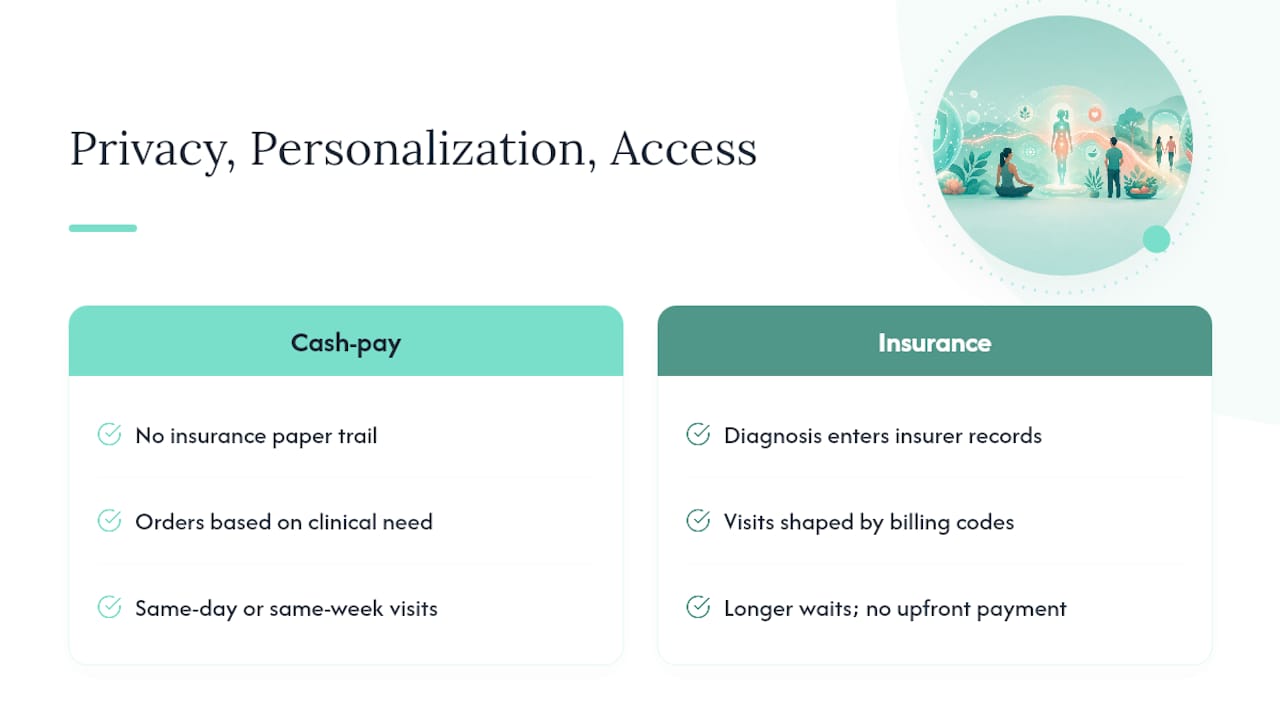
Privacy, Personalization, and Access: How the Two Models Really Differ
Privacy is where cash-pay pulls furthest ahead. When you bill insurance, your diagnosis codes, treatment history, and lab orders pass through your carrier’s systems and become part of a record that can affect future coverage decisions, life insurance applications, and even employer-sponsored plan reviews in some cases. Cash-pay visits generate no such insurance-side paper trail unless you choose to submit a superbill yourself.
Personalization follows a similar pattern. Insurance-based visits are shaped by billing codes; a clinician has to document a diagnosis that fits a covered code before ordering a related test. Cash-pay practitioners aren’t constrained that way. They can order what the clinical picture calls for, structure a visit around your actual concerns instead of a chief complaint field, and revisit a treatment plan without needing to justify it to a claims reviewer.
Access is the more mixed picture. Cash-pay clinics often offer same-week or even same-day appointments because they’re not managing the patient volume that insurance reimbursement rates typically require staying profitable. That’s a real advantage if you’re dealing with worsening symptoms and don’t want to wait six weeks for a new-patient slot. On the other hand, cash-pay access is gated by ability to pay upfront, which insurance-based care, whatever its other frustrations, doesn’t require in the same way. If cost is a hard constraint, insurance-based access can be the more reliable path even with longer wait times.
Budgeting for Ongoing Cash Pay Functional Medicine Care
Treat year one as your highest-cost year and plan accordingly. Most of your spending goes toward the initial workup: intake visit, baseline labs, and getting a treatment plan started. Building a simple three-part budget makes this less overwhelming to plan around.
First, separate one-time costs from recurring ones. Your first specialty lab panel is a one-time expense; monthly supplement refills and membership fees are recurring. Second, decide upfront how many follow-up visits you can realistically afford in year one, and ask your practitioner what a typical treatment timeline looks like for your specific concern. Third, build in HSA or FSA contributions specifically earmarked for functional medicine costs if you’re eligible. Even a modest monthly contribution adds up to real savings on pre-tax dollars by the time your first lab bill arrives.
Year two budgets typically shrink. With baseline data established, testing becomes more targeted, and many patients move from monthly or biweekly visits to quarterly check-ins. If a practice offers a membership tier, this is often the point where switching from fee-for-service to membership pricing starts to save money, since your visit frequency has stabilized enough to make a flat rate worthwhile.
What Cash Pay Patients Actually Experience
The patients who report the most satisfaction with cash-pay functional medicine tend to share a pattern: they came in after months or years of unresolved symptoms, multiple specialists, and normal-range lab results that didn’t explain how they felt. The extended intake visit is usually where things shift. Patients frequently describe it as the first time a clinician connected their sleep, digestion, stress, and energy complaints into a single working theory instead of referring them to yet another specialist.
That said, the experience isn’t uniformly positive for everyone. Patients managing a tight budget sometimes describe the first-year cost as a genuine strain, particularly when specialty lab results point to a need for additional testing beyond what they initially budgeted for. The clinics that handle this best are transparent from the first phone call about what a full workup might cost, rather than letting costs surface incrementally across several visits.
The throughline across most patient experiences is that satisfaction correlates less with the dollar amount spent and more with how clearly the practice communicated cost expectations upfront. Patients who felt blindsided by a $600 lab panel they didn’t expect report frustration regardless of how good the clinical outcome turned out to be. Patients who saw an itemized estimate before agreeing to testing report feeling in control of the process, even when the total cost ended up similar.
Can You Combine Cash Pay Functional Medicine With Insurance?
Yes, and many patients do exactly this. The most common approach is keeping your insurance plan active for catastrophic coverage, emergency care, and any conventional treatment your existing specialists provide, while paying cash specifically for functional medicine visits and specialty testing your insurer wouldn’t cover anyway.
There are a few mechanical limits worth knowing. If your functional medicine visit results in a prescription, that prescription can typically still be filled and billed through your regular insurance and pharmacy benefit, since the prescribing itself isn’t what triggered cash payment. Basic imaging or referrals your functional practitioner recommends can often be routed to an in-network provider and billed normally through your insurance, as long as the referral itself doesn’t require the functional medicine visit to be billed as the originating service.
Where things get more complicated is with Medicare. If your functional medicine provider has formally opted out of Medicare, you generally cannot submit a superbill from that visit to Medicare for reimbursement, even though the underlying service might otherwise be covered. This is a common point of confusion, and it’s worth confirming directly with the practice before your first visit if you’re on Medicare.
The bottom line: hybrid use of insurance and cash-pay works well for most patients, but it requires knowing which parts of your care fall on which side of that line before you get a surprise bill.
Common Misconceptions About Cash Pay Functional Medicine
“Cash-pay means insurance never applies.” Not true. Superbills allow many patients to submit for out-of-network reimbursement, even if the practice itself doesn’t bill insurance directly.
“All functional medicine tests are expensive and unproven.” Some specialty panels are pricier, but many standard labs used in functional medicine are the same tests run in conventional care, just interpreted with a broader reference range and a root-cause lens.
“Cash-pay practices aren’t held to the same standards as insurance-based ones.” Licensing, board certification requirements, and HIPAA obligations apply regardless of billing model. Payment method doesn’t change a clinician’s legal or ethical obligations.
“If it’s cash-pay, the price must be negotiable or hidden.” Legitimate practices publish or readily disclose pricing. A refusal to give you a straight answer on cost is a sign of a poorly run practice, not a normal feature of the cash-pay model.
When Cash Pay Functional Medicine Is Worth It
Cash-pay functional medicine earns its cost when you’re dealing with a complex, unresolved health picture that a 15-minute insurance visit simply can’t untangle. If your case is straightforward and your insurance covers it well, there’s no reason to pay out of pocket for the same outcome.
For most people, the smartest move is a hybrid one: keep insurance for catastrophic and conventional care, and reserve cash-pay dollars for the root-cause work insurance won’t touch. Whatever route you choose, insist on written pricing, superbills, and documented consent. Those three things protect you more than any single lab result ever will.
— Lauren
Training the Next Generation of Cash-Pay Functional Practitioners
If you’re a nurse or healthcare practitioner reading this from the other side of the exam table, wondering how to build a compliant, well-run cash-pay practice of your own, that is exactly the gap such training programs aim to close. Where a traditional continuing-education path leaves you with theory and no framework for pricing, documentation, or patient agreements, The board-certification training pairs clinical functional medicine content with the practical business structure that a cash-pay model actually requires.

The Functional and Integrative Medicine Practitioner Course includes 48 CEU hours built for busy clinicians, covering root-cause assessment alongside the operational pieces this article just walked through: how to structure written financial policies, how to issue compliant superbills, and how to price visits so your practice stays sustainable. Weekly live business coaching rounds out the clinical training with real guidance on attracting and retaining wellness clients who stick around for the long haul. Some training programs offer a free short course as a hands-on preview before committing to a full certification path. Check the provider’s website to see which track fits your current stage.
This article is general information, not a substitute for advice from a qualified doctor. Consult a qualified healthcare professional about your own circumstances before acting on anything here.
Sources
- Evaluating Insurance vs. Cash Pay
- Functional Medicine Lab Panel Cost in 2026 | Vital Signs Today
- Insurance vs Cash-Pay Functional Medicine: 2026 Cost Reality
- How to Start a Cash-Based Functional Medicine Practice | IMU
FAQ
Is Cash Pay Functional Medicine Worth the Cost?
It’s worth it for patients with complex, unresolved symptoms who need longer visits and broader testing than insurance typically covers. For straightforward conditions with good insurance coverage, conventional in-network care is usually the more cost-effective route.
How Much Does a First Year of Cash Pay Functional Medicine Cost?
Most patients spend between $3,000 and $8,500 in year one, covering consultations, specialty labs, and supplements. Year two costs are typically lower once baseline testing is complete.
Can I Use My HSA or FSA for Functional Medicine Visits?
Yes, most visit fees and many lab costs qualify as eligible expenses under HSA and FSA plans. Confirm specific eligibility with your plan administrator, since coverage details vary by plan.
Will My Insurance Reimburse Me for Cash Pay Visits?
Sometimes, through a superbill listing CPT and ICD-10 codes that you submit yourself for out-of-network reimbursement. About 62% of cash-pay clinics provide superbills, though many advanced specialty tests still won’t qualify for reimbursement even with one.
Does Functionalacademy Offer Training for Clinicians Who Want to Run a Cash Pay Practice?
Yes. Functionalacademy’s Functional and Integrative Medicine Practitioner Course includes 48 CEU hours plus business coaching aimed at helping clinicians build compliant, sustainable cash-pay workflows. Current pricing and course details are available directly on the Functionalacademy site.